The latest was Rod Dreher, the famous author of The Benedict Option. But many Christian authors and intellectuals have moved to Budapest in recent years. They have taken advantage of the opportunities provided by conservative think tanks in the country and have found fertile ground to advance their ideas. The point, however, is that Hungary is more than just a destination for intellectuals. It is a place where the demand for Catholic education is growing, and consequently, the cultural impact of Catholicism. The numbers speak for themselves, especially the number of children attending church schools.
Currently, there are 355 Catholic institutions in 771 different locations, employing 14,430 teachers to educate 114,562 students. These institutions are supported by 15 dioceses and 26 monastic orders, as well as the Organization for the Maintenance of Social Institutions, the Gál Ferenc University, and the Károly Eszterházy Catholic University.
The growth has been steady. After World War II, the Church operated 1% of nursery schools, 41% of primary schools, 24% of city schools, 28% of secondary schools, and 17% of vocational institutes.
Then came communism, which tried to eradicate everything, and it failed. An agreement in 1950 allowed eight Catholic secondary schools, run by Benedictines, Franciscans, Regular Poor Clerics of the Mother of God, and Sisters of the School of Notre Dame, to continue operating.
So when the state was rebuilt in 1990, it didn’t have to start from scratch, although the number of Catholic schools is only 9% of all Hungarian educational institutions.
But this percentage is likely to rise because Catholic schools enjoy greater freedom in outlining their curricula and are considered higher education, leading to many projects.
Currently, there are 182 Catholic institutions of public education in Hungary, attended by 66,000 students. They are the preferred schools of the Hungarian middle class, partly because of their greater freedom in outlining their curricula.
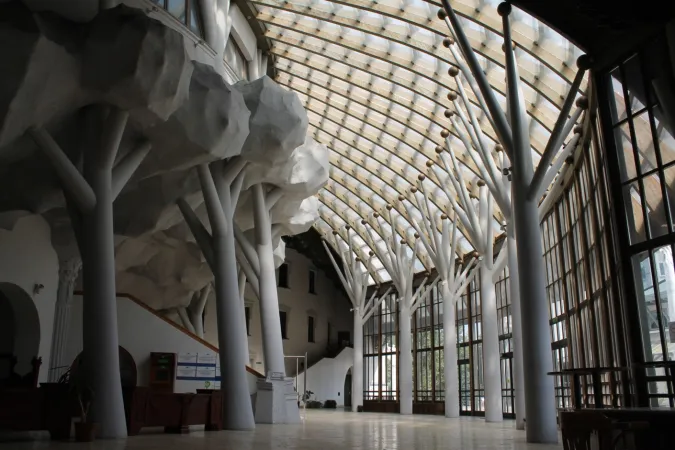
In addition to Catholic schools, there are also universities. After the constitutional change of 1990, Catholic universities were able to flourish. Pope Francis will visit Pázmány Péter Catholic University, founded in 1992 when the Hungarian Episcopal Conference established a humanities faculty along with the Faculty of Catholic Theology in Budapest, making it a Catholic university. Inaugurated by Cardinal Pio Laghi, prefect of the Congregation for Catholic Education, on October 4, 1992, the university saw the birth of the Faculty of Law and Political Science in 1995, the Institute of Canon Law Specialization in 1996, and the Faculty of Technology and Information in 1998. In 1999, the university became a pontifical foundation.
Other Catholic universities are the Gál Ferenc University, successor to the College of Theology in Szeged, and the Károly Eszterházy Catholic University in Eger. And then, there are other theological colleges or ecclesiastical colleges in the archdioceses and dioceses of Esztergom, Eger, Győr, Nyíregyháza, Pécs, Veszprém, and Vác. About 18,000 students are studying in Catholic universities.
Zachar Péter Krisztián is the vice president of Kesz (Keresztény Értelmiségiek Szövetsége), the Alliance of Catholic Intellectuals. It is a civil organization, but one that lives in proximity to the Churches. Speaking to ACI Stampa, Krisztián explains that the Hungarian religious context sees most citizens professing themselves as Christians. The majority of these are Catholics, and “processes are seen in the West, such as the growth of individualism, the exclusion of religious issues from public life, the abandonment of traditional beliefs in favor of a new and syncretistic spirituality, are already having an impact, but with a delay of two or three decades.” This, Zachar added, is mainly because “there is a general lack of progress due to dictatorship.”
But there is also a favorable climate because “the current government strongly builds on the tradition of historical churches and seeks to defend classical Christian values.” Therefore, religious values “remain an important part of the culture and identity of the nation.”
In particular, with its long history and impact evidenced by works of architecture, art, and literature, Catholicism still has a substantial and evident role. This can be seen from the movement. This is the Day! That regularly brings together thousands of young people to worship God, pray for the Hungarian nation, and strengthen ties with members of Christian denominations and communities, but also from the success of the Catholic Social Days, which bring together thousands of people throughout Hungary and represent a meeting point for people who are already involved in the charitable, educational, and healthcare workers of the Church.
For Zachar, however, the point is whether “current educational institutions, religious traditions, and government provide enough support to younger generations to pass on the faith.” Another challenge concerns “the decline in Mass participation,” and then in addressing the fact that Hungary “since the fall of communism in recent decades has become extremely diversified,” with a pluralism that has “tested the traditional role of Catholicism as the dominant religious and cultural force in Hungary.”
There is also a more specific debate: should the Church follow social expectations and the opening of a pluralistic society, or can it formulate different positions than those expectations based on its traditions?
These challenges are also colored by opportunities because “the Church can continue to play a role in promoting social justice, helping the poor, and providing moral and spiritual guidance to its members.” The hope is that Pope Francis’ visit will strengthen “building a common future while preserving our roots and rediscovering and loving our Catholic faith.”