After more than five weeks in the hospital battling double pneumonia, doctors advised Pope Francis to take two months of rest. Yet the Holy Father chose a different path. Rather than withdraw from public life, he remained close to the faithful—quietly, persistently—until the very end.
His final weeks became a testimony not of strength regained, but of love sustained.
A Simple Greeting, A Profound Presence
Just two weeks after his release, Pope Francis made a brief but meaningful appearance at the closing Mass for the Jubilee of the Sick and the World of Healthcare. At the end of the liturgy, he offered no long address, no elaborate reflection—only a simple greeting:
“Good Sunday to everyone!”
“Buona Domenica a tutti!”
In those few words, there was something unmistakable: the shepherd had returned to his flock, even in weakness.
He remained in St. Peter’s Basilica afterward, receiving the sacrament of reconciliation, spending time in prayer, and passing through the Holy Door in union with the pilgrims. It was a quiet but powerful act—placing himself not above the faithful, but among them.
Returning Again and Again
In the days that followed, the Pope continued to appear in unexpected ways. He entered St. Peter’s Basilica without his usual papal attire, simply to pray and greet those present. There was no ceremony, no distance—only presence.
On the eve of Palm Sunday, he made his way to the Basilica of St. Mary Major, where he paused before the beloved Marian icon, Salus Populi Romani. It was a place he had visited countless times before and after his apostolic journeys. Now, it became part of his final pilgrimage.
Holy Week Begins
On Palm Sunday, Pope Francis once again emerged briefly, greeting the faithful gathered in St. Peter’s Square:
“Happy Palm Sunday and Happy Holy Week.”
“Buona Domenica delle Palme, Buona Settimana Santa.”
The appearance lasted only minutes, but it carried the weight of a lifetime of pastoral care. Afterward, he returned inside the Basilica, lingering in prayer before the tomb of the Apostle Peter, then before Pope St. Pius X and the monument to Benedict XV.
Even in frailty, his instinct remained the same: to pray, to remember, to remain rooted in the communion of the Church.
Close to the Forgotten
Holy Thursday brought one of the most telling moments of his final days. Though too weak to preside over the traditional liturgies, Pope Francis made a private visit to Rome’s Regina Coeli prison.
There, he spent time with around 70 inmates—men often overlooked, often forgotten. He could not perform the customary washing of the feet, yet he made his intention clear: he still wanted to be close to them.
It was a gesture entirely consistent with his pontificate—a Church that goes to the margins, even when the journey is difficult.
Easter: The Final Blessing
Over the Easter weekend, the Holy Father made several brief appearances, culminating in his final public act on Easter Sunday.
From the loggia of St. Peter’s Basilica, he delivered his Urbi et Orbi blessing. His final words to the world were as simple as they were profound:
“Brothers and sisters, happy Easter.”
“Cari fratelli e sorelle, Buona Pasqua.”
The message itself was read on his behalf, but the blessing was his. Before him stood tens of thousands gathered in the square—cheering, praying, waving—receiving what would be his last public gesture as Bishop of Rome.
One Last Ride
Afterward, in a moment that now feels almost providential, Pope Francis descended into the square in the popemobile—for the first time since his hospitalization.
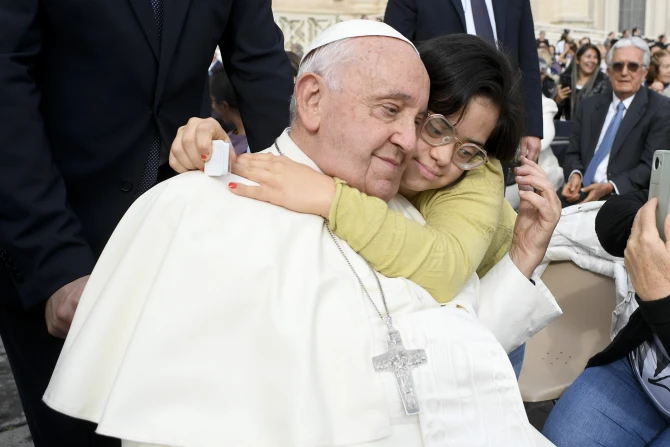
For more than fifteen minutes, he greeted the 50,000 faithful gathered below. He blessed them, smiled at them, lingered among them. It was not a grand tour, but a final embrace.
That ride would be his last.
The End of a Pontificate
The following morning, at 7:35 a.m. local time, Pope Francis passed away after suffering a stroke that led to a coma and subsequent heart failure.
His final days were not marked by withdrawal, but by encounter. Not by silence, but by presence.
Despite his frailty, he chose to be where he had always been: among the people, in prayer, and within the living heart of the Church.
In the end, Pope Francis did what he had done from the beginning—he went out, he stayed close, and he gave everything.
Adapted by Jacob Stein