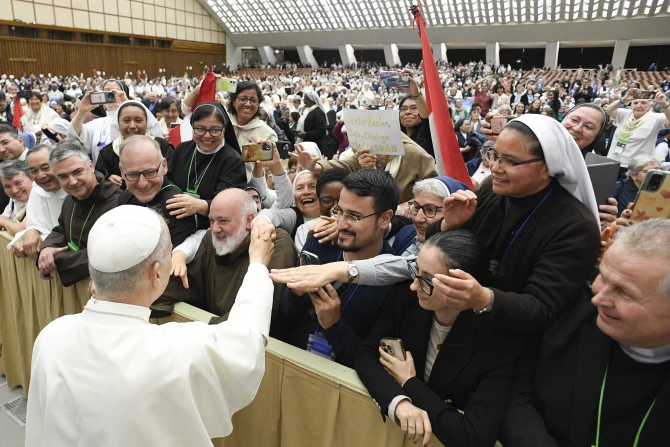
ROME — Some cardinals and faithful who have a devotion to the traditional Roman rite have expressed concern that the liturgy appears to be sidelined in the extraordinary consistory currently underway at the Vatican after the cardinals voted to give priority to other issues on the agenda.
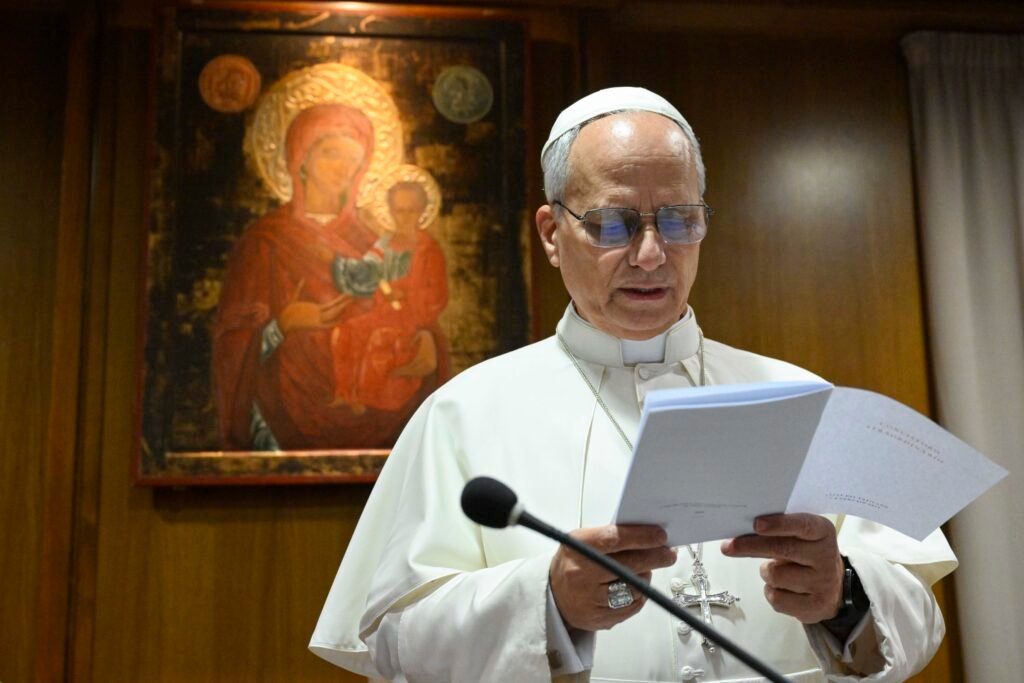
In his opening address to the consistory yesterday, Pope Leo XIV reaffirmed to the cardinal participants that they will have the opportunity to “engage in a communal reflection” on four themes already preannounced to be on the meeting’s agenda.
Those topics, he said, were Pope Francis’ 2013 apostolic exhortation Evangelii Gaudium, “that is, the mission of the Church in today’s world”; Praedicate Evangelium, the late pope’s apostolic constitution reforming the Roman Curia; the Synod and synodality “as both an instrument and a style of cooperation”; and the liturgy, “the source and summit of the Christian life.”
But Leo added that “due to time constraints, and in order to encourage a genuinely in-depth analysis, only two of them will be discussed specifically.”
The cardinals were then asked to make clear which two of the four they would want to be specifically debated and, according to Vatican spokesman Matteo Bruni, “a large majority” decided the topics would be “evangelization and the Church’s missionary activity drawn from rereading Evangelii Gaudium,” and “the Synod and synodality.”
Bruni told reporters at a press briefing Wednesday evening that the 170 cardinals taking part were divided into 20 groups, which were then divided into two blocks. Eleven groups consisted of cardinals in Rome including curial cardinals and those who have concluded their service and are no longer electors. The remaining nine groups were cardinal electors of local Churches (archbishops and bishops of dioceses), cardinal electors who are nuncios and cardinal electors who have concluded their service but remain electors due to being under the age of 80.
Bruni said that “for reasons of time,” the cardinal secretaries of the second block had the job of reporting back the decision of the cardinals. “They had three minutes to explain the work done within the groups and the reasons that led to the choice of the two themes.”
The Holy Father had made clear in his opening address that it was his preference to hear back from the second block as he does not usually receive advice from those cardinals. “It is naturally easier for me to seek counsel from those who work in the Curia and live in Rome,” he said.
But the decision not to make the liturgy a key theme was disappointing to some cardinals and traditional faithful.
The liturgy has long been a particularly sensitive issue, and especially to traditional-minded Catholics following recent sweeping restrictions on the older form of the Latin rite during Pope Francis’ pontificate. These faithful experienced the restrictions not as a mere disciplinary change but as a judgment on their fidelity, spirituality, and ecclesial belonging, which many have described as deeply wounding and divisive.
The popular Italian traditional website “Messa in Latino“ wrote Jan. 7 that it had contacted some anonymous but important cardinals who all said they were “discouraged and disappointed” about the relegation of the liturgy as a discussion topic.
In comments to the National Catholic Register, CNA’s sister news partner, on Jan. 8, the website’s editor Luigi Casalini asked: “To whom did the pope delegate this choice, and according to what criteria were these cardinals of the nine local Churches selected in order to remove — in effect — two topics?” He also wondered “why cardinals sensitive to the issue” appear to have “made no attempt to lobby” for the liturgy to be included as a core topic of discussion, “even before the consistory.”
The consistory, he added, “appears to be in perfect continuity with the synods and the thought of Francis” — a reference to how recent synods were silent on the traditional liturgy.
Speaking to journalists Wednesday, Bruni tried to offer some reassurance. “The other two themes will still be addressed in some way, because mission does not exclude the liturgy,” he said. “On the contrary, in many ways it does not mean exclusion. It means that they will still be addressed within the others or in some other way.”
He added: “As the pope said and as he noted in both his opening and closing speeches [on Wednesday], the themes cannot be separated from each other, because in mission and evangelization there is liturgy.”
Casalini said he was looking ahead to the two free discussions today to see “whether the topic of the liturgy will be taken up again.”
This story was first published by the National Catholic Register, CNA’s sister news partner, and has been adapted by CNA.