Synod on Synodality delegates from Africa and Oceania said this week their communities are already living out synodality — and they are ready for their voices to finally be heard by the universal Church.
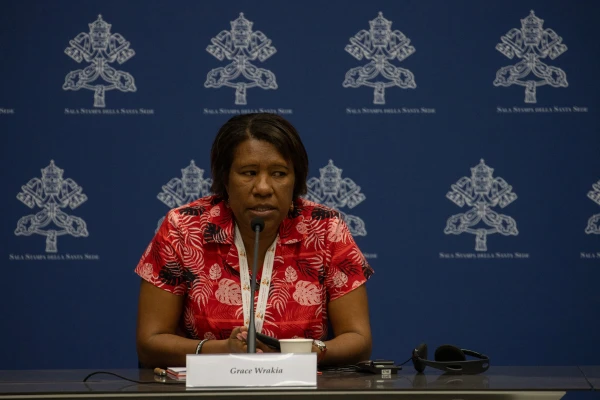
A representative of the bishops’ conference of Papua New Guinea and the Solomon Islands said she is happy the Church and Pope Francis invited those two countries to participate, despite their small size.
“For many years we have been listening and now we would like to speak. And we would like you to listen,” Grace Wrakia said, addressing journalists at a press briefing Oct. 11.
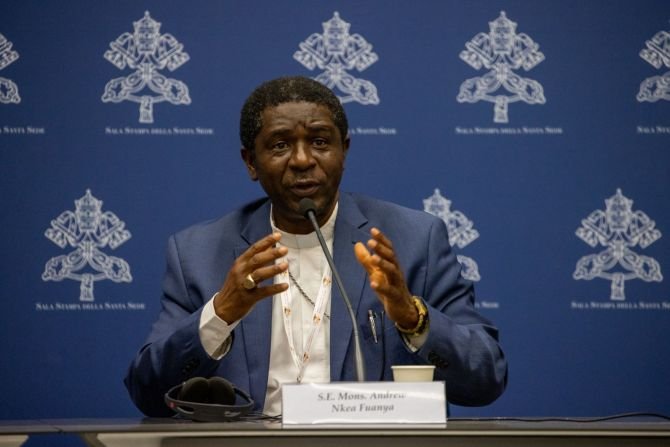
Archbishop Andrew Nkea Fuanya of Bamenda, Cameroon, said at an Oct. 12 briefing that the Synod on Synodality is “a chance for the voice of Africa to be heard.”
“This synod is a very big consolation to Africa, because with the problems we have in Africa sometimes we feel isolated and abandoned,” he explained.
“Africa has its own specificities and its own peculiarities and when we come together as the universal Church in a synodal journey, it is an opportunity for Africa’s voice to be heard,” he repeated.
At the October 2023 assembly, the African participants are able to express themselves “freely and happily,” the Cameroonian archbishop said. “And I think that this is a very wonderful opportunity for Africa to make its own mark in the synod.”
A synodal culture
Both delegates expressed that in the family and community-centered cultures of their countries, synodality “is something that we do.”
Wrakia, who is one of 20 synod delegates from Oceania, explained that in Melanesian spirituality, relationships are very important, and they are built around sharing common ideas, not ethnicity or looking alike.
“Synodality is something, as I have just said … that we do. We live synodality, we live in communion,” she underlined, adding that before a village makes a decision, everyone, including women, speaks.
“Synodality forms part of the African culture,” Fuanya said, “because we always do things together as a family and when we do things together as a family, we always consult everyone in the family.”
He described different “levels” within the Catholic community. Before the parish level, which he said can often be quite large, there is a “mission station,” while below that, the “basic Christian communities are made up of families,” where everyone is able to express themselves.
“Our culture helps us to be synodal,” said Fuanya, one of three African bishops on the synod’s ordinary council.
Colonization and evangelization
The bishops’ conference of Papua New Guinea and the Solomon Islands has 23 dioceses and a total population of 8 million, 25% of which is Catholic, Wrakia said. Christianity arrived in the two South Pacific countries just 150 years ago.
Papua New Guinea, Wrakia’s country, is “very diverse,” she explained, with 1,000 tribes and more than 800 languages.
The four elements of the indigenous Melanesian spirituality of Papua New Guinea — community living, an integrated worldview, harmonious relationship, and religious rituals — “allowed my ancestors to embrace Christianity and especially Catholicism,” she noted, adding that outside influences, like the colonization of the past and today’s globalization and secularization, now threaten their community life.
A communications official told journalists Oct. 12 that synod discussions the prior afternoon focused on interreligious and intercultural dialogue.
“There was a call to strengthen dialogue with Indigenous communities [and to] talk about colonialism and [its] impact on Indigenous communities,” Sheila Leocádia Pires said.
Responding to a question about the colonization of Indigenous cultures by missionaries and “the guilt of the Church with regards to history,” Wrakia drew a comparison between old and new forms of evangelization.
“In those early years, when Christianity first came to Papua New Guinea, that was evangelization. It was how those missionaries knew how to do it,” she said. “And now, in this time and era, we call it new evangelization: where we are more aware of each other’s culture.”
“When missionaries come to us now,” Wrakia continued, “they come with an open mind, respecting the cultures that are already in our land and evangelizing according to how we, the Indigenous people, already believe: respecting our land, respecting our waters, and respecting the way we have been living as a community for thousands of years.”
“So I would say, in those early years, in those previous years of missionary activities, [it] was different. And now it will not be the same method of evangelization,” she said.
“Because now we know each other. And so for the Gospel to take root in this time and era, evangelization has to take a new form. And one of them is listening to us, the Indigenous people, and not just us listening to the foreign missionaries.”
This article was originally published on CNA.