The papal almoner is a key position in the Vatican, one that has played a vital role in the Church and its charitable undertakings for centuries.
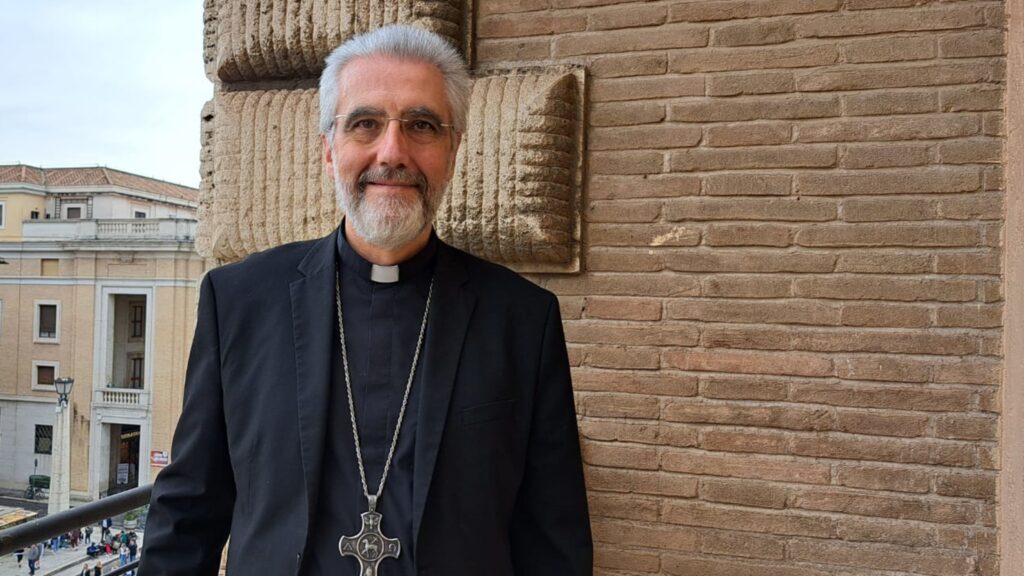
Pope Leo XIV on March 12 appointed Spanish Augustinian Bishop Luis Marín de San Martín aspapal almoner and prefect of the Dicastery for the Service of Charity, elevating him to the rank of archbishop at the same time.
Marín de San Martín replaces Cardinal Konrad Krajewski, who will return to his native Poland as the new metropolitan archbishop of Łódź. Krajewski was named almoner in 2013, a cardinal in 2018, and prefect of the newly constituted charity dicastery in 2022.
The papal almoner is a key position in the Vatican, one that has played a vital role in the Church and its charitable undertakings for centuries. But what is the purpose of this office? What does an almoner do, and how does he fit into the complex structure of the Holy See?
Role emerged in earliest years of the Church
Matthew Bunson, vice president and editorial director of EWTN News, said the role of almoner dates back to the earliest days of the Church.
“This has always been a concern of the popes — to care for those most in need,” he said. Popular history holds that Pope Gregory I, also known as Gregory the Great, who took control of much of the civil authority in Rome in the absence of civil government, wept upon learning that an indigent citizen of Rome had starved to death, leading the sixth-century pope to emphasize ministries to the poor.
The position of almoner fully emerged under Innocent III, whose papacy took place in the late 1190s and early 1200s. “Subsequent centuries gave it more form,” Bunson said.
He noted that Pope Leo XIII sought more mechanisms for funding the charities overseen by the almoner. Among the fundraising mechanisms that emerged from his papacy was the custom of papal blessings; Catholics may be familiar with such blessings by seeing them framed and hung in the homes of the married couples to whom they are often given.
Though the papal alms office has for years headed global charity efforts at the behest of the pope, Bunson said Pope Francis during his papacy placed an “immense” amount of importance in the office, transforming it into a dicastery and making it what has been described as a “flagship initiative of the pontificate.”
Krajewski utilized the office to offer assistance to Ukrainians after the Russian invasion of their country in 2022. Domestically, meanwhile, the office oversees major charity initiatives in Rome, including the Mother of Mercy Clinic and the San Martino Outpatient Center.
Though commentators and analysts regularly opine on the authority and prestige of various Vatican appointments, the almoner position, Bunson said, is less one of power and more one of “pastoral care and spiritual care.”
The position’s importance is illustrated by the fact that it is one of the few Vatican offices that remains wholly uninterrupted in the event of a pope’s death or resignation.
Another such position is the head of the Apostolic Penitentiary, the so-called “tribunal of mercy,” the dicastery concerned with the internal forum and indulgences, especially the forgiveness of sins.
That official always keeps his job to ensure every Catholic always has an opportunity for God’s loving mercy. Similarly, the almoner retains his office because “everyone needs direct access to the Church’s pastoral care,” Bunson said.
He also noted that Marín de San Martín is an Augustinian. “Traditionally, the apostolic almoner is attached very closely to the papal household,” Bunson said. “Leo is continuing to surround himself with Augustinians.”
The charitable purpose of the position was perhaps best exemplified by a directive Pope Francis reportedly gave to Krajewski upon appointing him to the office. “You can sell your desk. You don’t need it,” the pope said, according to Krajewski himself.
“You need to get out of the Vatican,” Francis told him. “Don’t wait for people to come ringing. You need to go out and look for the poor.”
This article was originally published by EWTN News English.