Serving as a Catholic bishop in Papua New Guinea means reaching communities scattered across islands, navigating difficult waters, and accompanying people whose cultures and languages reflect an extraordinary diversity.
In an interview with EWTN Vatican journalist Magdalena Wolinska-Riedi, Bishop Yachk Tad of the Diocese of Alotau-Sideia shares his experience of missionary life in one of the Church’s most geographically challenging regions.
Papua New Guinea is home to hundreds of tribes, languages, and dialects. Its geographical isolation has helped many communities preserve their traditions, but it has also made communication and access to essential services difficult.
Serving a Church shaped by hundreds of cultures
When the bishop first prepared to serve in the country, his superior general offered him a simple piece of advice: forget European standards, because life and culture there would be completely different.
That lesson became central to understanding the people he was called to accompany.
The history of evangelization in Papua New Guinea has been a gradual process. Early missionaries established chapels and churches, followed by schools and healthcare centers. Translators helped communicate the Gospel in local languages, while Tok Pisin developed as a common language among people speaking many different tongues.
Through preaching, education, healthcare, and personal relationships, missionaries helped establish Christian communities across the country.
Three days by boat to reach remote communities
The geography of the diocese makes pastoral ministry particularly demanding. Approximately 95% of its territory is ocean, with only 5% consisting of land.
While four parishes are located on the main island, other communities are scattered across smaller islands that can only be reached by motorboat or ship.
Travel can be dangerous, uncomfortable, and time-consuming. Reaching one of the most remote parishes can take approximately three days and three nights by ship.
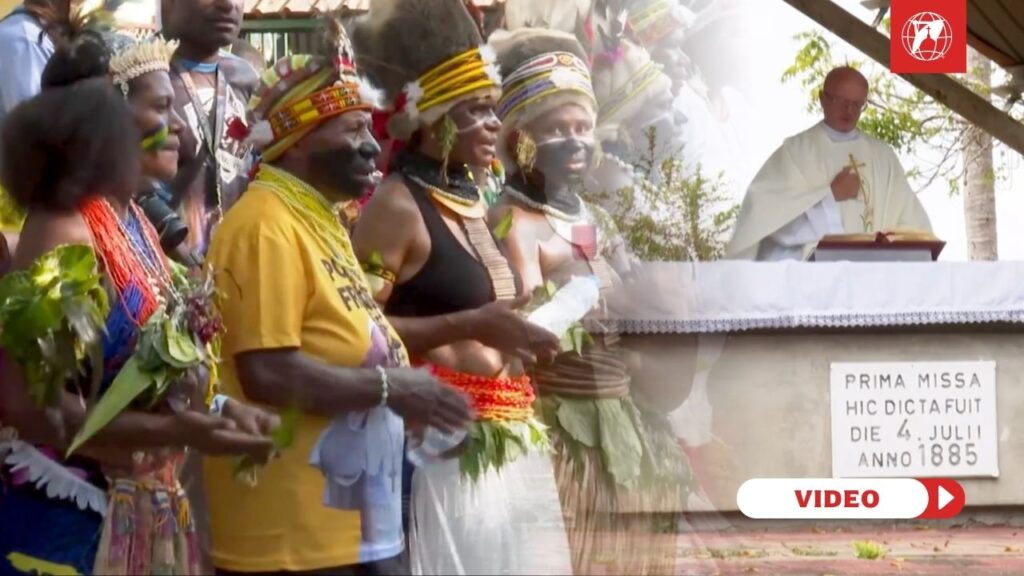
The bishop describes arriving at communities soaked by seawater and being welcomed with elaborate traditional ceremonies, including dances, speeches, and songs. These celebrations are followed by prayer in the local church.
Such encounters reveal the importance of cultural traditions in the lives of the people and the warmth with which they welcome their bishop.
The diocese has only around 20 priests to serve its widespread territory. As a result, many Sunday celebrations take place without a priest and are led by lay catechists. In these celebrations, the Blessed Sacrament is reserved in the tabernacle, and consecrated hosts are distributed for Holy Communion.
Prayer sustains the Church in remote territories
The shortage of priests highlights the essential role of lay people in sustaining the Church’s life in communities where priests cannot be present every Sunday.
Despite the physical demands of his ministry, Bishop Tad emphasizes that the greatest foundation of pastoral work is prayer.
Referring to Pope Leo XIV’s emphasis on prayer in pastoral ministry, he invites Catholics around the world to pray for the priests and people of his diocese.
Remaining in the presence of the Lord, he explains, brings solutions and opens paths forward amid difficulties.
His testimony highlights the dedication required to serve communities separated by vast stretches of ocean and the faith that sustains the Church in places where access to pastoral care remains difficult.
For Bishop Tad and the communities he accompanies, missionary work means more than reaching distant islands. It means being present, celebrating the faith, and ensuring that even the most isolated communities remain connected to the wider Catholic Church.
Adapted by Jacob Stein. Produced by Bénédicte Cedergren; Camera by Alberto Basile, Fabio Gonnella; Video Edited by Giada D’Ottavi.