Pope Francis has emphasized the difference between bishops’ conferences and bishops in a new interview with America Magazine.
“The bishops’ conference is there to bring together the bishops, to work together, to discuss issues, to make pastoral plans. But each bishop is a pastor,” the pope said in a lengthy interview conducted at his Vatican home on Nov. 22 and published Nov. 28.
“Let us not dissolve the power of the bishop by reducing it to the power of the bishops’ conference.”
The conversation with the Jesuit publication covered a wide range of topics, including the role of bishops, racism, polarization, sexual abuse, the Vatican-China deal, and whether he has any regrets from his time as pope.
In the interview, Pope Francis was told about a 2021 America Magazine survey that found that Catholics in the United States consider the U.S. Conference of Catholic Bishops to be the least trustworthy out of the groups listed — 20% of U.S. Catholics surveyed found the USCCB to be “very trustworthy.”
Francis was asked: “How can the U.S. Catholic bishops regain the trust of American Catholics?”
“The question is good because it speaks about the bishops,” he responded. “But I think it is misleading to speak of the relationship between Catholics and the bishops’ conference. The bishops’ conference is not the pastor; the pastor is the bishop. So one runs the risk of diminishing the authority of the bishop when you look only to the bishops’ conference.”
“Jesus did not create bishops’ conferences,” he added. “Jesus created bishops, and each bishop is pastor of his people.”
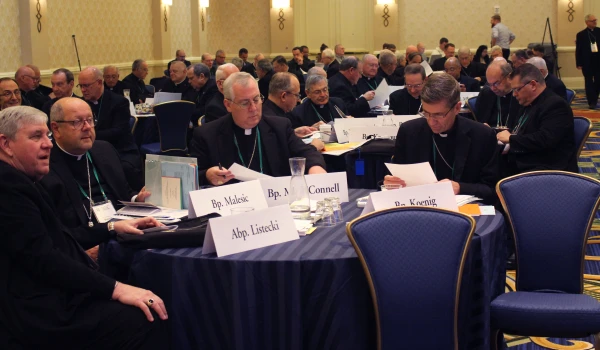
Pope Francis said the emphasis should be on whether a bishop has a good relationship with his people, not on administration.
He gave the example of Bishop Mark Seitz of El Paso, Texas: “I do not know if he is conservative, or if he is progressive, if he is of the right or of the left, but he is a good pastor.”
In the U.S., the pope said, there are ‘some good bishops who are more on the right, some good bishops who are more on the left, but they are more bishops than ideologues; they are more pastors than ideologues. That is the key.”
“The grace of Jesus Christ is in the relationship between the bishop and his people, his diocese,” he said.
A bishops’ conference, instead, is an organization meant to “assist and unite.”
Pope Francis was also asked whether the USCCB should prioritize the fight against abortion over other issues.
To which he said: “this is a problem the bishops’ conference has to resolve within itself.”
The pope pointed out that the activity of a bishops’ conference is on the organizational level, and in history, conferences have at times gotten things wrong.
“In other words, let this be clear: A bishops’ conference has, ordinarily, to give its opinion on faith and traditions, but above all on diocesan administration and so on,” he said, again emphasizing the sacramental nature of the pastoral relationship of a bishop to his diocese and its people.
“And this cannot be delegated to the bishops’ conference,” he added. “The conference helps to organize meetings, and these are very important; but for a bishop, [being] pastor is most important.”
In the interview, Pope Francis also denounced polarization as “not Catholic,” and said the Catholic way of dealing with sin is “not puritanical” but puts saints and sinners together.
He also said in the U.S., where there is a Catholicism particular to that country, something he called “normal,” “you also have some ideological Catholic groups.”
On the topic of sexual abuse in the Catholic Church, Pope Francis was asked about the apparent lack of transparency when it comes to accusations against bishops, compared with the handling of accusations against priests.
The pope called for “equal transparency” going forward, adding that “if there is less transparency, it is a mistake.”
To a question about Black Catholics, Francis said he is “aware of their suffering, that he loves them very much, and that they should resist and not walk away” from the Catholic Church.
“Racism is an intolerable sin against God,” he added. “The Church, the pastors and laypeople must continue fighting to eradicate it and for a more just world.”
Asked if he has any regrets, or if he would change anything he has done in nearly 10 years as pope, Francis said in English, as he laughed, that he would change “all! All!”
“However, I did what the Holy Spirit was telling me I had to do. And when I did not do it, I made a mistake,” he added.
On his seeming constant joyfulness, the pope said he is not “always like that,” except when he is with people.
“I would not say that I am happy because I am healthy, or because I eat well, or because I sleep well, or because I pray a great deal,” he explained. “I am happy because I feel happy, God makes me happy. I don’t have anything to blame on the Lord, not even when bad things happen to me. Nothing.”
He said the Lord has guided him through both good and difficult moments, “but there is always the assurance that one does not walk alone.”
“One has one’s faults,” he said, “also one’s sins; I go to confession every 15 days — I do not know, that is just how I am.”
This article was originally published by EWTN News English.