At the Holy Thursday chrism Mass, Leo XIV said the Church must reject domination, power, and “calculated strategy” in favor of humble service, unity, and peace.
Pope Leo XIV on Holy Thursday proposed Christian mission as an antidote to what he called the “imperialist occupation of the world,” saying it is now a priority to remember that “neither in the pastoral sphere nor in the social and political spheres can good come from abuse of power.”
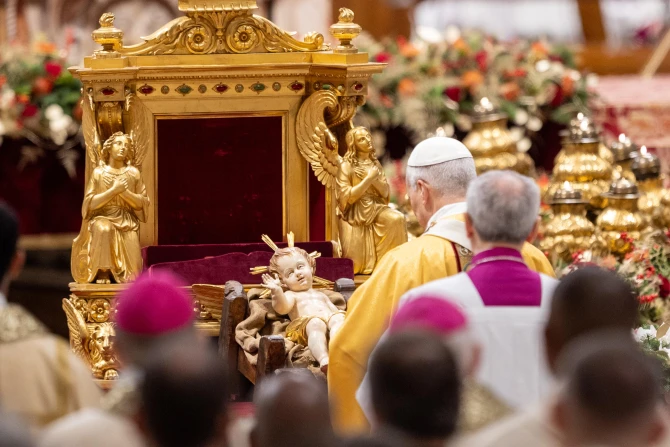
At the chrism Mass in St. Peter’s Basilica on April 2, the pope reflected on the mission God entrusts to his people and warned that it must never be distorted by “a desire for domination, entirely foreign to the way of Jesus Christ.”
“The cross is part of the mission: The sending becomes more bitter and frightening, but also more freeing and transformative,” Leo said. “The imperialist occupation of the world is thus disrupted from within; the violence that until now has been the law is unmasked.”
The pope did not point to any specific geopolitical situation when he used the phrase.
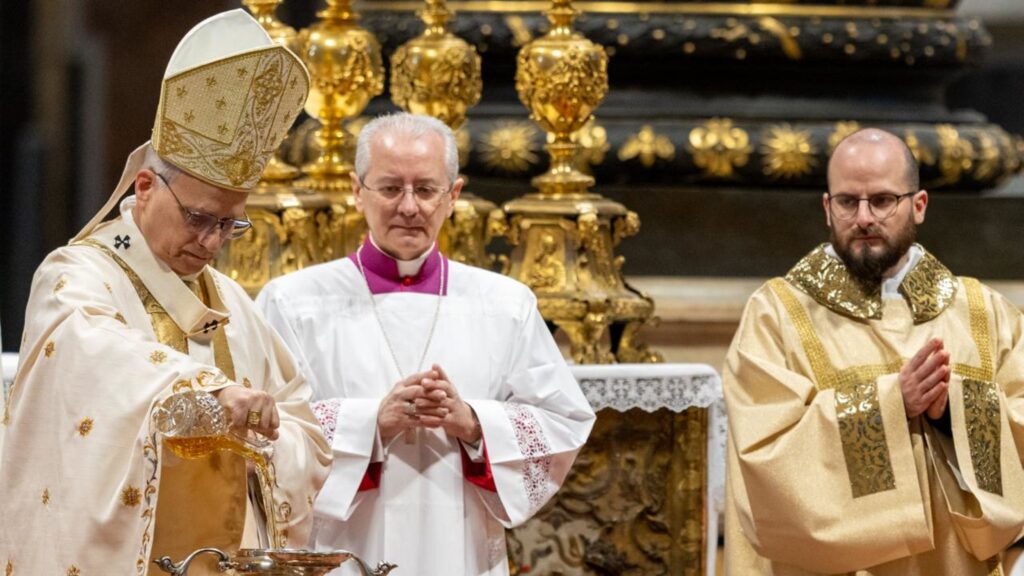
The chrism Mass, one of the principal liturgies of Holy Thursday, includes the blessing of the holy oils that will be used throughout the year in the sacraments of baptism, confirmation, anointing of the sick, and holy orders. During the Mass, priests also renew the promises they made at ordination.
Presiding over the rite for the first time as bishop of Rome, Leo addressed nearly 1,000 priests in St. Peter’s Basilica and emphasized that the Christian mission is never lived in isolation or in rupture with the Church.
“Each of us takes part in it according to our own vocation in a deeply personal obedience to the voice of the Spirit, yet never without others, never neglecting or breaking communion!” he said.
The pope said the Easter Triduum, which begins later on Holy Thursday, calls Christians not to flee trial but to pass through it with Christ.
“What we are about to relive, in fact, possesses the power to transform what human pride generally tends to harden: our identity and our place in the world,” he said. “Jesus’ freedom changes hearts, heals wounds, refreshes and brightens our faces, reconciles and gathers us together, and forgives and raises us up.”
Leo also stressed that the Church is apostolic because it is sent out, not static, and said bishops and priests are called to remain at the service of a missionary people.
He warned that mission has too often been warped by worldly logic and said authentic Christian love cannot be tied to force or display.
“Love is true only when it is unguarded; it requires little fuss, no ostentation, and gently cherishes weakness and vulnerability,” he said.
The pope also cautioned against approaching the poor with worldly signs of influence.
“There is no ‘good news to the poor’ … if we go to them bearing the signs of power, nor is there authentic liberation unless we free ourselves from attachment,” he said.
Instead, Leo pointed to the witness of the great missionaries, who, he said, embody “quiet, unobtrusive approaches, whose method is the sharing of life, selfless service, the renunciation of any calculated strategy, dialogue, and respect.”
He added that Christian mission requires simplicity and reverence before the mystery present in every people and culture.
“As Christians, we are guests,” he said. “To be hosts, in fact, we must learn to be guests ourselves.”
Even in places marked by secularization, he said, the Church must not think in terms of conquest or reconquest but of listening, accompaniment, and witness. That is possible only when the Church walks together, he said, and when mission is not “a heroic adventure reserved for a few, but the living witness of a body with many members.”
Leo also reflected on the possibility of rejection in Christian mission, recalling Jesus’ expulsion from Nazareth. Yet even that trial, he said, can become the place where the Gospel reveals its deepest power.
“How many ‘resurrections’ are we called to experience when, free from a defensive attitude, we immerse ourselves in service like a seed in the earth!” he said.
During the homily, the pope cited St. Óscar Romero, the archbishop of San Salvador murdered in 1980, as a witness of persevering hope amid danger and suffering.
At the close of his reflection, Leo urged Catholics to renew their commitment to a mission marked by unity and peace.
“In this dark hour of history, it has pleased God to send us to spread the fragrance of Christ where the stench of death reigns,” he said. “Let us renew our ‘yes’ to this mission that calls for unity and brings peace. Yes, we are here! Let us overcome the sense of powerlessness and fear!”
This story was first published by ACI Prensa, the Spanish-language sister service of EWTN News. It has been translated and adapted by EWTN News English.