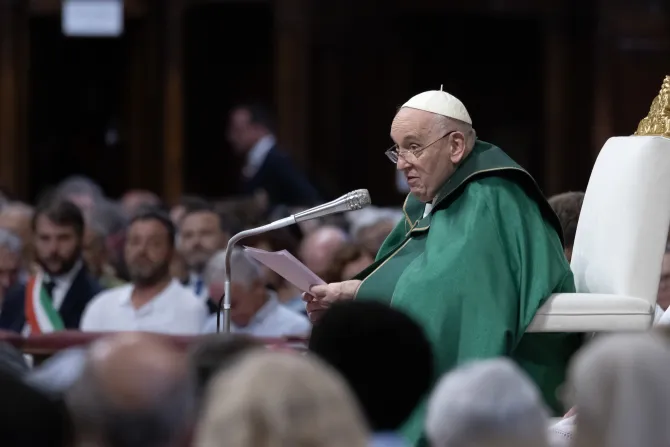
Pope Leo XIV on Saturday condemned usury, a practice that is sometimes an extremely grave sin that speaks to the corruption of the heart of those who see others only as “objects of exploitation.”
Usury can be defined as charging too much interest on a loan, a practice that has existed since ancient times. Traditionally, the Catholic Church taught that the sin of usury was the act of demanding any benefit or profit for the sole purpose of lending. This understanding has evolved over time, and the Church no longer condemns the general practice of lending with interest, as long as it is moderate.
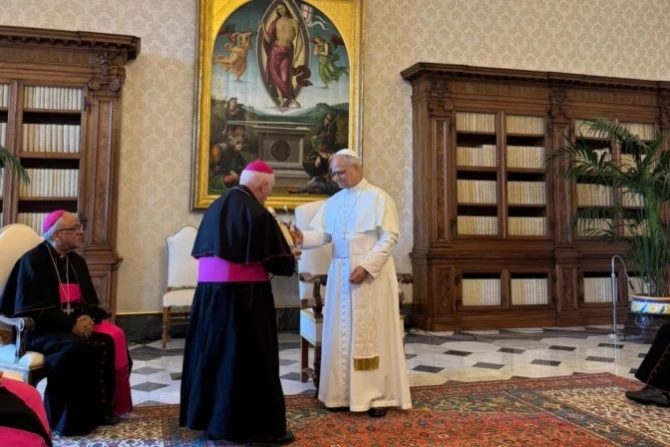
On Oct. 18, the Holy Father received the National Anti-Usury Council of Italy in the Vatican Apostolic Palace. For 30 years, the council has been dedicated to “combating a problem that has a devastating impact on the lives of so many people and families,” according to the Vatican Press Office.
In his address, the pontiff stated that “the phenomenon of usury points to the corruption of the human heart. It is a painful and ancient story, already attested to in the Bible. The prophets, in fact, denounced usury, along with exploitation and every form of injustice toward the poor.”
“How far God is from the attitude that crushes people to the point of enslaving them! It is a grave sin, at times very grave, because it cannot be reduced to a mere accounting issue; usury can bring crisis to families, it can wear down the mind and heart to the point of leading people to think of suicide as the only way out,” the pope said.
Although there are forms of usury that appear to be helpful to those in financial difficulties, in the end it reveals itself “for what it is. The consequences are paid especially by fragile people, such as those who are victims of gambling” or like those facing “difficult moments, such as for instance extraordinary medical treatment or unexpected expenses beyond their means or those of their families. What first presents itself as a helping hand in reality becomes, in the long run, a torment.”
Leo XIV continued, saying “usurious financial systems can bring entire peoples to their knees. Similarly, we cannot overlook ‘those whose usurious and avaricious dealings lead to the hunger and death of their brethren in the human family’ (Catechism of the Catholic Church, No. 2269): their responsibilities are grave and they fuel structures of iniquitous sin.”
After urging respect for the dignity of all, especially the weakest and most vulnerable, the Holy Father urged: “Either we regain our moral and spiritual dignity or we fall into a cesspool.”
Jesus, Zacchaeus, and a path to conversion of usurers
Pope Leo then referred to the Gospel passage (Luke 19:1-10) in which Jesus meets Zacchaeus, the chief tax collector of Jericho, who “was accustomed to abuse, oppression, and bullying. It was normal for someone like him to take advantage of his position to exploit people and earn money by robbing the weakest.”
“And so Jesus seeks out Zacchaeus: He calls him and tells him that he wants to stay at his house. And then the unthinkable happens: Jesus’ generosity completely takes the man aback and puts him with his back against the wall. Coming to his senses, Zacchaeus realizes that he has done wrong and decides to repay ‘with interest’!” Leo continued.
“No one asked him for so much, not even the Mosaic law. But the fact is that his encounter with Christ transformed his heart, and then everything changed. Only generosity is so effective that it reveals to us the meaning of our humanity,” the pope emphasized.
The pontiff pointed out that “when the pursuit of profit prevails, others are no longer people, they no longer have a face, they are just objects to be exploited; and so we end up losing ourselves and our souls. The conversion of those who engage in usury is just as important as closeness to those who suffer from usury.”
This story was first published by ACI Prensa, CNA’s Spanish-language news partner. It has been translated and adapted by CNA.