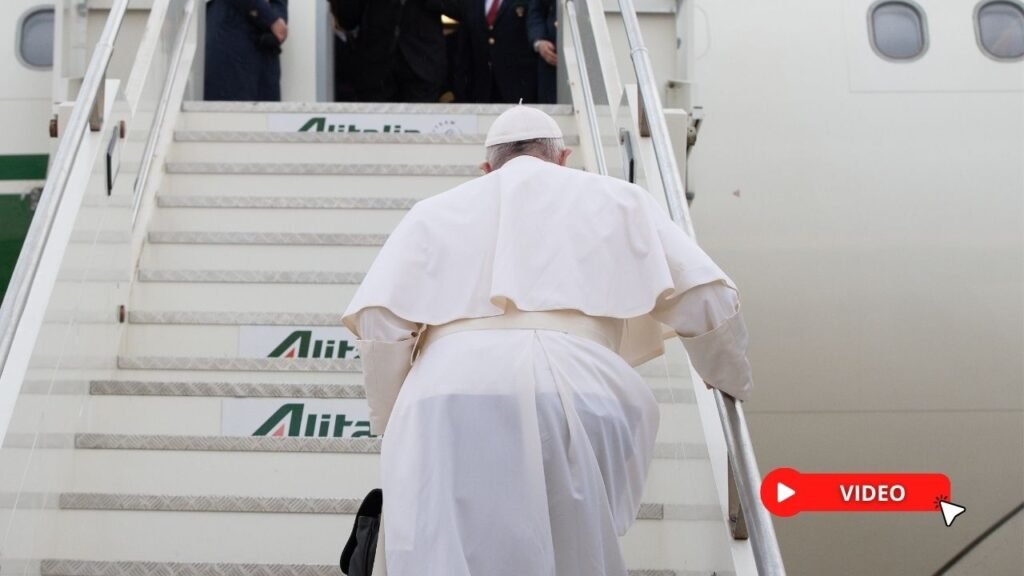
From the very first months of his pontificate, Pope Francis turned travel into a defining pastoral gesture. His journeys were never diplomatic formalities, but deliberate encounters with suffering, hope, and forgotten peoples. Step by step, flight by flight, his trips traced the spiritual geography of a Pope determined to reach the world’s peripheries.
Lampedusa: Where It All Began
Just months after his election, Pope Francis made a choice that would set the tone for everything that followed. On July 8, 2013, instead of a carefully planned pilgrimage, his first trip outside Rome took him to the tiny Mediterranean island of Lampedusa, a frontline of migration and human tragedy.
Magdalena Wolinska-Riedi, correspondent for the EWTN Vatican office, recalls the shock inside the Vatican when Francis suddenly announced his intention. She remembers that he told the gendarmerie and the Swiss Guard, “I want to fly to Lampedusa,” triggering immediate confusion—“consternation, how is that possible? When? Everything has to be prepared…” What made the moment extraordinary, she explains, was the contrast with the past. After pilgrimages “carefully prepared over a long time during the papacies of Benedict and John Paul II,” Francis wanted to go immediately, “as quickly as possible to Lampedusa, among the forgotten, the marginalized, and the most unfortunate,” because it was a need of the heart.
That journey revealed a Pope of the peripheries—one who would consistently choose places where pain was most visible.
World Youth Day: A New Pope, a New Style
Francis’ first major international trip brought him to Rio de Janeiro for World Youth Day, an event originally planned by Benedict XVI but transformed into the stage of a new pontificate. Millions of young people from across the world flooded Brazil, encountering a Pope whose language, gestures, and closeness felt immediately different.
From Rio to Krakow, Panama, and Lisbon, Francis carried the World Youth Day spirit across continents, speaking directly to young Catholics and reminding them that the Church’s future is built through presence, encounter, and joy.
Carrying the Cross of Humanity
Behind every papal journey stood an immense security operation. For more than thirteen years, Domenico Giani served as head of Vatican security, protecting three popes and overseeing more than one hundred apostolic trips, many of them in high-risk contexts.
Reflecting on those experiences, Giani describes how travel revealed the true weight of the papacy. He explains that it was about “having seen and touched situations, imagining myself as the one helping Peter carry a weight.” For him, the image became clear over time: “what I always said was that the Pope is the greatest Cyrene of humanity, because he truly carries the cross of humanity. And we were small Cyrenes.”
In nearly fifty international journeys across sixty-five countries, Francis confronted humanity’s wounds directly—never from a distance.
Fear Never Stopped Him
In 2016, Francis traveled to Armenia, where he firmly condemned the Armenian Genocide despite warnings from political leaders, including the Turkish president. His stance made clear that fear would not dictate his pastoral choices.
Africa became another central chapter. Over four visits, Francis carried a consistent message of peace, denouncing violence, the arms trade, and the spread of Islamist terrorism. He challenged the international community for turning its back on Africa’s suffering and insisted that the continent’s pain was not invisible to the Church.
In a historic first, Francis inaugurated a Holy Year outside Rome. The Extraordinary Jubilee of Mercy began not in grandeur, but in the cathedral of Bangui, in the Central African Republic—one of the poorest and most fragile places on earth—where he opened a simple wooden Holy Door.
The United States and the Cry of the Victims
In 2015, Pope Francis traveled to the United States, where one of the most painful encounters of his pontificate took place: meeting victims of clerical sexual abuse. Speaking with rare clarity, Francis declared, “God weeps. The crimes and sins of sexual abuse of minors may no longer be kept secret,” committing himself personally to action. He promised, “I commit myself to ensuring that the Church makes every effort to protect minors and I promise that those responsible will be held to account.”
The trip underscored that his journeys were not ceremonial, but moral confrontations with reality.
Iraq: The Most Dangerous Journey
Throughout his pontificate, Francis crossed all continents, but in his 2025 autobiography he would later recall that the most dangerous trip was his 2021 visit to Iraq. EWTN Vatican correspondent Colm Flynn was aboard the papal flight and witnessed the extraordinary security operation firsthand.
Flynn recalls that “we were told there were ten thousand soldiers and security personnel there just to protect the Pope,” adding, “and I believe it is because I think we saw all 10,000 of them. We saw soldiers and people who were armed everywhere we looked.”
After the long pause imposed by the COVID-19 pandemic, Iraq became the first destination of Francis’ renewed global mission. No pope had ever visited the country before—not even John Paul II. Francis entered a land scarred by war and violence to deliver a simple but radical message: hope.
To the Edges of the Map
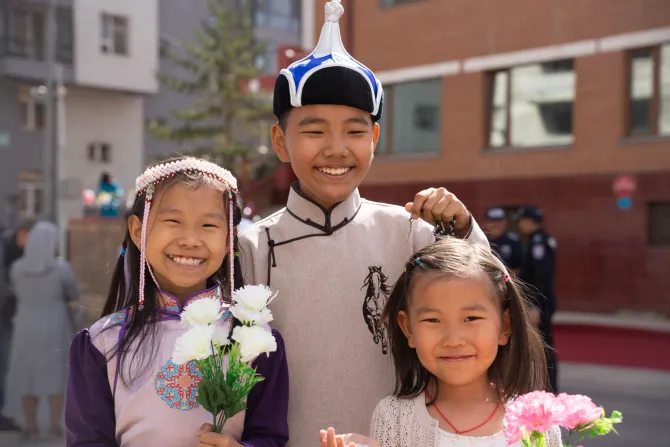
From Iraq to Myanmar, from the United Arab Emirates to North Macedonia, from South Sudan to Bahrain, Francis consistently traveled to places where Catholics are a small minority. In August 2023, he made history once again by becoming the first pope to visit Mongolia, a vast land between Russia and China.
There, amid the sweeping steppes, one moment stunned observers worldwide: Francis warmly embraced two bishops from Hong Kong and offered an unexpected word of closeness to Chinese Catholics—some of whom had taken great personal risks to be present.
Asia emerged as a defining frontier of his papacy. Francis visited the continent more than any pope before him.
A Tireless Pilgrim of Peace
His most physically demanding journey came in September 2024: twelve days, four countries, and over 33,000 kilometers across Southeast Asia and Oceania—Indonesia, Papua New Guinea, Timor-Leste, and Singapore.
Across all these journeys, one message never changed. As a pilgrim of peace, Pope Francis traveled hundreds of thousands of kilometers, often into conflict zones and fragile societies, tirelessly insisting that peace is not an abstract ideal but a responsibility—one that must be carried, like a cross, to the farthest corners of the earth.