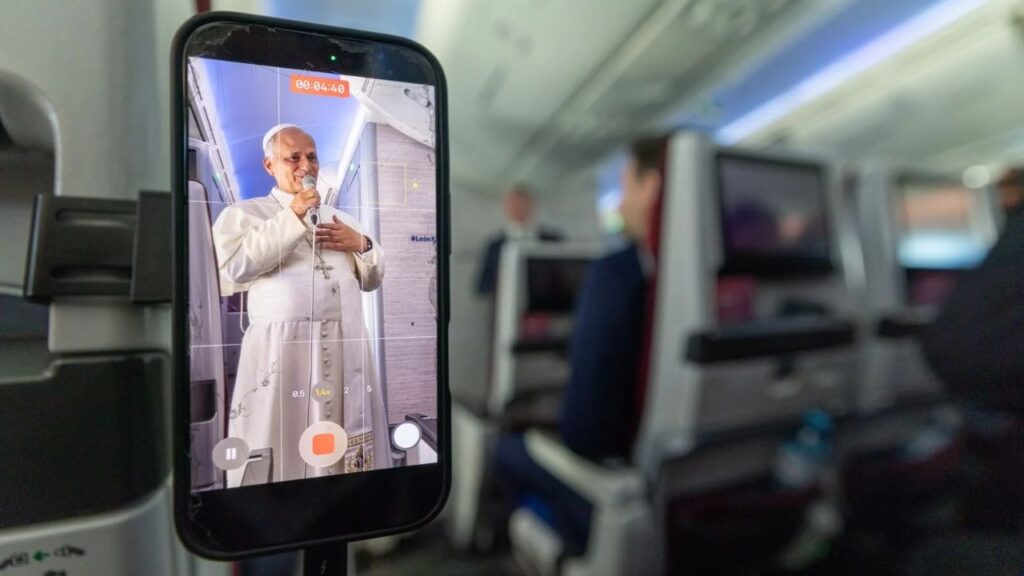
Papal Journey · In-Flight Press Conference
On the return flight from Uruguay, Argentina and Peru, Pope Leo XIV spoke about the faith of the peoples he encountered, political polarization, the Church’s responsibility toward abuse victims, his health and the priorities of his pontificate.
Pope Leo XIV reflected on an apostolic journey shaped by what he called “Magnifica Humanitas.” Speaking with journalists aboard the papal flight to Rome, the Pope addressed the Church’s witness in secular societies, Argentina’s social and economic tensions, the faith of the Peruvian people, vocations in the Amazon and unity within the Church.
Watch the in-flight press conference
Pope Leo XIVPope Leo XIV’s answers to journalists aboard the return flight from his apostolic journey to Uruguay, Argentina and Peru.
Note on the text. We publish the Pope’s answers in their entirety based on the available transcript. Remarks delivered in Italian and Spanish have been translated into English; verbal fillers and unintended repetitions have been lightly edited. The journalists’ questions have been summarized and identified as such. Unintelligible or uncertain passages are marked in square brackets. This is an editorial version, not an official transcript of the Holy See.
“Magnifica Humanitas” and the journey
Pope Leo XIV
I’ll begin in English. Good afternoon, everyone. It’s good to see you. Thank you for the work you have done accompanying me on this journey. I hope I did not tire you out too much.
I think it was a wonderful trip in many ways. Three countries, three very different countries, yet with elements in common, not only linguistically. At the same time, there are great differences among them.
“We could call this trip ‘Magnifica Humanitas,’ because it was a true experience of meeting people and recognizing the gifts of the different cultures, the different peoples, the different cities and rural areas that we visited.”Pope Leo XIV
At the same time, we recognized that the great gift of humanity is all the greater because it is God’s creation. And because God chose to incarnate, God chose to become human to help us recognize how great this gift of humanity is.
We saw it in so many different ways, so many different colors, different music, different expressions of faith and devotion throughout the days we’ve been traveling.
Personally, I want to thank God and thank the peoples, communities and countries that welcomed me, that welcomed us, during these days, recognizing that there truly is much to celebrate. There is much value in human experiences and religious experiences, in the experience of devotion and faith that we were able to share during these days.
I believe this, above all, is where we should emphasize the beauty of a journey such as this: an apostolic journey focused primarily on sharing the faith and the message of the Gospel among various peoples who have different experiences, often with suffering and pain, but who always celebrate our faith in God.
Well, thank you very much. If anyone would like to ask something, I am ready to try to answer.
Health and the message to Uruguay
How do you feel after the journey? Were you surprised by the stamina you showed?
Pope Leo XIV
Other people are surprised by me. I thank God.
The truth is that, as everyone knows, it has been a little more than a month since a fairly significant operation. But from the beginning I had in mind that the trip was scheduled and I wanted to complete it.
With God’s help, and I believe deeply in the power of prayer, I received messages literally from all over the world. With a certain determination that I also have, and with the help of the doctors, it became clear that it was possible.
I have to say that I am not at 100 percent, but I am doing quite well. Stamina is one of the gifts the Lord has given me. So, thanks be to God.
In Uruguay, you urged people not to confuse smallness with insignificance. What example can the Church in Uruguay offer to other communities? Why did you decide to visit Uruguay, and what fruits do you hope the visit will leave among Catholics and in the country’s largely secular society?
Pope Leo XIV
We are in the month of November, and Advent and Christmas are approaching. I think, for example, of a Nativity scene and of those small villages where Jesus arrived with his message, and of how a small community can do great things, not because it is enormous in itself, but because faith begins like a mustard seed.
In Uruguay, we all saw, perhaps some people were surprised, that the response of the Catholic community, and not only the Catholic community, was tremendous.
Then, through a happy providence in the planning, we were able to be present for the feast and celebration of Our Lady of the Thirty-Three, a feast of great importance in the devotion of Catholics in Uruguay and in the country’s history.
These elements show that even in a country considered secular, a country where many people perhaps no longer actively practice a faith or religion and where participation may be limited or nonexistent, the Church, the faithful and Christians have much to say.
The response during these days was wonderful, and I believe the visit left a seed that will grow.
Pope Francis, Argentina and Milei
What were your meetings with President Javier Milei like, and what message did you want to convey to his government? Why did Pope Francis never return to Argentina?
Pope Leo XIV
I will not try to answer the second question because I do not know, and I cannot pretend to read Francis’ mind, even though I was his collaborator and knew him during the last few years. I leave it to the mystery of eternal life; we will be able to ask him.
I had already met President Milei in Rome when he came to the Vatican. It was similar with Francis: politically, they represented very different outlooks, and yet they apparently got along very well.
“The message I want to give, the message I want to bring, is not political. I speak about magnifica humanitas.”Pope Leo XIV
That is what I discussed with President Milei: respect for the human person and the need to give greater consideration above all to those most in need within Argentine society.
Yes, we spoke about economic questions and some of the difficulties the country is still experiencing. But above all there was a mutual understanding about the value of life and the value of the human person at every stage. We must find ways to work together on that.
That is the direction our conversation took. You also saw, both upon arrival and at the departure, that he was open to hearing this message. I believe that, in this sense, it was something very positive.
Algorithms, polarization and unity
The visit left a profound mark on Argentina at a difficult moment for the country. What advice would you like to leave to Argentine society?
Pope Leo XIV
I believe we are all becoming increasingly aware of how we have allowed ourselves to be swept along by algorithms and into a polarization that is not accidental, but in many situations has been intentionally provoked.
You have a very important role in helping everyone overcome this form of polarization and in saying: look at what Argentina experienced for a few days. How was it possible that the right, the left, everyone, was there in the streets, celebrating and rejoicing in something much greater than a political argument?
Personally, I believe deeply in the message of Jesus Christ, while having great respect for those who are not Christians and choose another path. But this message of building bridges and seeking reconciliation allows us to rediscover that there are elements within humanity far greater and far deeper than the things that so often cause division, hatred and polarization.
“There will continue to be differences of opinion, but there is no need for us to end up hating one another or using such violent language.”Pope Leo XIV
I would like to think that, if nothing else, the visit helped awaken this conviction in the hearts of many people: we can change that way of thinking; we can think differently.
Let us hope, once again, to sow seeds of hope and a message about the possibility of unity despite difficulties and differences, seeking solutions while always keeping in mind the common good, the good of the people.
Poverty and Catholic social teaching
Argentina has seen a sharp impoverishment of the middle class, and many people are suffering because of the economic situation. What can Catholic social teaching say about this?
Pope Leo XIV
Without turning this into a lesson in economics, there are international issues and factors that have contributed to this very heavy burden, causing so many problems for the middle class, not to mention the poorest.
We must encourage everyone, the people and citizens, but also the political class, to see how they can work together to rebuild and improve living conditions for the entire population.
In some cases, this includes international cooperation. It includes seeking solutions to those difficulties that are having such a strong economic impact on peoples.
We must all look to the common good. Often, if small businesses receive help, they can do more to create jobs and strengthen the possibility of a middle class.
It is very important not only to encourage individuals to find ways to live with hope, but also to encourage the powerful to seek values that serve everyone’s good and to work in a world where fewer and fewer people possess more and more.
The accumulation of wealth is also addressed by Catholic social teaching: how can wealth be redistributed more equitably so that we do not see the reduction, or even elimination, of the middle class? We must strengthen the working class, people and movements so that they can live with greater dignity.
Peru’s affection and the rosary
What moved you most about the affection shown by Peruvians, including the person who tried to offer you a rosary? What will you carry with you into your ministry, and when might you return?
Pope Leo XIV
Let us set aside the last question, because I do not know where I will go next year, much less farther into the future.
Organizing the Pope’s visit to these places requires an enormous amount of work. I thank all the communities: Lima, Pucallpa, Cusco and Chiclayo. We truly must recognize and thank everyone who worked on this. Asking it of them too frequently would not be fair, so we will let them rest for a while.
The affection of the Peruvian people, including the person who, with great faith, simply wanted to offer me a rosary, are things one carries in one’s heart, perhaps in one’s eye, but they mark one’s life.
“There is real enthusiasm here, deep faith here and a desire to receive the Lord’s blessing through, in this case, a servant: the Pope.”Pope Leo XIV
That closeness is itself a message from both sides. To be able to share the faith with joy and to give a blessing is a little like the Gospel account of the woman who wanted only to touch the hem of Christ’s garment to receive his blessing.
I try, and thanks be to God, with the energy he gives me, to be close to them. But I also receive. Their enthusiasm, faith and devotion are truly a gift from God.
They shared these gifts with me and with everyone throughout the world who witnessed what we experienced. I thank God; there are no other words.
Abuse victims and the responsibility of bishops
How can Peruvians preserve the unity, faith and hope awakened by the visit? What did you experience in your meeting with people who reported abuse by members of the Church?
Pope Leo XIV
In one sense, at least in part, the answer is one and the same.
The Pope could visit every country and the whole world if there were enough time. But there is one Pope. He represents Christ as the Vicar of Christ. Yet the Church lives at the local level with the bishops, who are the shepherds.
I believe that at least part of my message, which I also shared with the bishops, is that they must carry forward the experience of faith that we lived during these days.
“Now it is your turn to continue. Do not lose the gifts we have shared during these days, so that this experience of joy, devotion and faith may continue to grow.”Pope Leo XIV
With regard to the victims, this is certainly not the first time I have spoken with victims in Peru or in other countries. But the Pope cannot listen to everyone throughout the world.
This, too, is a gesture expressing the desire to be close to victims and to help them find a path, perhaps little by little, that can lead them to genuine healing.
At the same time, it is a commitment to keep working on prevention, so that these things may never happen again.
It is also a call to the bishops and pastoral workers in their dioceses: those closest to these situations must fulfill their responsibility, accompany people and help ensure that there is justice and that these crimes are never repeated.
The operation and the importance of prevention
How did you experience your unexpected hospitalization? Will you require further examinations or treatment, and will anything change in your life as Pope?
Pope Leo XIV
The first news came as a surprise. I had no symptoms and felt well. Then, as part of annual routine examinations that I have generally undergone for many years, they discovered what first appeared to be a shadow. After further tests, they saw that there was something there. A biopsy showed that it was a tumor.
Because, as I said earlier, I wanted to make this journey, I said: “Let us do it immediately.” Perhaps it was God’s grace, but I was calm. I felt that it had to be done, so we did it.
I trusted the doctors and the medical care available to us. Thanks be to God, everything went very well.
The part of the lung they removed contained the tumor completely; it was confined there. There is no need for any other treatment for it.
As a precaution, just as with annual checkups, it will be necessary to remain attentive, but in a normal way.
“Get checkups. Prevention is very important. Seek care when treatment is needed. We should not be so afraid; the necessary steps should be taken.”Pope Leo XIV
Thanks be to God, in this case, and also through the strength of so many people’s prayers, everything went very well, and I am here as a witness to all of it.
Vocations, the Amazon and married priests
Missionary territories in the Amazon have very few priests. Is the possibility of ordaining viri probati, mature married men, still open under your pontificate?
Pope Leo XIV
Let me first add some perspective, beginning with where I started my missionary activity in Chulucanas.
When I first went to Peru, there were perhaps between 15 and 20 American Augustinians and two Peruvians. Today, among the Augustinians in northern Peru, I do not think there are any Americans, perhaps one, but there are 35 Peruvians.
The Spirit works in many ways. In areas where vocation promotion and formation are carried out in productive ways, the door is not closed to thinking that there could be more priests, and more Peruvian priests, in the future to serve these missionary areas.
There are challenges in the Amazon region, where the question of vocations has been more complicated for many different reasons. There is much work to be done.
One of the solutions proposed for consideration is the one you mentioned. It is not the only solution, but it is a solution that can cause division in some areas of the Church, because there is not universal acceptance of that concept.
“The Holy Spirit may continue to suggest an idea, but not only to me. The Pope does not change Church doctrine. We all have to listen. The bishops have to listen.”Pope Leo XIV
It may be that some things will change in the future. For now, however, I believe an important part of my ministry in the Church is to heal and bring people together.
First, let us come together; let us consider what we believe the priorities need to be; and then we will see how we move forward from there.
The whole question of married men as clergy is complicated. There are others who have different proposals, but all these things will take time, and we will move forward as the Lord guides us.
A conditional resignation letter
Your predecessors signed a conditional letter of resignation for a situation such as a coma or another form of incapacity. Have you signed such a letter?
Pope Leo XIV
I do not see a need for that. Thanks be to God, canon law already has various provisions that address this issue.
I trust in God’s hands, as I said before I was elected Pope. I may eventually do it, I think, but for now I do not see a need. Thank you.
The United States, Korea and Mexico
What did the United States give you and how did it shape you? Could there be a future visit to the United States and Mexico?
Pope Leo XIV
Upcoming journeys are still being planned for 2027. One that is confirmed is Korea for World Youth Day. Beyond that, there are several possibilities and we are considering them, but that is all I can say for now.
In many respects I am a gringo, a North American. Before the conclave, an article in one of the newspapers represented here said: “Prevost is the least American of the Americans.”
When I speak about matters in general, I am direct; I say things as they are.
Speaking about my health, even saying, “Well, this is what I am going through,” would not be typical in many countries and cultures. It is somewhat more common in the United States.
My deep faith in democracy and democratic participation is also part of being North American.
My way of living the faith has been greatly affected and transformed by Peru. But I grew up in a multicultural family in the United States in which the faith was also lived. I was formed in that culture as well.
As for Guadalupe: of course. I have been to Guadalupe several times. You may dream, but do not wake up yet, because I will get there, I will get there.
Spiritual abuse and Traditionis Custodes
Is the Holy See preparing a document on spiritual abuse? Are you considering making Traditionis Custodes more flexible? Will you soon appoint new cardinals, and will you reconsider your priorities after the operation and the journey?
Pope Leo XIV
In reverse order: I do not comment on future cardinals. There are still enough of them, and I believe the number is currently about 116. I will eventually get around to that.
Spiritual abuse is a very serious issue in the Church. It is being studied in the Vatican.
There is no specific document ready for immediate publication, not yet, but there is the concept itself and the need to address some of these issues canonically.
That is one of the difficulties, because in order to administer justice, one must have a codification or juridical expression of how it is to be applied.
It is still a very broad concept, although we could probably all describe specific cases or kinds of situations in which it has occurred. We are studying it and working on it.
No, not at present. Traditionis Custodes was Pope Francis’ decision, and we will continue to follow it.
Traditionis Custodes includes the possibility of dispensations or permission for the Tridentine Mass, the Vetus Ordo Mass, to be celebrated.
For the unity of the Church, the vast majority of Catholics around the world celebrate according to the rite of Vatican II, the rite of Paul VI, and we will continue to do so. There is a path available for those who wish to apply for a dispensation.
I do not feel that I need to adjust my priorities. Things will basically continue as we have been doing them.
Elections, dialogue and reconciliation
After the U.S. midterm elections, what do you expect for the country at a time marked by polarization, hybrid warfare and cognitive warfare?
Pope Leo XIV
“I would like to see a greater capacity for dialogue, bridge-building and reconciliation; less controversy, less war and less division.”Pope Leo XIV
I know that this, too, is a dream, but I know it is possible. So we will see.
I am not making a political statement. I am promoting the social teaching of the Church, in the hope that some people will listen and that we will always seek to promote dialogue and the ability to listen.
Thank you all. I hope you can rest a little during the flight.
Follow EWTN News in English for all the special coverage during Pope Leo’s Apostolic Trip to Uruguay, Argentina and Peru. Read more about Pope Leo’s responses during the In-Flight Press Conference.