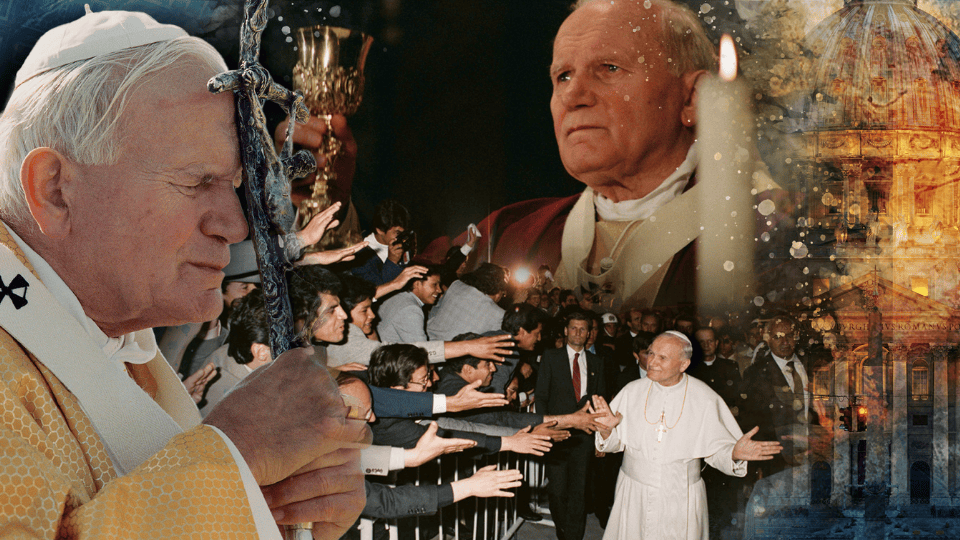
Twenty years after his death, the memory of Pope St. John Paul II remains vivid in the hearts of millions. His papacy, the third longest in the history of the Church, left an indelible mark not only on Catholicism but also on the political and cultural fabric of the modern world. From his youth in war-torn Poland to his final days of prayer in Rome, John Paul II’s legacy continues to inspire faith, courage, and hope across generations.
A Pope Formed by History
Born Karol Wojtyła in 1920, John Paul II grew up in a Poland besieged by totalitarian forces. He experienced firsthand the brutalities of the Nazi occupation and the crushing weight of communist rule. These trials forged in him a deep resilience and a conviction that faith could withstand even the harshest persecution.
His experiences during World War II, including forced labor and the loss of family members, gave him a profound empathy for the suffering. These years also deepened his vocation to the priesthood, shaping a spirituality rooted in both endurance and hope.
Those who knew him often recalled how these early hardships gave him the moral authority to stand against oppression later as pope. His historic visit to Poland in 1979, where he urged his people to “be not afraid” and called on the Holy Spirit to “renew the face of the earth,” became a spark that ignited the Solidarity movement and, eventually, the collapse of communist regimes across Eastern Europe.
Courage in the Face of Danger
John Paul II’s role in challenging communism made him a target. On May 13, 1981, he survived an assassination attempt in St. Peter’s Square. The attack left him gravely wounded, yet his response revealed the depth of his faith. He publicly forgave his assailant, Mehmet Ali Ağca, visiting him in prison and offering him his hand as a brother.
Although speculation abounds regarding the Soviet Union’s possible involvement in the plot, no definitive evidence has ever been found. Yet the attempt on his life only reinforced the pope’s conviction that his mission was guided by Providence. He attributed his survival to the intercession of the Virgin Mary, even placing the bullet removed from his body into the crown of Our Lady of Fatima.
A Missionary Pope
John Paul II was a tireless pilgrim. Over the course of his pontificate, he traveled to more than 120 countries, bringing the message of Christ to every corner of the world. His charisma drew enormous crowds, but behind the public image was a man rooted in prayer.
Cardinal Stanisław Dziwisz, his longtime secretary, recalled how prayer permeated every moment of the pope’s day. Whether dictating homilies, greeting delegations, or preparing for journeys, John Paul II continually turned his heart to God. He was especially devoted to the rosary and the Stations of the Cross, even arranging for the stations to be installed on the roof of the Apostolic Palace so he could walk and pray privately.
His Marian devotion, summed up in his motto Totus Tuus (“Totally Yours”), reflected his lifelong reliance on the Virgin Mary. After losing his mother at age nine, he turned to Mary as a spiritual mother, and later consecrated the Church and the world to her Immaculate Heart.
A Man of Nature and Simplicity
Despite his global stature, John Paul II never lost his love for the mountains and the outdoors. He often slipped away from the Vatican in disguise, accompanied only by a few priests, to hike, ski, and pray in the Abruzzo region near Rome. These escapes allowed him moments of quiet reflection and closeness to God in nature.
Locals remembered seeing him eat simple meals—bread and sausage cooked over a fire—and pray in small, ruined chapels tucked in the mountains. For him, nature was not just recreation but a place where he encountered God’s majesty and drew strength for the challenges awaiting him back in the Vatican.
The Final Witness
In his later years, as Parkinson’s disease took its toll, John Paul II’s suffering became itself a form of testimony. Even as his body weakened, he continued to appear in public, determined to show the dignity of human life even amid frailty. At the Great Jubilee of 2000, those who saw him walk with difficulty to lead World Youth Day in Rome recalled both his physical struggle and his unwavering spirit.
His final days were marked, as always, by prayer. Surrounded by close collaborators, he held a rosary in his hands even when speech was no longer possible. Outside his window, crowds of young people gathered in St. Peter’s Square, praying with him until he peacefully returned to the Father’s house on April 2, 2005.
A Light for the Future
Two decades later, John Paul II remains a figure who transcends his time. He was not, as he humbly said, the man who “knocked down the Berlin Wall with his own hands,” but his witness of courage, prayer, and fidelity helped change the course of history.
He is remembered as a man who prayed deeply, loved intensely, and bore suffering with dignity. His words—“Do not be afraid”—continue to echo as a challenge and encouragement for the Church and the world today.
In the silence of prayer, in the beauty of the mountains, and in the courage of his witness, St. John Paul II’s path of holiness still lights the way for millions around the globe.
Adapted by Jacob Stein