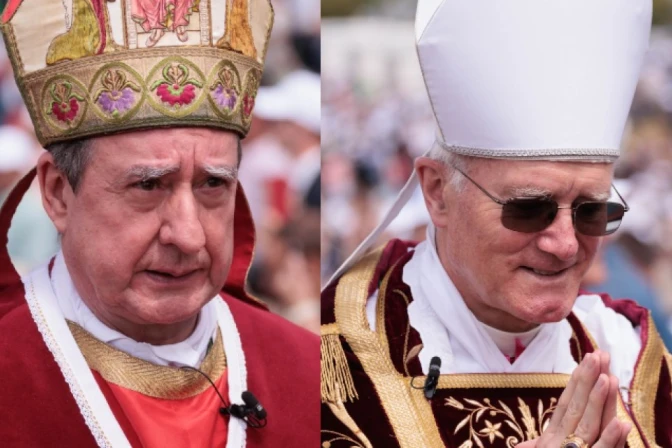
Society of St. Pius X bishops Galarreta and Fellay have been excommunicated twice: by Pope John Paul II in 1988 and again on July 2 for the canonical offense of schism.
Two bishops of the Society of St. Pius X (SSPX) — Spaniard Alfonso de Galarreta and Swiss Bernard Fellay — incurred automatic excommunication by committing the canonical offense of schism following the ordination of four bishops without the permission of Pope Leo XIV.
The Dicastery for the Doctrine of the Faith on July 2 declared that the SSPX is in a state of schism following the ordinations.
With this Vatican decision, Galarreta and Fellay represent a unique case: They have each been excommunicated twice.
Against the will of St. John Paul II, both were consecrated bishops in 1988 by Archbishop Marcel Lefebvre, founder of the SSPX, thereby incurring the penalty of schism and excommunication. Pope Benedict XVI pardoned them in 2009.
Fellay entered the Écône, Switzerland, seminary in 1977 and was ordained a priest in 1982. After serving as the societyʼs bursar general, he was elected superior of the SSPX in 1994, a position he held until 2012.
During his tenure, a certain rapprochement took place between the SSPX and the Vatican, leading to Pope Benedict XVIʼs decision to lift the excommunication in January 2009.
However, this decision did not eliminate the illegitimacy of his ministry, as the Bavarian pontiff explained in a letter published in March of the same year.
De Galarreta was born in Torrelavega, Spain, and his family emigrated to Argentina, where he entered the La Plata seminary in 1975. Rejecting the reforms driven by the Second Vatican Council, he decided to transfer to the Écône seminary in 1978.
Lefebvre ordained him a priest in Buenos Aires in 1980. Five years later, de Galarreta assumed the role of superior of the fraternityʼs South American district.
He was subsequently assigned as superior of the Autonomous House in Spain and served as the director of the Our Lady Co-Redemptrix Seminary in La Reja, Argentina.
Following the 2018 election of Father Davide Pagliarani as superior of the SSPX, Galarreta was promoted to first assistant general of the society.
This story was first published by ACI Prensa, the Spanish-language sister service of EWTN News. It has been translated and adapted by EWTN News English.