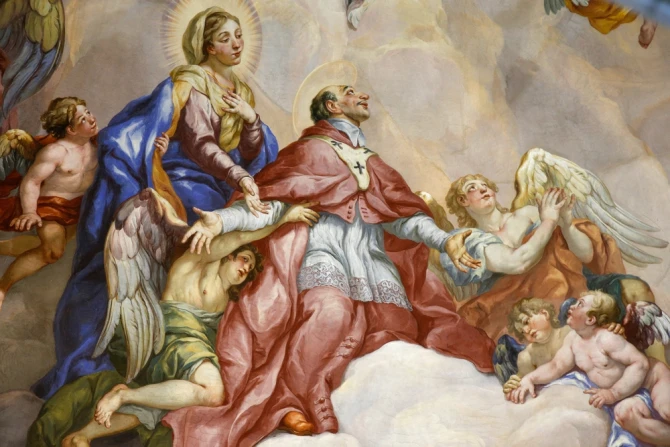
St. Charles Borromeo, whose feast day the Catholic Church celebrates Nov. 4, was a cardinal and a prominent teacher of the Catholic faith. He generously donated much of his considerable wealth to charity and sacrificed his own health to help plague victims at a time when many other authorities fled.
And, despite what you might have heard, he probably wasn’t obese.
Why does that matter? Well, because Charles is popularly invoked as a patron saint of stomach ailments and also of obesity and dieting. These patronages — and whether or not he was himself obese — are not mentioned in hagiographies of St. Charles, so it’s unclear how this particular association began. Charles was known for helping the poor in times of famine and for practicing self-mortification, and he was certainly not known to indulge in food to excess.
Whether or not his invocation by dieters is appropriate, what is clear is that St. Charles Borromeo had a massive influence on the Church.
Charles was born in 1538 near Milan. He was born wealthy — in fact, he was part of the famously rich and influential Medici family — but sought to use his wealth to benefit the Church rather than himself.
Owing in part to his well-connected family, Charles soon assumed staggering responsibilities, serving as a papal diplomat and supervisor of major religious orders.
Charles was a central figure in the Council of Trent (1545–1563), which among other things served as the Church’s official answer to the Protestant Reformation. Its twofold mission was to clarify Catholic doctrine against Protestant objections and reform the Church internally against many long-standing problems. As a papal representative, Charles participated in the council’s conclusion in 1563, when he was only 25, and was ordained a priest during the council. He also played a leading role in assembling its comprehensive summary, the Catechism of the Council of Trent.
Charles’ uncle, Pope Pius IV, appointed him archbishop of Milan in 1563, and soon after he became a cardinal. He found his diocese in a state of disintegration, after two generations of virtually no local administration or leadership. Charles got straight to work establishing schools, seminaries, and centers for religious life. He constantly directed the work of restoration of ecclesiastical discipline and the education of the young, even down to minute details. He tried as much as possible to live a simple life and give to the poor whenever possible, and he practiced self-mortification.
The clergy during this time were in many cases lax and careless, living scandalous lives, such that the people had grown to be equally negligent and sinful. While bishop of Milan, St. Charles oversaw many dramatic and effective reforms of the clergy, the liturgy, and of religious education. He encountered much opposition to those reforms, so much so that a group of disgruntled monks attempted to kill him, but he was miraculously unharmed when an assassin fired a gun straight at him while kneeling in prayer at an altar.
He was very active in preaching and ministry and was famous for bringing back many lapsed Catholics to the Church. As a result, today he is honored as the patron saint of catechists and catechumens, people who teach and learn the faith. In fact, he was the founder of the Confraternity of Christian Doctrine, which systematically instructed children in the faith — the forerunner of the modern “Sunday school.”
In 1571, the region where Charles was working suffered a severe famine, during which he worked tirelessly to help the starving, supporting at his own expense as many as 3,000 people daily for three months. At the same time, Charles himself suffered various ailments, including a low fever.
A few years later, a plague struck Milan. Charles was convinced that the plague was sent as a chastisement for sin and sought to give himself all the more to prayer and to service to his people. He paid personal visits to plague-stricken houses to comfort those suffering, and as a spiritual penance, he walked in procession, barefoot, with a rope around his neck and a relic in his hand.
At the end of 1584 Charles suffered a skin infection in one of his legs but still continued to travel to take care of his diocese. He died young at the age of 46 on Nov. 3, 1584, and was canonized 26 years later, in 1610.
This story was first published on Nov. 4, 2022, and has been updated by CNA.