In the traffic-clogged streets of central Rome, far from the noise that often surrounds the modern concept of “care,” there is a place where medicine rediscoveres the unhurried rhythm of listening. The home of the Opera dei Santi Angeli serves as a quiet refuge for laypeople, priests, families, and pilgrims searching for silence, prayer, and spiritual renewal.
Here, the auxiliary sisters welcome guests with a disarming simplicity, offering hospitality that feels more like family than lodging. Removed from the bustle of Rome’s tourist crowds, they prepare meals themselves and provide treatments inspired by the healing tradition of Saint Hildegard of Bingen.
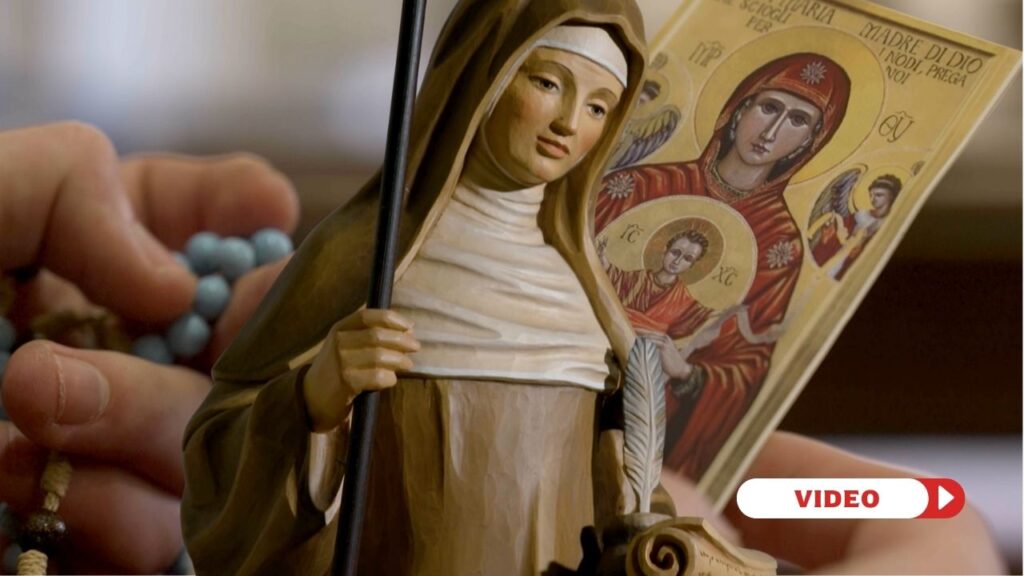
Prayer shapes the rhythm of the house. Guests are invited to lay their burdens at the feet of Our Lady, Undoer of Knots, whose image stands at the center of the chapel.
Simona Ferrara of Opus Angelorum explains that the spiritual focus of the house begins with the Virgin Mary. “We always say that the mistress of the house is the Madonna we have in the chapel — Our Lady, Undoer of Knots — because for us, of course, Christ is the center,” she said. “And so the retreats are always structured in the morning: Mass is celebrated first, then breakfast, followed by these meetings after breakfast, and then we have lunch together.”
Healing the Soul Through Silence and Prayer
Retreats typically last three to four days and welcome small groups. The schedule alternates between moments of quiet reflection in one’s room and shared prayer, creating a rhythm designed to address the deeper wounds of the soul.
Ferrara emphasizes that prayer does not require special skills. “Because the wounds are many — and the wounds of the soul are healed before the Lord, before the Blessed Sacrament, even in silence,” she said. “You don’t need to know how to pray. And truly, miracles can be seen.”
Yet spiritual care is only part of the approach practiced here. For years, the sisters have also preserved an ancient tradition known as Hildegardian medicine, inspired by the writings of the 12th-century nun, mystic, and healer Hildegard of Bingen.
Daniela Palamenghi, who oversees the house’s natural remedies, describes Hildegard’s legacy simply: “Hildegard was the world’s first naturopath.”
For Palamenghi, healing begins with prevention, especially through diet. Foods recommended by Hildegard remain central to the house’s approach.
“We use many spelt-based products — one of the grains with virtually endless properties because it is rich in amino acids,” she explained. “It’s also helpful when you’re feeling a bit tired or experiencing digestive difficulties, since it’s a grain that satisfies without causing bloating.”
Natural remedies also play a role, including herbal mixtures such as Gewürzkraft to support the immune system, Roman pyrethrum as a natural antibacterial, and galangal — a root related to ginger — believed to support heart health.
Simona Ferrara recounts a personal experience that strengthened her confidence in this tradition. “The cardiologists who later operated on me said it wasn’t possible — I am a living case,” she said.
She recalled how galangal helped her during a heart attack. “By taking this root, I could really feel myself improving, even amid the suffering, of course.”
Body and Soul: A Single Path to Healing
The sisters emphasize that medicine and prayer cannot be separated. Saint Hildegard’s vision of healing treats the body and soul as deeply connected.
Father Joachim Welz of the Order of Canons Regular of the Holy Cross summarizes this perspective: “And the body is healthy only when the soul is healthy — and the soul is healthy when the body is not, let’s say, enslaved by vices.”
Fabiana Ferrara, another member of Opus Angelorum, adds that emotional and spiritual struggles can also affect physical health.
“According to Saint Hildegard, in her revelations, illness is caused by sadness — by what we today call stress,” she explained. “This sadness creates a malaise within the body, and therefore the foundation of healing lies not only in nutrition but also in the inner peace we must learn to achieve.”
In this house, care is not simply a reaction to symptoms but an attentive concern for the whole person — body, mind, and spirit. Sister Katerina demonstrates how ancient remedies remain part of daily life, including a traditional preparation known as the “wine of the heart.”
“The ‘wine of the heart’ is quite easy to prepare, as it requires only four ingredients: white wine, wine vinegar, honey, and parsley,” she said. “It is very beneficial, because Saint Hildegard says it ‘heals the heart’ and helps overcome heart ailments.”
A Hidden Mission of Care
Those who arrive at the Opera dei Santi Angeli are not simply treated but accompanied. Listening becomes part of the therapy, and illness is approached not only as something to fight but also as something to understand.
As Katerina Welz explains, many people arrive with complex stories. “Sometimes people arrive with serious illnesses and share their stories with us, and you can’t help them much — because it’s they who must come to understanding,” she said. “This journey with Saint Hildegard transforms your whole life.”
For the sisters who serve here, this quiet work is a vocation lived largely out of sight.
“We are consecrated sisters in the world,” Fabiana Ferrara explained. “We have taken vows of chastity, poverty, and obedience, like all consecrated people in the world. But in hiddenness, much like the Madonna, or rather our absolute reference — Saint Hildegard.”
She added that Hildegard’s writings also emphasize the complementarity of men and women within the life of the Church.
“Unlike what many feminist movements or interpretations suggest, she clearly explained in her writings the roles of men and women,” Ferrara said. “The woman, through a kind of solidarity with other women, is called to help and become a guardian of the man — from the earliest age through adulthood.”
Through their quiet work of hospitality, prayer, and healing, the sisters continue a tradition rooted in the wisdom of Saint Hildegard of Bingen — a vision that sees the restoration of the human person as a journey of body, soul, and faith.
Adapted by Jacob Stein. Produced by Alexey Gotovskiy; Camera by Fabio Gonnella, Andrea Manna; Video Edited by Giada D’Ottavi; Special thanks & Credits to Casa Santa Maria degli Angeli.