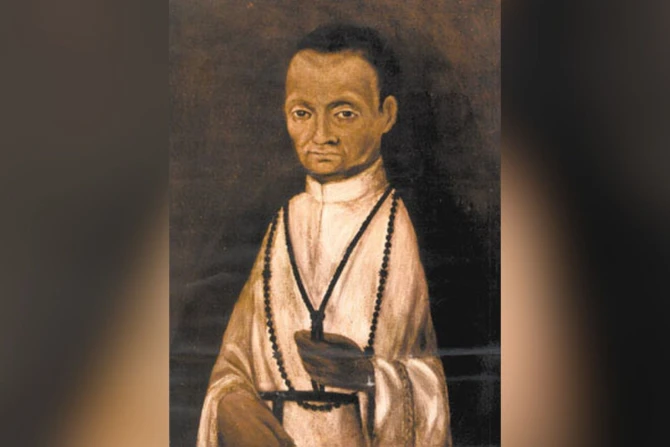
On Nov. 3, the Catholic Church celebrates the feast of St. Martin de Porres, a Peruvian Dominican brother who lived a life of humble service and charity and became the first Black saint of the Americas.
Here are seven fascinating facts about this inspiring saint:
1. His father refused to acknowledge him.
De Porres was born in Lima, Peru, in 1579. He was the son of a Spanish nobleman and former Panamanian Black slave. His father, Don Juan de Porres, refused to publicly acknowledge the boy as his own because Martin was Black, like his mother. Being biracial would prove challenging for Martin de Porres throughout his life.
2. He started practicing medicine before he was 13.
De Porres served as an apprentice to a doctor, and before the age of 13 he began to learn the practice of medicine. He would eventually become a barber, which at the time performed minor medical and surgical procedures like pulling teeth or emptying abscesses.
3. He faced discrimination as a Dominican.
De Porres entered the Dominican order in 1603. Becoming a Dominican brother proved to be challenging for de Porres because a Peruvian law at the time prevented people of mixed race from joining religious orders. Therefore, he lived with the community and did manual work, earning himself the nickname “the saint of the broom” for his diligence in cleaning the Dominicans’ quarters.
Eventually he was allowed to enter the order, despite the law, and worked in the infirmary tending to the sick and among the impoverished of Peru. “I cure them, but God heals them,” de Porres would say when curing the sick. He also had the task of begging for alms that the community would use to clothe and feed the poor. He also established an orphanage and planted an orchard from which those in need could freely take a day’s supply of fruit.
4. He levitated and bilocated.
De Porres was deeply prayerful, so much so that many of the brothers witnessed him levitating in intense prayer and embracing the crucified cross. De Porres reportedly also had the gift of bilocation, and some of his contemporaries said they encountered him in places as far off as Japan even as he remained in Lima. Some claimed he had appeared to them supernaturally behind locked doors or under otherwise impossible circumstances.
5. He refused to eat meat.
De Porres loved animals. He refused to eat meat and ran a veterinary hospital for sick animals that seemed to seek out his help. Portrayals of the saint often include cats, dogs, and even the rats to whom he showed compassion.
6. He is the patron saint of multiple manual labor occupations.
De Porres was known for the various assignments he carried out and which earned him the title of patron saint of barbers, the sick, and street cleaners. On the 50th anniversary of St. Martin de Porres’ canonization, Father Juan Anguerri, director of the St. Martin de Porres Home for the Poor, said: “These are often thankless tasks, but yet through his humble service, St. Martin sent a message to revitalize these jobs.”
7. He was canonized more than 300 years after his death.
Martin de Porres died on Nov. 3, 1639, at age 60. He was canonized by Pope John XXIII on May 16, 1962. At his canonization Mass, John XXIII called him “Martin of Charity.”
This CNA story was first published on Nov. 3, 2021, and has been updated.