As Milan prepares to welcome the world for the upcoming Winter Games, the Catholic Church is also opening its doors to athletes, visitors, and locals—offering a spiritual home in the heart of the city.
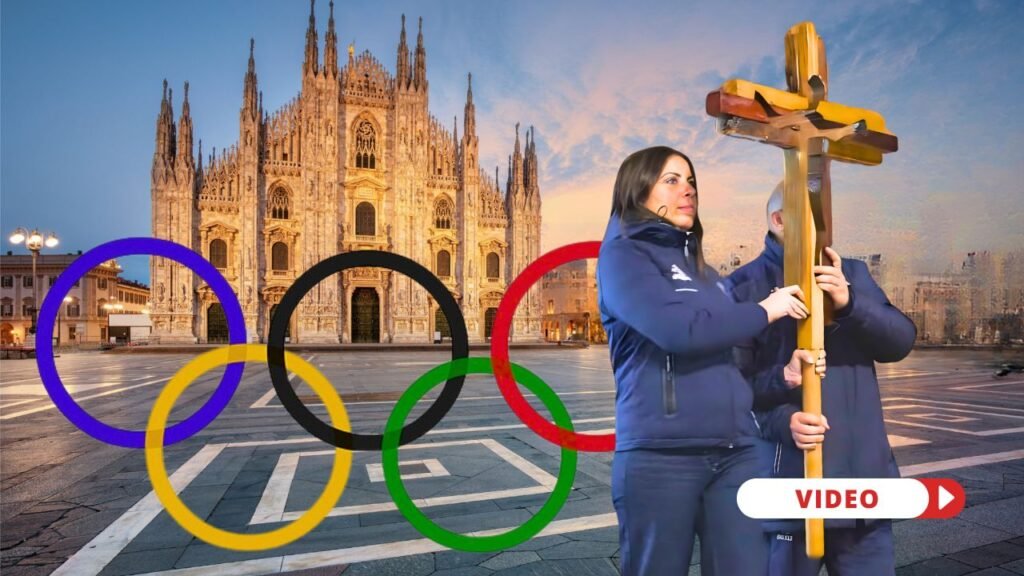
Since the London 2012 Games, the Olympic and Paralympic Cross has accompanied athletes at major international events. It has been present at World Youth Day and global sporting moments, including the 2014 FIFA World Cup, the Rio 2016 Olympics, World Youth Day 2023, and the Paris 2024 Olympics. Now, in 2026, the Vatican has sent the cross to Milan, where the Winter Games will take place.
Many were already anticipating its arrival. Teams of young local athletes accompanied the cross in procession as it entered the Basilica of San Babila, a historic church located in one of the most central and accessible parts of the city.
A Cross That Points Beyond Competition
The arrival of the cross highlights the Church’s desire to accompany the Olympics not only as a cultural and international event, but also as a moment to reflect on the deeper meaning of human striving, excellence, and unity.
Bishop Paul Tighe, Secretary of the Section of Culture of the Dicastery for Culture, explained that sport can reveal something essential about the human person and the spirit.
“We celebrate all the things that enhance human life and sport is one of those things. The eyes of the world are going to be focused on Milan Cortina, the spectacular, the mountains, the snow, the excellence of the art, but in the midst of all we want to celebrate the human spirit, which is expressed in so many ways, including in forms of faith. So what we are trying to do is to try and invite people during this time, when they are here for sport, to think about the things that give purpose and meaning in life.”
In the days leading up to the Games, tourists and athletes have already begun filling Milan’s streets. The Olympic Village has opened its doors to participants—and the local Church is doing the same.
San Babila Opens Its Doors to Athletes and Visitors
The Basilica of San Babila is becoming a spiritual point of reference during the Games, with chaplains available to accompany athletes and staff.
Father Stefano Guidi, Director of the Oratory and Sports Service at the basilica, emphasized that the Church wants to be close to those involved in the competitions, not only during moments of celebration, but also in the pressures of preparation and performance.
“There are chaplains specifically dedicated to accompanying and staying close to the athletes, as well as to all the staff involved in preparation, training, and the running of the competitions. We specifically chose the Basilica of San Babila, right in the heart of Milan, a place that is very easy to find and highly accessible, so that Olympic Village staff, athletes, tourists, and everyone visiting over these days can also have a place to pray.”
During Mass marking the arrival of the cross, Archbishop Mario Delpini of Milan announced that Pope Leo XIV had sent a message for the occasion. In it, the Holy Father expressed his hope that “healthy competition will contribute to building bridges between cultures and peoples and promote welcoming, solidarity and peace.”
Archbishop Delpini noted that the message reflects a long tradition of the Church’s engagement with sport and public life.
“Pope Leo has shown, with these few words, a great interest in this event. […] This demonstrates that the Holy See pays attention to the Milano Cortina Games, but more broadly, that there is a tradition of integrating ecclesial sensitivity with the practice of sport.”
A Symbol of Peace During the Olympic Truce
The Olympic and Paralympic Cross itself carries a symbolic message: it is made of wood from 15 countries, including China, Russia, Australia, the Holy Land, Brazil, and Argentina. In a world marked by division and conflict, the cross becomes a sign of unity—especially during the Olympic Truce, the ancient tradition calling nations to set aside hostilities during the Games.
Bishop Tighe reflected on the importance of that tradition today.
“The Olympic truce is an old idea that people were able to set aside all their differences for the sake of enabling their athletes to get to the games. And it’s an important celebration in a world that is marked by so much violence and so much hatred, to celebrate the importance of peace, something that Pope Leo has talked about from the beginning, the importance of peace.”
For the coming weeks, the Basilica of San Babila will remain open as a place of prayer and welcome for athletes and spectators alike—offering a reminder that sport, at its best, can become more than competition: it can become a bridge.
Adapted by Jacob Stein; Produced by Paola Arriaza Flynn; Camera by Anthony Johnson; Video edited by Gianluca Gangemi