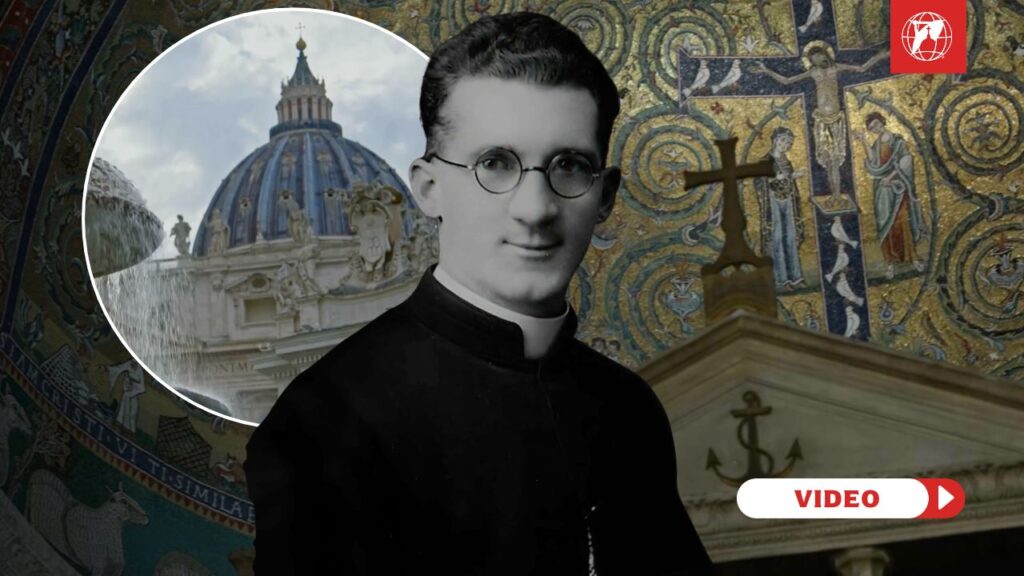
During the Nazi occupation of Rome in World War II, an Irish priest working inside the Vatican helped lead an underground rescue operation that saved an estimated 6,500 people from persecution. Monsignor Hugh O’Flaherty organized a network of safe houses across the city and within Vatican territory, sheltering Jews, prisoners of war, and others fleeing Nazi forces.
Known for his courage and determination, O’Flaherty became a target of the Gestapo as his rescue operation expanded. Yet even under the threat of arrest, he continued helping those in danger.
His story remains remembered in Rome and in his native Ireland, where his actions are honored as one of the most significant rescue efforts carried out from within the Vatican during the Second World War.
From County Cork to the Vatican
Coming from rural County Cork in Ireland, Hugh O’Flaherty rose quickly through the ranks of the Vatican. He served as an official at what was then known as the Sacred Congregation of the Doctrine of the Faith, where his work involved studying questions concerning Church doctrine and advising the Pope through his superiors.
“He had no fear. He was special. I mean, for him, everything was possible,” says Father Stefan Heid, a historian and archaeologist who has studied O’Flaherty’s life.
Father Enda Murphy, who works at the Dicastery for Divine Worship and the Discipline of the Sacraments, explains that O’Flaherty’s abilities were recognized early in his career.
“Well, it was obvious to seem that he had the talent and the gifts to do the job. He had been a good student at the urban college here, just up on the hill up there. And obviously he had been spotted as someone with talent and he was then invited, first of all, into the Vatican’s diplomatic service.”
After serving in several countries, O’Flaherty returned to Rome and eventually joined the Congregation for the Doctrine of the Faith.
An underground network inside and outside the Vatican
When Nazi forces occupied Rome in 1943, O’Flaherty could not stand by as innocent people were persecuted. He organized an underground network of safe houses throughout the city, including locations within the Vatican itself.
The operation was known simply as “Organization.”
Father Heid explains that O’Flaherty used his room in the Vatican’s Campo Santo area as a temporary hiding place. However, most of the people he helped were sheltered elsewhere in Rome.
“He had, of course, many friends, helpers and a team, a whole team which organized about 200 safe rooms, safe houses in the city, in various places,” Father Heid says.
The network provided places of refuge for those fleeing Nazi persecution, with O’Flaherty coordinating the efforts of people willing to risk their own safety to help others.
The Vatican’s unique position also offered a measure of protection. The border between Vatican City and German-occupied Rome became a crucial frontier: German authorities could not legally cross into Vatican territory.
A German college became the Irish priest’s home
In a remarkable irony, O’Flaherty lived at the Pontifical German College, even as he became one of the Nazis’ principal adversaries in Rome.
He had moved there in 1938, after his work at the Holy Office brought him close to the college.
“The German college was not only for German priests, that’s the first to say, and then he was here because for simple reasons it was easy for him. He was working beside in the Holy Office, and his chief said: ‘You can stay here,’” Father Heid explains.
The college was situated in a particularly sensitive location during the war, surrounded by German soldiers outside Vatican territory and Vatican security forces within its borders, including the Swiss Guard.
“And so it was here surrounded by police and military,” Father Heid says.
Despite the dangers, O’Flaherty continued his rescue work, relying on a wide network of friends and collaborators to shelter those in need.
The Irish Dominicans remember a legacy of refuge
O’Flaherty’s story remains alive among the Irish community in Rome, particularly the Irish Dominicans at the Basilica of San Clemente. Their own history is closely connected to the experience of persecution and refuge.
The Irish Dominicans have been present at San Clemente since 1677. As Father Paul Lawlor, rector of the basilica, explains, the community originally came to Rome as refugees fleeing persecution in Ireland under Oliver Cromwell.
“The Irish Dominicans, we’ve been here since 1677. Of course, refugees from Ireland, you know, from the Cromwellian persecution in Ireland. And we came here and this became a college where students could come and study for the priesthood and go back to Ireland. So it’s interesting that we were here as sort of refugees. And then this place became a refuge for people during the Second World War.”
The Dominicans themselves played a role in sheltering and assisting people fleeing Nazi persecution during the war. Their connection to O’Flaherty’s story has endured through generations.
“When I came here first, way back in the 1970s, there were many people around Rome, priests and bishops, who remembered him,” Father Lawlor recalls. “And they were all fascinated by this figure, you know, who would live such a brave and did such courageous action and helping people, all who were in difficulty, not just during the war, but even after the war.”
Father Lawlor describes O’Flaherty as “an extraordinary person,” whose bravery and concern for those in danger left a lasting impression on the Church in Rome.
Today, Monsignor Hugh O’Flaherty is remembered in both Rome and Ireland for an underground operation that helped save an estimated 6,500 people during the Second World War. His story stands as a testament to the courage of those who risked their lives to protect others.
Adapted by Jacob Stein. Produced by Bénédicte Cedergren; Camera by Patrick Leonard.