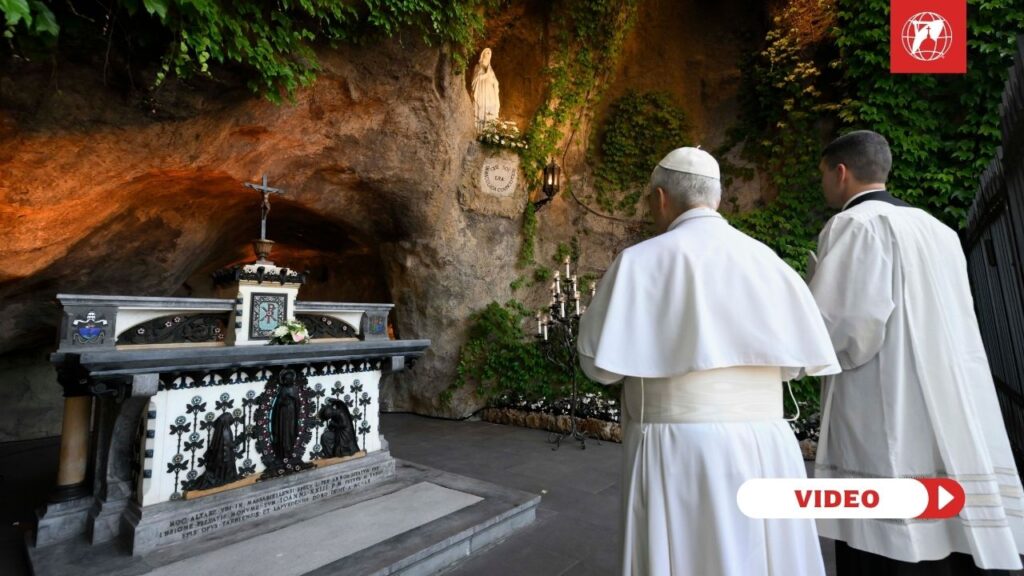
VATICAN CITY — Hidden among the flowers, trees and winding paths of the Vatican Gardens is a little piece of Lourdes.
Around 30 images of the Blessed Virgin Mary can be found throughout the gardens, representing devotions from across the Catholic world — from Our Lady of Guadalupe and Our Lady of Fatima to lesser-known Marian titles.
Perhaps the most famous, however, is the Vatican’s replica of the Grotto of Lourdes.
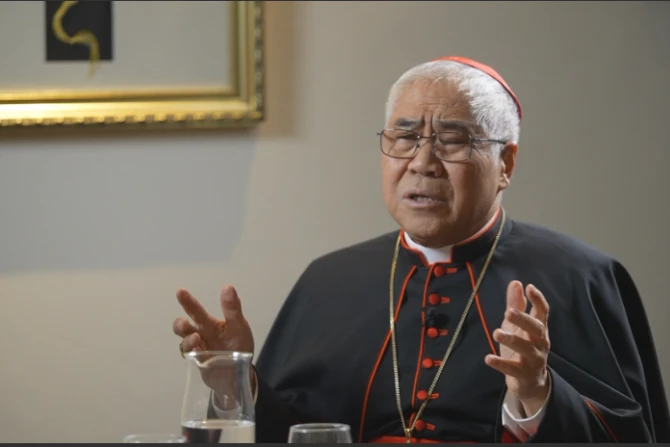
“Everybody is amazed when we say we have the Lourdes Grotto in the Vatican,” Sister Emanuela Edwards of the Sisters of Divine Revelation told EWTN. “And they all say, well, how did it arrive?”
The answer begins with Pope Leo XIII.
Bringing Lourdes to the Pope
Between Feb. 11 and July 16, 1858, the Virgin Mary appeared to Bernadette Soubirous at the Grotto of Massabielle near Lourdes in southern France.
Bernadette described the Lady as dressed in white with a blue sash, yellow roses at her feet and a rosary on her arm.
In the decades that followed, Lourdes became one of the world’s most important Marian pilgrimage destinations, drawing pilgrims seeking healing and entrusting their illnesses and suffering to the intercession of the Blessed Virgin Mary.
Pope Leo XIII had a particular devotion to Mary and to Lourdes. But the political circumstances surrounding the “Roman Question” meant that he did not leave the Vatican during his pontificate.
“So he couldn’t visit Lourdes,” Edwards explained.
Instead, Lourdes came to him.
According to Edwards, the Bishop of Tarbes had the grotto created as a gift for the Pope, allowing Leo XIII to pray before a replica of the famous Marian shrine without leaving the Vatican.
The grotto subsequently became an important place of papal prayer and Marian devotion.
A place of prayer for generations of popes
Leo XIII was far from the last pope to develop a connection with Lourdes.
Pope Pius XI beatified Bernadette Soubirous in 1925 and canonized her in 1933. Decades later, Pope Benedict XVI would walk through the Vatican Gardens to the grotto to pray before the image of the Immaculate Conception.
“The Holy Fathers are all devoted to this particular place, and the Grotto has a special place in their hearts,” Edwards said.
Traditionally, a procession through the Vatican at the end of May concludes at the grotto with the recitation of the Rosary.
Pope Leo XIV has continued that tradition of papal prayer.
At the conclusion of the Marian month, the Pope presided over the Rosary at the grotto, dedicating each decade to people suffering because of war and violence.
“The Virgin Mary is the model of the believer who inclines the ear of the heart to listen to ‘what God says,’” Pope Leo said.
“Contemplating the mysteries of the Rosary with Mary leads us to recognize in Jesus Christ the one final Word spoken by the Father, a Word of peace for all who return to him with contrite hearts.”
The gardeners behind the grotto
Maintaining the Vatican’s “Little Lourdes” requires work that is rarely seen by visitors.
Vatican gardeners continually care for its flowers and vegetation, ensuring the historic Marian shrine is ready for prayer and papal visits.
Stefano Giampaolo, a forestry expert with the Governorate of Vatican City State, described caring for the gardens as a privilege.
“I have never had the pleasure of seeing the Holy Father in prayer,” he said, “but I must say that I feel privileged to work here, in this setting, and to care for these gardens.”
The work has become more challenging in recent years, particularly during Rome’s hot summers.
“The care is constant,” Giampaolo explained. “In recent years, it has become increasingly difficult to maintain the floral arrangements, especially because of the very, very high temperatures during the summer season.”
The gardeners inspect the flowers frequently, often beginning early in the morning, and replace plants when necessary.
The Lourdes Grotto requires particular attention because it contains one of the gardens’ most elaborate floral displays.
A six-decade rosary
Flowers, however, are only one of the grotto’s remarkable details.
Below the statue of the Virgin Mary appears the message Our Lady gave to Bernadette identifying herself as the Immaculate Conception, written in the local Gascon Occitan dialect.
Looking more closely at the statue reveals another unusual feature.
Mary is holding a rosary with six decades rather than the five Catholics would ordinarily expect.
“If you look at Our Lady, you can see that her rosary is particular, it’s almost unique,” Edwards said.
She explained that in the area where the apparitions occurred, Catholics had a tradition of praying an additional decade for the souls of the faithful departed.
When Mary appeared, Edwards said, “she wanted to appear in a way that was recognizable to the people of that place.”
A direct connection to Lourdes
Perhaps the Vatican grotto’s most remarkable treasure stands at its center.
The altar has a direct historical connection with the original shrine in France.
“This is the altar that was actually present at the time of the apparition,” Edwards explained, pointing to a Latin inscription recording its history.
The altar was later presented to Pope John XXIII.
“And so in that way,” Edwards said, “we have something that connects us to the actual time of the apparition here in the heart of the Vatican.”
More than a century after the Vatican grotto was created for Pope Leo XIII, it remains a place where the history of Lourdes, the Marian devotion of the popes and the daily work of the Vatican Gardens come together.
Hidden within the world’s smallest state is, in a sense, a little piece of Lourdes — a place where generations of popes have turned to the Blessed Virgin Mary in prayer.
Adapted by Jacob Stein. Produced by Bénédicte Cedergren; Camera by Alberto Basile; Video Edited by Giada D’Ottavi.