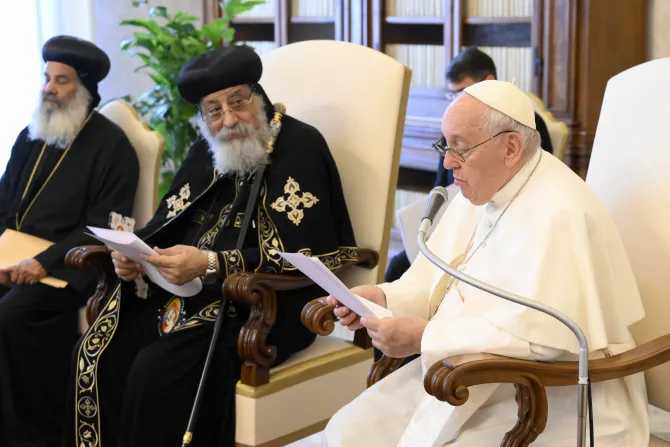
The Synod on Synodality at the Vatican will see another premiere this week, as the gathering switches from group work in small circles to a plenary assembly — one of the official “Congregationes Generales.” Journalists will finally, for a time, be able to tune into actual speeches and proceedings in the audience hall.
One important speech is the statement of Cardinal Jean-Claude Hollerich in his role as relator general, given at the end of the discussion of every section of the document.
The next report — called “presentation” in the synod’s schedule — is expected on Oct. 13, and another one will take place on Oct. 18. It is likely these will be livestreamed, too.
This week unfolds with new speeches but also themes of potential external influences, the quest for synodal communion, and the whispers of reform resonating through the Vatican halls.
Agendas at play?
Concerns linger about the potential for pressure groups to sway the synod’s course. It’s hardly coincidental that last Friday, Cardinal Fridolin Ambongo Besungu, the archbishop of Kinshasa, claimed at a press briefing that no one would bring their personal agendas let alone try to impose them upon others. “There is no agenda; we are all brothers and sisters,” the African prelate reiterated.
The Congolese cardinal also said the process’ outcome would be “welcomed by everyone as the will of God.”
Any mention of seeking communion at the synod is hardly surprising: It’s a common refrain in many a sideline conversation, evoking a semblance of déjà vu — or a return to the past.
Before 2014, the term “synodal consensus” was the order of the day, with documents subjected to a paragraph-by-paragraph vote. The absence of a two-thirds majority vote led to withholding the publication of documents, a practice aimed at fostering communion over division.
In a bid for apparent transparency, Pope Francis previously has consistently disclosed all forms of final documents and the vote tally. This synod, however, will take a different route.
Instead of a final document, a summary document will take the stage, its approval hinging more on the general recounting of the synod’s experience rather than particular chapters.
Come October 2024, the assembly’s endorsement of the final text could potentially upend the summary document.
What is at stake this week
Much anticipation surrounds what is happening on Monday afternoon, as the synod commission designated for drafting the summary document will cast votes. These results — revealing the names of commission members — could provide a sneak peek into the document’s formulation or, at the very least, hint at the overall tone of the papers and, therefore, the whole synod.
As per the official calendar, two key points from the Instrumentum Laboris, the working document, are slated for discussion this week:
Section B1: “How can we be more fully a sign and instrument of union with God and unity of the human race?”
Section B2: “Co-responsible for the mission” with a central inquiry: “How to share tasks and gifts in the service of the Gospel?”
The small working groups — “circoli minori” — are set to present their interventions on Oct. 11 followed by finalizing and submitting their reports to the General Secretariat on Oct. 12.
The process culminates in a free afternoon earmarked for a pilgrimage, presumably to the Roman catacombs. From Oct. 13 onward, section B2 of the Instrumentum Laboris will undergo scrutiny.
Two afternoons this week are allocated for the “conversation of the Spirit,” described as a time of common discernment for the synod. Outlined in sections 37 to 39 of the Instrumentum Laboris, this process encompasses three phases: profound deliberation before speaking in the assembly, a spell of silence and prayer to resonate with others’ requests, and a session to pinpoint key issues and forge a common consensus.
The “conversations of the spirit” aim to craft a document that embodies consensus and communal spirit. Whether this objective will be met is yet to be seen. The fact that Cardinal Hollerich has already hinted at a road map for the ensuing year implies a cautious dip into the waters for now.
Come next year, these “conversations” might hone in on specific topics with a sharper focus, although that remains speculative terrain.
A reform agenda beyond the synod?
At the synod’s inception, the emphasis on confidentiality — expressed by Pope Francis, Cardinal Mario Grech, and Hollerich — showed concern over media-driven agendas. However, there are apparent attempts underway this week by certain interest groups to drive their respective agenda, hoping to change the very essence of the Catholic Church.
Self-appointed reformers are spearheading a conference called Spirit Unbounded, scheduled for Oct. 8-14 and accessible online. Two documents framing this event are the “Bristol Text” and a proposal for a constitution for the Catholic Church.
Exploring the Bristol text unveils a clear agenda: The document portrays the Church as a “secular” entity, clamoring for “democratic structures at all levels,” advocating for canon law to align with the Universal Declaration of Human Rights and urging a revamp of the liturgical ministry.
Similarly, the proposal for a constitution for the Catholic Church echoes a secular tone as it delineates a human-authored constitution. However, it reaffirms the Gospel as the prime reference for every Christian.
The push for a democratized Church is familiar to observers of the German Synodal Way and other initiatives.
The program also lists theologian Rafael Luciani, who is among the experts/facilitators of the synod. Luciani has repeatedly underscored his view that Church structures need a synodal overhaul.
The program features controversial liberation theologian Leonardo Boff and former Irish President Mary McAleese. She has used strong language to criticize the Catholic Church, using expressions like “channels of homophobia” and claiming that baptizing babies infringes on human rights.
Another speaker is Cherie Blair, spouse of former British Prime Minister Tony Blair. Her topic is Catholic attitudes and teachings about women.
Both inside and outside the synod hall, the question on many people’s minds this week will be: Does this conference running parallel to the synod signify a mobilization of pressure groups, or is it an endeavor to sway media discourse devoid of hopes to alter the synod’s trajectory?
This article was originally published on Catholic News Agency.