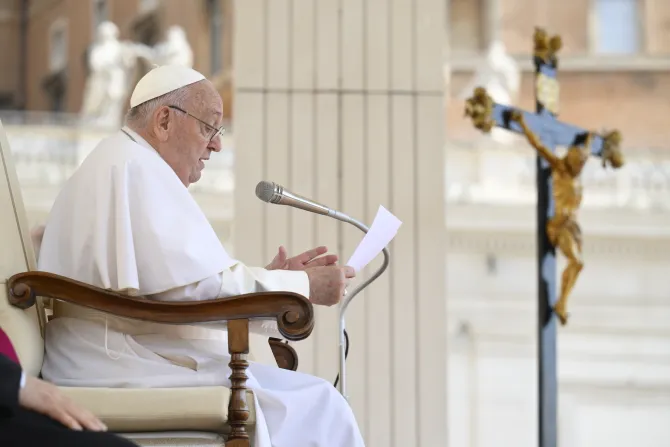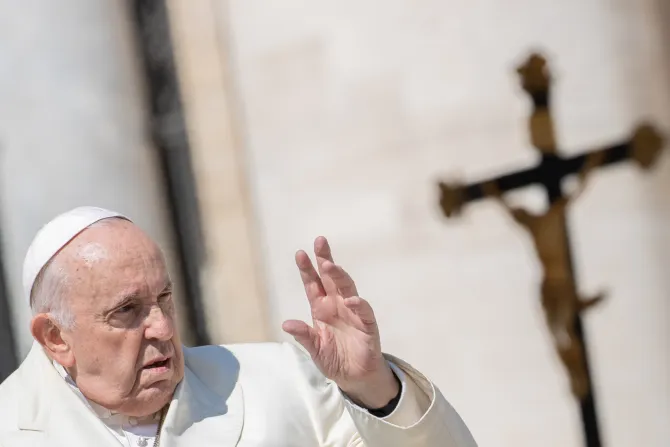
Pope Francis has expressed deep reservations about the direction of the Catholic Church in Germany, warning that concrete steps currently being taken “threaten” to undermine unity with the universal Church.
The pope made his criticisms in a letter to four German Catholic laywomen that was published in the German newspaper Welt on Nov. 21.
“There are indeed numerous steps being taken by significant segments of this local Church that threaten to steer it increasingly away from the universal Church’s common path,” the pope wrote.
The letter, dated Nov. 10, was written in German and included the pope’s handwritten signature.
Chief among the pope’s concerns is a push to set up a permanent “Synodal Council,” a mixed body of laity and bishops that would govern the Catholic Church in Germany. Establishing this council is a top priority for the German Synodal Way, a controversial initiative that has demanded significant changes in Church structure and teaching.
In his letter, the pope underscored that this kind of “consultative and decision-making body” as currently proposed “is not in alignment with the sacramental structure of the Catholic Church.” He referenced a Jan. 16 letter from high-ranking Vatican officials to German bishops, which he specifically authorized, that explicitly prohibited the establishment of the Synodal Council.
A committee of Synodal Way leadership recently met on Nov. 10-11 in Essen to lay the groundwork for the Synodal Council, which they aim to establish no later than 2026.
Four German bishops voted in June to block funding for the preparatory committee, and a total of eight out of 27 German ordinaries were absent from the Nov. 10-11 meeting.
In his recent letter, Pope Francis proposed a different path forward for the Church in Germany.
Instead of seeking “salvation” in “constantly evolving committees” or “self-absorbed dialogues rehashing the same themes,” the pope underscored the need for the Catholic Church in Germany to be rooted in “prayer, penance, and adoration.”
He also called upon German Catholics to “engage with our brothers and sisters” on the margins, especially the sick, imprisoned, and those “at the thresholds of our church doors.”
“I firmly believe that in these places, the Lord will guide us,” Pope Francis wrote.
The letter was addressed to the theologians Katharina Westerhorstmann and Marianne Schlosser, journalist Dorothea Schmidt, and the religious philosopher Hanna-Barbara Gerl-Falkovitz. The four German laywomen had previously been delegates to the Synodal Way but resigned in February in protest. They wrote to the pope on Nov. 6 expressing their concerns about the direction of the Catholic Church in Germany.
In his response, the pope urged the four women to pray for him and “for our common cause of unity.”
The German theologian Martin Brüske described the pope’s letter as a clear and forceful signal to halt the work of the synodal committee.
“The flagship of Peter has given the German Church a broadside across the bow,” said Brüske in a statement provided by New Beginning, a group of German Catholics critical of the Synodal Way. “Those who do not want to hear and see this will bear full responsibility if they ultimately disappear into the maelstrom of division.”
Leadership of the German Synodal Way has recently framed their push to establish the Synodal Council as consistent with Pope Francis’ emphasis on increased synodality in the Catholic Church, including the recent Synod on Synodality assembly at the Vatican.
In an Oct. 29 statement, Thomas Söding, vice president of the Central Committee of German Catholics (ZdK), described the Vatican assembly as “a confirmation of the Synodal [Way] in Germany.” He added that German plans to establish a permanent Synodal Council were consistent with the October synod report’s call for greater decentralization.
The German Synodal Way, a joint effort of the German Bishops Conference and the ZdK, was launched in 2019. The noncanonical process concluded its initial stage in March, passing resolutions to not only move forward with establishing a Synodal Council but also to bless same-sex unions and push for women’s ordination at the level of the universal Church.
The pope’s letter to the four laywomen was not the first time he has commented on the Synodal Way. In January, he criticized the process as “elitist” and “neither helpful nor serious.” Before the start of the Synodal Way, he wrote a June 2019 letter to “the Pilgrim People of Germany,” calling for a focus on evangelization in the face of “growing erosion and deterioration of faith.”
This story was originally posted on CNA.