The Vatican released the Synod on Synodality’s “synthesis report” on Saturday night outlining key proposals discussed during the nearly monthlong assembly’s confidential conversations.
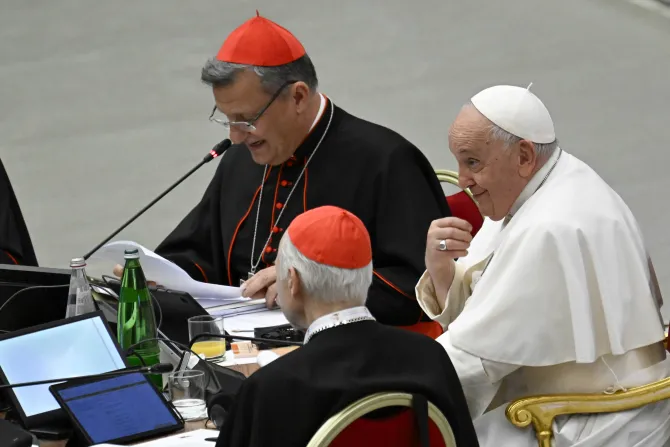
The highly anticipated text was approved paragraph by paragraph on Oct. 28 by a vote of 344 synod delegates, which for the first time included women and other non-bishops as voting members.
The document, the synthesis of the assembly’s work from Oct. 4–29, proposes a “synodal Church” that implements synodality throughout Church governance, theology, mission, and discernment of doctrine and pastoral issues.
The 42-page text, released by the Vatican in Italian, covers 20 topics from “the dignity of women” to “the bishop of Rome in the College of Bishops.” For each topic, “convergences,” “matters for consideration,” and “proposals” are outlined.
More than 80 proposals were approved in the synod vote, including establishing a new “baptismal ministry of listening and accompaniment,” initiating discernment processes regarding the decentralization of the Church, and strengthening the Council of Cardinals into a “synodal council at the service of the Petrine ministry.”
Other proposals include giving lectors a preaching ministry “in appropriate contexts,” implementing structures and processes to increase the accountability of bishops in matters of economic administration, supporting “digital missionaries,” and promoting “initiatives that enable shared discernment of controversial, doctrinal, pastoral, and ethical issues in the light of the word of God, Church teaching, theological reflection, and valuing synodal experience.”
The document also encourages churches to experiment with “conversation in the spirit”— the listening-and-reflection method the synod’s delegates have used in their deliberations this month — and forms of discernment in the life of the Church. It calls for the implementation of “the exercise of synodality at regional, national, and continental levels.”
Absent from the summary report are definitive conclusions on same-sex blessings, women’s ordination, and a handful of other hot-button topics that have drawn the lion’s share of media attention during this year’s assembly.
Throughout the document, areas of disagreement among the synod participants are listed as “matters of consideration.” Among them are women’s access to diaconal ministry, priestly celibacy, “Eucharistic hospitality” for interfaith couples, and assigning the handling of abuse cases to another body instead of the bishops.
Written by “experts” invited to attend the synod and overseen by a commission of 13 synod delegates, the text says it aims to be “a tool at the service of ongoing discernment.” It is divided into three main sections on the elements of a synodal Church, participation in mission, and processes that enable dialogue with the world.
Vatican spokesman Paolo Ruffini said that more than 1,000 amendments were submitted by synod delegates to the original draft of the report after it was presented to the assembly on Wednesday.
Voting on the text took place on Saturday night with each paragraph requiring the approval of two-thirds of the members present for inclusion in the final report.
Every paragraph was approved in the voting process. A paragraph describing “uncertainties surrounding the theology of the diaconal ministry” and calling for more reflection on women’s access to the diaconate received the most negative votes.
“Rather than saying that the Church has a mission, we affirm that the Church is mission,” the document says.
“The exercise of co-responsibility is essential for synodality and is necessary at all levels of the Church,” it adds.
The text is the culmination of days of discussion by 365 synod delegates during the 16th Ordinary General Assembly of the Synod of Bishops after years of consultation at local, national, and regional levels since the global synod process was launched in 2021. It lays the foundation for the second Synod on Synodality assembly that will take place in October 2024.
The 2023 synod assembly will come to its formal conclusion on Oct. 29 when Pope Francis offers the closing Mass in St. Peter’s Basilica.
This article was originally published on Catholic News Agency.