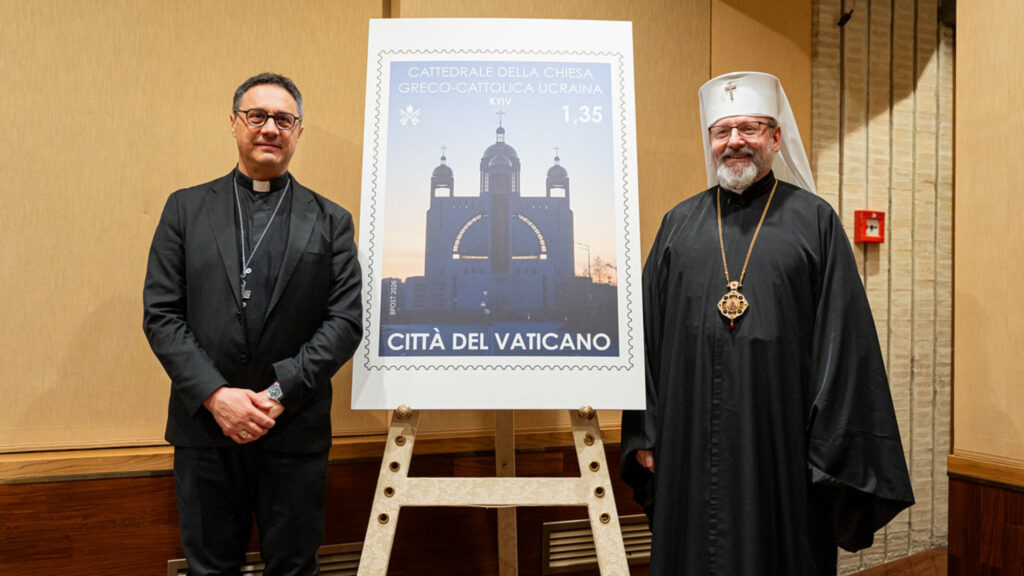
The stamp features the Ukrainian Greek Catholic Cathedral of the Resurrection of Christ in Kyiv.
A new Vatican stamp issue honoring Ukrainian Catholics marks three major milestones for the Catholic Church in Ukraine, even as the country continues to endure the ongoing war.
The stamp features the Ukrainian Greek Catholic Cathedral of the Resurrection of Christ in Kyiv, depicted rising amid the darkness of blackouts caused by Russian bombardments — an image meant to reflect the harsh reality Ukrainians have faced since 2022.
According to the Vatican City State’s Office of Postal and Philately, the special issue commemorates three events “of great spiritual relevance” for Ukraine: the 30th anniversary of the restoration of the Catholic Diocese of Kyiv after the fall of the Soviet Union; the 20th anniversary of the return of the seat of the father and head of the Ukrainian Greek Catholic Church to Kyiv; and the 12th anniversary of the cathedral’s construction.
The first stamps were issued Thursday, Feb. 26, and presented at an event at the Vatican Museums attended by Archbishop Emilio Nappa, secretary-general of the Governorate of Vatican City State, and Major Archbishop Sviatoslav Shevchuk, father and head of the Ukrainian Greek Catholic Church. Representatives of 20 diplomatic missions accredited to the Holy See also attended, along with clergy and members of ecclesial and civil organizations.
Shevchuk said the stamp recalls “the history of martyrdom of the Ukrainian Greek Catholic Church,” which survived persecution and was later reborn, according to a statement from his archbishopric’s secretariat.
Father Felice Bruno, head of the Vatican’s postal and philately service, said the issue is meant to “express closeness and affection” toward a Church that “for centuries has suffered persecutions and trials” and that in the last four years has endured “the very grave consequences of a cruel and dehumanizing war.”
Calling the presentation “a great moment of consolation” for his Church, Shevchuk said: “We feel truly embraced by the Holy See with this particular attention to our history and to our life in this tragic moment of war.”
“It is divine providence that this event takes place in the context of the painful remembrance of the fourth year since the beginning of the full-scale war in Ukraine,” he said.
Reflecting on the Church’s revival after Ukraine’s independence and its return to Kyiv, Shevchuk noted that the Ukrainian Greek Catholic Church “did not recover any of its old temples but built a new patriarchal cathedral,” which since its consecration on Aug. 18, 2013, has become “a home and refuge for thousands of people,” both during the Revolution of Dignity and throughout the war.
He also pointed to the stamp’s contrast of darkness and evening sky as a sign of hope: “The cathedral dedicated to the Resurrection carries within itself the light that never goes out, the light of the risen Christ.”
“We in Ukraine have hope precisely because we believe in the Resurrection,” Shevchuk said. “That is the message our cathedral — and also this stamp presented today — must convey to a humanity torn by so many conflicts and wars.”
Nappa said the stamp issue is “a sign of recognition for the bond that unites us in faith in God and in sharing the universal human values of peace and fraternity.” He added that the cathedral depicted on the stamp is a symbol of strength and hope, a sign of the light of Christian faith “that never goes out.”
After the remarks, Shevchuk and Nappa unveiled the stamp and carried out its first-day cancellation. Organizers noted it is the first joint philatelic initiative between the Vatican City Governorate and the secretariat of the head of the Ukrainian Greek Catholic Church in Rome.
This story was first published by ACI Prensa, the Spanish-language sister service of EWTN News, and has been translated and adapted by EWTN News English.