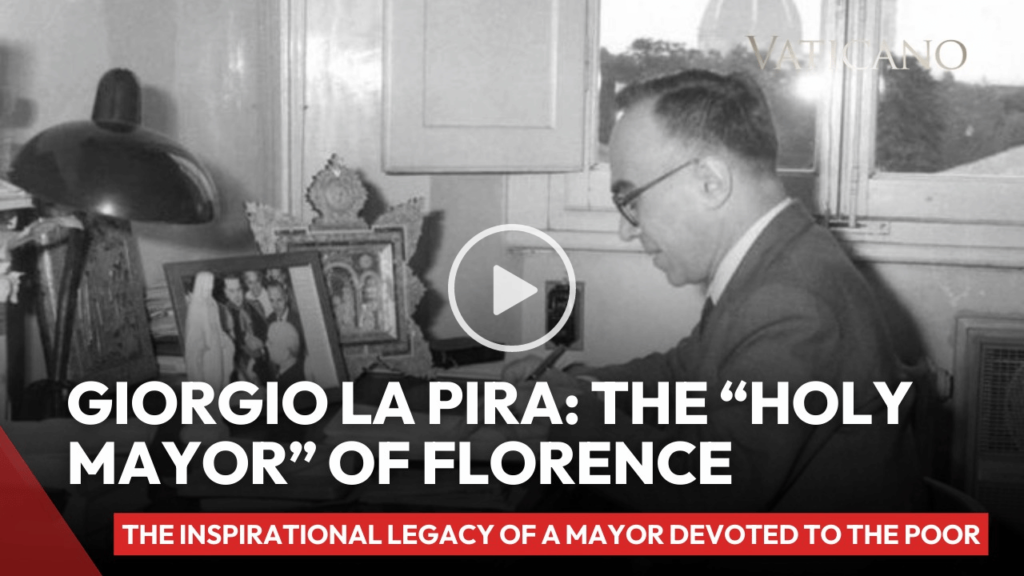
Florence, Italy – Giorgio La Pira, the esteemed mayor of Florence during two consecutive terms between 1951 and 1965, is fondly remembered as the “Holy Mayor” for his profound impact on the city. Born, in 1904, in the humble town of Pozzallo, Sicily, La Pira is hailed as a leading advocate of “social Catholicism,” leaving behind an enduring legacy of compassion, spirituality, and commitment to the impoverished.
His Eminence Cardinal Giuseppe Betori, Metropolitan Archbishop of Florence, reflects on the essence of Giorgio La Pira’s mission, emphasizing that he believed a “good society” could only thrive if it were firmly rooted in spirituality. La Pira’s early conferences, aptly named “conferences for Christian civilization,” underscored his conviction that true justice could be inspired solely by the Christian spirit. At a time when materialism, both historical and practical, dominated the world, La Pira strove to reignite religious fervor.
Born into a modest Sicilian family, La Pira embarked on his university studies in law in Messina before moving to the University of Florence, where he graduated in Roman Law in 1926. Eight years later, he achieved the esteemed position of chair of “Institutions of Roman Law” at the same university.
Concurrently, La Pira deepened his faith, joining the San Marco convent in Florence as a Dominican tertiary. Here, he initiated the “Mass of the Poor,” a Eucharistic celebration dedicated to impoverished individuals. Following each service, he engaged with the destitute, addressing global issues and simplifying the concerns of political leaders to include the poor in these critical dialogues.
Cardinal Betori highlights that, “At the end of Mass, he would talk with the poor about the problems of the world. He would talk with the poor he had gathered around him, and he would bring down to earth in a simplified dimension the problems political statesmen deal with, such as global peace, and he included the poor in that dialogue, because these are problems that concern everyone.”
In 1939, La Pira distanced himself from the fascist regime, establishing the anti-fascist magazine “Principles.” The publication aimed to defend human dignity and freedom of expression, but it was soon suppressed by the totalitarian government. Threatened by authorities, La Pira went into hiding, leaving his beloved city.
After World War II concluded, La Pira returned to Florence in 1946 and was elected a deputy to the Constituent Assembly. He was entrusted with formulating the fundamental principles of the Constitution of the Italian Republic. As Cardinal Betori points out, “This doctrinal preparation of his can be seen in his service to society as a ‘Constituent Father.’ He made a decisive contribution, visible in the first 15 articles of the Constitution, which precisely address the fundamental rights of human dignity.”
In 1952, La Pira organized the First International Conference for Peace and Christian Civilization, fostering deep connections among political leaders from across the globe. His commitment to global peace reached its zenith in 1955 when mayors from world capitals convened at Palazzo Vecchio in Florence, signing a pact of friendship and peace.
Throughout his life, La Pira exhibited unwavering devotion to the poorest of the poor, earning the endearing title of “father of the family” in Florence. His strong religious dimension profoundly shaped his relationships with others, underscoring the significance of compassion, love, and solidarity.
Giorgio La Pira passed away in Florence on November 5, 1977, yet his legacy lives on. In 2018, Pope Francis declared him venerable, marking the culmination of the second phase of his beatification process, which commenced in 1986.
Edited by Jacob Stein