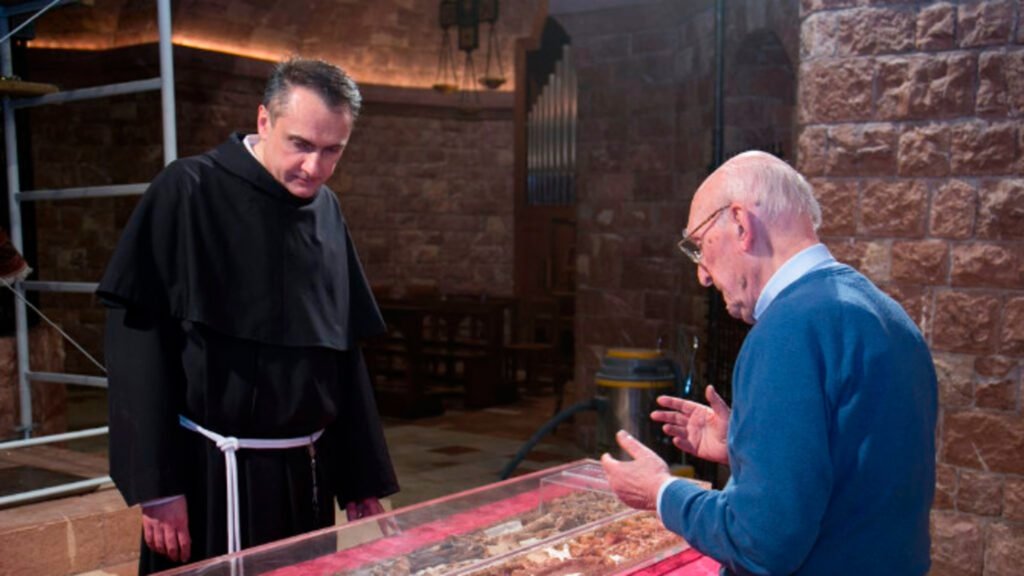
This will be the first public display of the beloved saint’s bodily remains.
About 350,000 people have registered to venerate the relics of St. Francis of Assisi — the first public display of the bodily remains of the beloved saint.
From Feb. 22 to March 22, the Lower Basilica of St. Francis in Assisi will welcome pilgrims from around the world who will come to the Italian city to pray before the body of the man whom ecclesial tradition has described as “the living mirror of the Gospel.”
The event marks a moment of great historical and spiritual importance on the 800th anniversary of the saint’s death: For the first time, his body will be transferred from its resting place in an underground chapel and placed in front of the papal altar in the Lower Basilica. In this way, the church will hold a “revealed treasure” for one month, granting pilgrims time for veneration and prayer.
Pope Leo XIV has proclaimed a special jubilee year for St. Francis of Assisi on the occasion of the 800th anniversary of his death. The year will extend until Jan. 10, 2027, during which the faithful may obtain a plenary indulgence.
A body hidden for centuries
After his death in 1226, St. Francis was buried beneath the main altar of the Lower Basilica in a location that was difficult to access in order to prevent any attempts to steal his remains. His body remained hidden there for centuries until it was discovered on the night of Dec. 12–13, 1818. Following an official examination of the tomb in 1819, the identity of the remains of the Poor Man of Assisi was confirmed.
In the 20th and 21st centuries, the tomb was opened twice: first in 1978 and then in 2015. Each time, the conviction was renewed that the saint’s body is a powerful sign of the love that moved him. It was shown to be the body of a man worn down by illness and by the wounds of Christ that he bore during the last two years of his life, pointing to his living of the Gospel until the very end.

St. Francis of Assisi’s remains after his tomb was opened in 2015. | Credit: Photo courtesy of the Sacred Convent of Assisi
Events accompanying the display of the remains
Before the public display of the saint’s body to the faithful, vespers will be celebrated on Saturday, Feb. 21, at 4 p.m. local time, reserved exclusively for Franciscan friars. The mortal remains will then be transferred in procession from the chapel that houses it to the Lower Basilica.
The event will also be accompanied by the publication of a special issue of the magazine “San Francesco Patrono d’Italia,” produced by the Sacred Convent of Assisi. The 160-page issue is entirely dedicated to the saint and includes contributions from the most prominent contemporary Franciscan scholars.
A Franciscan jubilee year
This special jubilee year dedicated to St. Francis is considered a unique spiritual gift for the entire Church. The Vatican’s Apostolic Penitentiary explained that the Holy Father is opening the way during this year to obtain the indulgence under the usual conditions.
Faithful throughout the world may obtain the indulgence by visiting any Franciscan church — or any place of worship anywhere in the world dedicated to St. Francis or connected with him for any reason — and by fulfilling the required conditions for obtaining the indulgence: receiving the sacraments of reconciliation and holy Communion, and praying for the intentions of the Holy Father.
A plenary indulgence, according to the teaching of the Catholic Church, is God’s remission of the temporal punishment that follows forgiven sins. The Church is able to remit these consequences of sin, since God has made her steward of the fruits of redemption.
This article was originally published by EWTN News English.