It’s easy to conceptualize the presentation of the Lord because we find it in Scripture. Luke’s Gospel tells of the Holy Family’s journey to the Temple when Jesus was 8 days old. According to Jewish custom, Jesus was to be circumcised and Mary purified.
There Mary and Joseph meet the prophets Anna and Simeon, who recognized the child as the Messiah who would bring about the fall and rise of many and become a sign of contradiction and the cause of a sword that would one day pierce Mary’s heart. We celebrate the feast of the Presentation of the Lord annually on Feb. 2.
The presentation of Mary, however, is not found in Scripture. Instead, we learn about Mary’s presentation from accounts that have come to us from apostolic times. What we know is found mainly in Chapter 7 of the “Protoevangelium of James,” which has been dated by historians before the year A.D. 200.
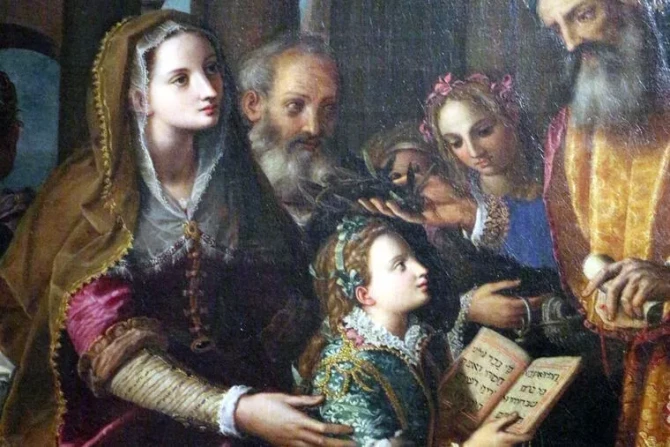
The “Protoevangelium of James” was ostensibly written by the apostle of the same name. It gives a detailed account in which Mary’s father, Joachim, tells his wife, Anna, that he wishes to bring their daughter to the Temple and consecrate her to God. Anna responds that they should wait until Mary is 3 years old so that she will not need her parents as much.
On the agreed day for Mary to be taken to the Temple, Hebrew virgins accompanied the family with burning lamps. The Temple priest received Mary, kissed her, and blessed her. According to James’ writing, the priest then proclaimed: “The Lord has magnified thy name in all generations. In thee, the Lord will manifest his redemption to the sons of Israel.”
After that, Mary was placed on the third step of the Temple and danced with joy. All the House of Israel loved Mary, and she was nurtured from then on in the Temple while her parents returned to their Nazareth home, glorifying God.
The celebration of the feast of the Presentation of the Blessed Virgin Mary grew slowly over the years.
On Nov. 21, 543, Emperor Justinian dedicated a church to Mary in the Temple area of Jerusalem. Many of the early Church Fathers celebrated this feast day, such as St. Germanus and St. John Damascene. In 1373, it was formally celebrated in Avignon, France, and in 1472, Pope Sixtus IV extended it to the universal Church. The Byzantine Church considers Mary’s Presentation one of the 12 great feasts of the liturgical year.
In 1974, Pope Paul VI wrote about this feast in his encyclical Marialis Cultus, saying: “Despite its apocryphal content, it presents lofty and exemplary values and carries on the venerable traditions having their origins in the Eastern Churches.”
The memorial of the Presentation of Mary has been noted in the Church since its early years and yet is easily forgotten or misunderstood.
Since it’s classified as a memorial and not a solemnity or holy day of obligation, it doesn’t draw much attention to itself other than a special opening prayer in the Mass. With this memorial, we celebrate the fact that God chose to dwell in Mary in a unique way. In response, she placed her whole self at his service. By our baptism, God invites us, too, into his service.
But there’s more to celebrating the presentation of Mary.
This feast gives us cause for great joy since Mary is truly our mother, given to us by Christ as he hung dying on the cross. Because we are part of her Son’s body, she loves us with as much devotion and tenderness as she loves Jesus. When we celebrate Mary’s presentation, we are giving Mary the honor she deserves and witnessing to her perfect purity as the virgin of Nazareth, the mother of God, and our mother.
Sts. Joachim and Anne surrendered their only daughter to God so that she would be completely free to follow his holy will. Although they loved her dearly, they knew that in the Temple Mary would always be near the Holy of Holies, surrounded by an atmosphere of godliness and grace. She would be instructed in Scripture and the history of the Jewish people. She would be under the guardianship and tutelage of the holy women of the Temple who had given their lives to God. One of them, Scripture scholars believe, was Anna — the woman who prophesied at the presentation of Our Lord. In the Temple, Mary would be completely focused on God and well prepared for becoming the mother of the Savior and mother of the body of Christ.
When we celebrate the presentation of the Blessed Virgin Mary, we remember the tremendous sacrifice Sts. Joachim and Anne made for our sakes. We give honor and respect to the Virgin, who is an example for all of us in our struggle for holiness. It is a privilege and an opportunity to express our gratitude for the gift of a pure, tender, and always-loving mother.
This story was first published by the National Catholic Register, CNA’s sister news partner, on Nov. 21, 2023, and has been adapted and updated by CNA.