Each year on Feb. 11—the feast of Our Lady of Lourdes—the Church observes the World Day of the Sick. Established in 1992 by St. John Paul II, the day was created to raise awareness of illness, encourage prayer, and invite Catholics to unite their suffering with Christ for the good of the Church and the world.
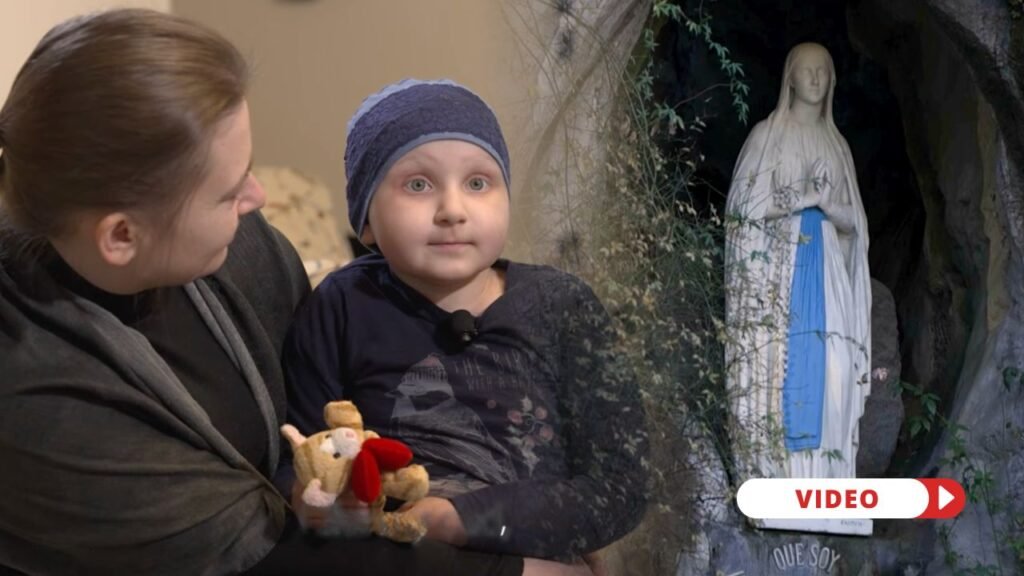
But for many families, sickness is not confined to one day on the calendar. For 10-year-old Marysia Szlązak, the past eight years have been defined by hospital stays, painful treatments, and repeated diagnoses that have reshaped her childhood and her family’s daily life.
A Diagnosis That Changed Everything
Marysia’s mother, Agata Szlązak, recalls how the first signs appeared when her daughter was only two years old. What began as fatigue and vomiting soon raised deeper concerns.
“Marysia was 2 years old at the time. She started to become less active, showed that her throat hurt, and began vomiting. At first, we only observed her, then we went to a doctor, to a gastroenterologist. We tried to treat it as reflux, but the medications were not effective. So, our doctor suggested that we should do more thorough tests in the hospital; maybe there they would find out what was going on and what the problem was. With a referral straight from the clinic, we went to the hospital.”
What followed was a turning point. Another doctor suspected the symptoms might be neurological, prompting urgent imaging.
“Another gastroenterologist thought that such symptoms—vomiting, nausea, and weakness—might have a neurological cause. Therefore, she immediately managed to arrange tests: a CT scan of the brain, and scheduled an MRI for the following day. Already during that first examination, it turned out that there was a tumor in Marysia’s head.”
The diagnosis led quickly to surgery to remove the tumor. From that moment, hospitals became a constant reality for the Szlązak family.
Years of Treatment, and Another Cross to Carry
Marysia’s father, Piotr Szlązak, describes how her treatment continued after surgery, with complications that made everything more difficult.
“We were at the hospital in Lublin, where after the surgery and neurosurgical intervention, Marysia was transferred from surgery to oncology, and in oncology, she simply started chemotherapy. At the hospital, there was also an infection of the cerebrospinal fluid.”
The infection delayed Marysia’s recovery and forced the family to search for the best care possible, even considering treatment abroad. Eventually, they were offered a place for Marysia at Bambino Gesù Children’s Hospital in Rome.
Piotr recalls how the recurring infection prolonged the ordeal, and how Marysia endured extreme procedures and rehabilitation.
“Unfortunately, the worst part was the infection, which delayed the entire treatment by several months, as it kept recurring. She also had a stem cell transplant. The cells were harvested, followed by intense chemotherapy, and she came through. Then we started neurorehabilitation. After several months of lying down constantly due to brain hypoxia, Marysia had to relearn how to walk and basically start over.”
Yet even after years of suffering, another devastating diagnosis arrived. In 2025, Marysia was diagnosed with osteosarcoma—an aggressive cancer affecting her femur. Doctors had no choice but to amputate her right leg.
Despite everything, Marysia speaks about her life with the simplicity of a child, describing the comfort she finds in her father’s presence and in ordinary moments.
“I like my dad. I like how he hugs me. When I go to the hospital with my dad, the doctors do tests on me. They check my little leg, they check what’s going on with my little leg. Sometimes we exercise at the gym, at the gym, just like dad, just like dad.”
Faith, Family, and the Meaning of Hope
In the center of the Szlązak family’s struggle is the conviction that their strength has come from God and their Catholic faith. Piotr says that their formation has helped them hold onto the dignity and value of every human life, even in suffering.
“I think that here, our faith, our formation also pointed to the fact that human life is the highest good. It’s simply another task, just another task for an ordinary Catholic Christian, who knows that human life is the most important, that every person has undeniable dignity, and that it’s worth fighting for each one. There is no life that is meaningless.”
Agata reflects on how faith can transform even the hardest circumstances, allowing suffering to become a place where grace can work.
“I believe that God can take every misfortune, every suffering, and every difficult situation and bring good out of it. Sometimes a situation may seem, from a human point of view, difficult, impossible, or unfair, but maybe it is necessary to awaken something in someone, to make a commitment, or to change something in their life.”
And in the middle of hospital visits and exhausting treatments, Marysia is still surrounded by the love of her family—including her younger sister Wanda, who is four years old.
“I am Wanda, I am 4 years old. I like to make Marysia laugh.”
Marysia responds simply:
“I like hugs from Wanda.”
The Szlązak family offers a living witness to the courage faith can give when life seems to fall apart. The World Day of the Sick is a reminder that suffering is not only temporary—it can also carry meaning. Seen through the life of Jesus Christ, who entered human pain and transformed it through love, even the darkest trials can become a place where hope is found and offered as prayer.
Adapted by Jacob Stein. Produced by Alexey Gotovskiy; Camera by Alberto Basile, Fabio Gonnella; Video edited by Ilaria Chimenti.