Pope Leo XIV carries on his pectoral cross, among others, a relic of an Augustinian martyr bishop, Anselmo Polanco, who was executed during the 1936–1939 Spanish Civil War.
SIGN UP FOR OUR NEWSLETTER HERE
In addition to bearing bone fragments of St. Augustine and his mother, St. Monica, the pontiff’s cross includes two relics of Spanish Augustinian bishops: St. Thomas of Villanova, archbishop of Valencia and a reformer of the Church in the 15th and 16th centuries, and Polanco, the martyred Spanish bishop of Teruel.
Polanco was born in 1881 in a small town in Palencia, northern Spain, and educated at the Royal Seminary College of Valladolid. At the age of 15, he received the Augustinian habit, one of the mendicant orders along with the Trinitarians, Franciscans, Dominicans, Carmelites, Mercedarians, and Servites.
After receiving his formation in Germany, he was appointed prior of the Augustinian Province of the Philippines. In 1935, he was appointed bishop of Teruel and apostolic administrator of the Diocese of Albarracín.
When the Spanish Civil War broke out in July 1936, after months of persecution against Catholics by the government of the Second Republic and despite having the option of leaving the diocese, he decided to remain.
The Battle of Teruel took place from December 1937 to February 1938 within his ecclesiastical jurisdiction, in which nearly 40,000 soldiers from both sides died.
On Jan. 1, 1938, Polanco celebrated his last Mass at the Teruel seminary and was arrested eight days later, remaining a prisoner of the Republican forces for 13 months.
On Feb. 7, 1939, with less than two months left until the end of the war, he was bound and taken in a truck with other prisoners to the Can Tretze ravine, where he was shot dead.
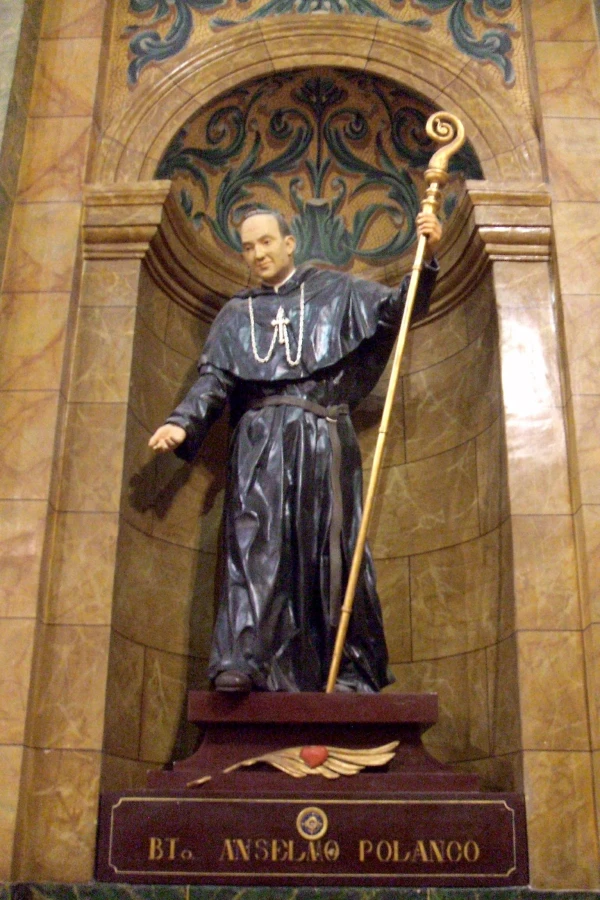
Polanco thus became the 13th Spanish prelate executed during those years of religious persecution. He was beatified on Oct. 1, 1995, by Pope John Paul II, and his remains rest in the Teruel cathedral alongside those of his vicar general, also a martyr, Father Felipe Ripoll.
A visit with young people to the Valley of the Fallen
In 2003, the International Meeting of Augustinian Youth took place at the Friar Luis de León Convention Center in Guadarrama, a town in the mountains northwest of Madrid and very close to the Valley of the Fallen. The theme was “Making These Times Better Together,” and the order’s prior general, Father Robert Prevost, now Leo XIV, participated in the event.
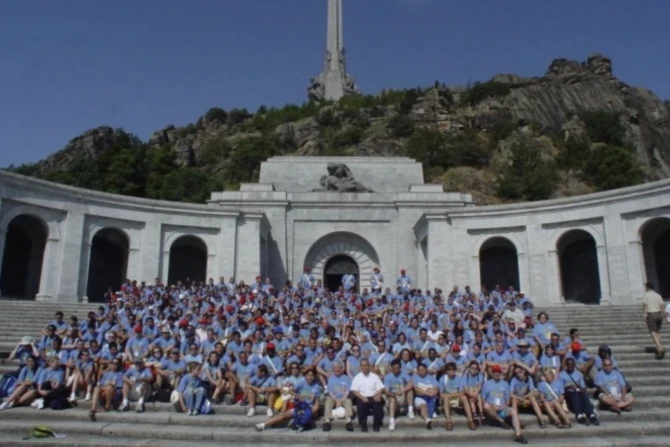
The youth gathering is highlighted as part of the history of the Spanish Augustinian Federation on its website. During those summer days, one of the activities was a visit to the Valley of the Fallen, the monumental complex built after the Spanish Civil War to pray for peace and reconciliation among Spaniards.
The future Pope Leo XIV attended with several dozen young Augustinians and a photo was taken with him and the group on the steps leading to the basilica’s entrance. In the picture he can be seen wearing a white shirt in the front row, surrounded by young people wearing blue T-shirts.
The fact that the priest, now the pope, visited the Valley of the Fallen has been perceived by some as opening a door to hope for the future of the monumental complex, especially given that the Spanish government has launched a controversial process of “resignifying” its nature.
Thousands of combatants from both sides, including numerous martyrs, are buried in the rock-hewn papal basilica, atop which stands the world’s largest cross.
An agreement, with Cardinal José Cobo acting as interlocutor, between the Spanish government and the Holy See to implement alterations to the complex has sparked opposition from a portion of the Spanish faithful.
When the specifications for taking bids on the project, which would include modifications to the Blessed Sacrament Chapel, were announced, the prelates emphasized that “the terms of the agreement between the government and the Holy See are general and the details or specifics were never gone into.”
This story was first published by ACI Prensa, CNA’s Spanish-language news partner. It has been translated and adapted by CNA.