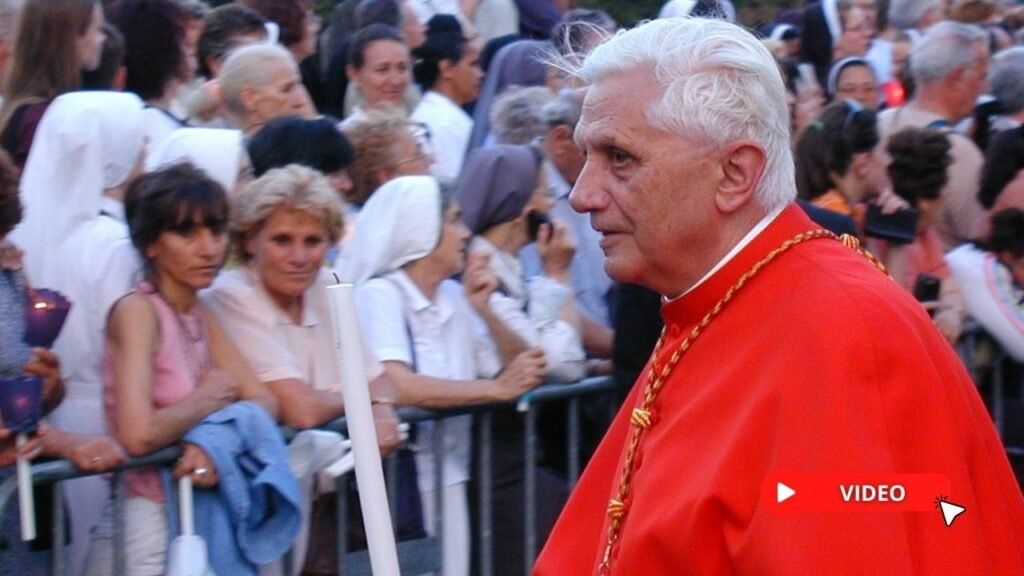
Three years after the death of Pope Benedict XVI, interest in his theological vision remains strong. To reflect on his enduring legacy, EWTN Vatican spoke with three people who knew Joseph Ratzinger closely and continue to safeguard his spiritual and intellectual heritage: Archbishop Georg Gänswein, his longtime private secretary; Professor Ralph Weimann, organizer of the Benedict Forum and promoter of his theology; and Cardinal Kurt Koch, Prefect of the Dicastery for Promoting Christian Unity.
Introducing the conversation from the EWTN Vatican office in Rome, Andreas Thonhauser set the tone for the reflection.
“Here at the EWTN Vatican office in Rome, we will ask three prominent figures to share with us their impressions of a pope who had a profound impact on Rome and the world,” he said, before turning first to Cardinal Koch.
A Faith That Speaks to the Modern World
Asked about his experience of Benedict XVI as prefect, pope, and later as Pope Emeritus, Cardinal Kurt Koch emphasized the deep unity between faith and reason that marked Benedict’s life.
“He was a Christian who was deeply rooted in his faith and who wanted to justify this faith in response to the questions people ask today and pass it on to others,” Cardinal Koch said. “He always was convinced that faith is the best thing that could happen to people.”
For Archbishop Georg Gänswein, memories of Pope Benedict are not fading with time, but growing stronger. Reflecting on the years he spent at Benedict’s side, he spoke of both personal gratitude and spiritual formation.
“The memories stay with me throughout the years,” Archbishop Gänswein said. “But as the anniversary of his death approaches, Benedict’s presence, his spiritual presence, becomes ever stronger.”
He added that living and working closely with Benedict XVI shaped him profoundly. “This combination of living together and learning from him has influenced my personality and my life in a very special way. For that I am only grateful.”
A Christ-Centered Theology for Every Generation
Much of Pope Benedict’s legacy is preserved and shared through initiatives such as the Benedict Forum, organized by Professor Ralph Weimann. Asked about the relevance of Benedict’s writings today, Weimann pointed to their enduring appeal.
“Pope Benedict has left us a rich treasure trove of theological works in which he provides guidance and principles,” Weimann explained. “Everyone must then apply these in their own way to their own lives. But these principles are valid, and more and more people are longing for them.”
At the heart of Benedict’s theology, Weimann said, is a clear focus on Christ.
“Well, first of all, it is a Christ-centered theology,” he noted. “He looks to Jesus Christ in everything. He is the one who gives us meaning. He is the meaning.”
Cardinal Koch expanded on this vision, highlighting Benedict’s conviction that God is not distant or abstract.
“For Benedict XVI, it was of course crucial that Jesus Christ is the gateway to God,” Cardinal Koch said. “God is not an unknown being who lives somewhere beyond the world, but one who wants to have a relationship with us humans.”
According to Koch, Benedict’s entire life was devoted to reopening that relationship in a world increasingly deaf to God.
“There is such a deafness toward God today,” he said, “and there is nothing more important for the Church, and therefore also for the Pope, than to reopen people’s access to this living reality of God.”
Truth, Love, and Witness
Addressing the continuing interest in Benedict’s theology across age groups, Archbishop Gänswein observed that his appeal transcends generations.
“When it comes to interest in theology or the theological work of Pope Benedict or Joseph Ratzinger,” he said, “there are actually no differences between generations. People are not just looking for theologians, they are looking for witnesses.”
For Cardinal Koch, the heart of Benedict XVI’s theology can be summed up in two words.
“I would say that Pope Benedict’s entire theology revolves around two central words,” he explained. “First, truth, and second, love.”
He stressed that for Benedict, faith and reason were never in conflict. “It is not unreasonable to believe, because God himself is reasonable. But God is not a mathematical reason, but rather a reason that reaches out to people, that loves people.”
In the end, Benedict’s message was simple yet demanding: humanity needs truth, and that truth is not an idea, but a Person.
“Humans are not only capable of truth, but need truth,” Cardinal Koch said. “And the real answer to this truth is God himself.”
Three years after his passing, Pope Benedict XVI continues to speak—through his writings, his witness, and a theology that insists God is not only Reason, but Love.
Adapted by Jacob Stein