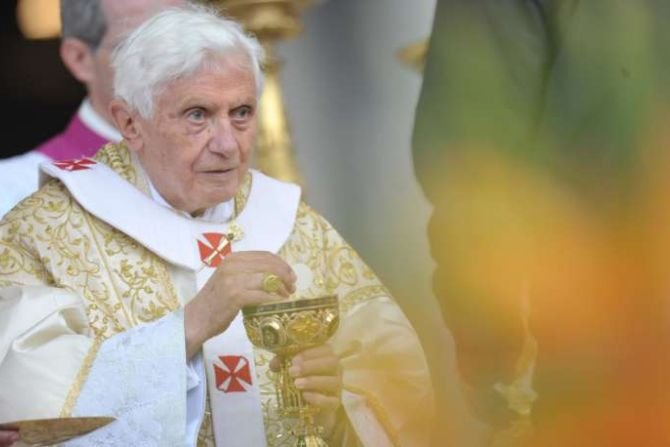
When Pope Benedict XVI died in Rome, the people of the Eternal City said it was the second time he had made Rome weep. The first was nearly ten years earlier, on February 28, 2013, when a snow-white helicopter lifted off from Vatican territory carrying a pope who had made history. With that flight, Benedict XVI became the first pope in almost 700 years to resign from the papacy.
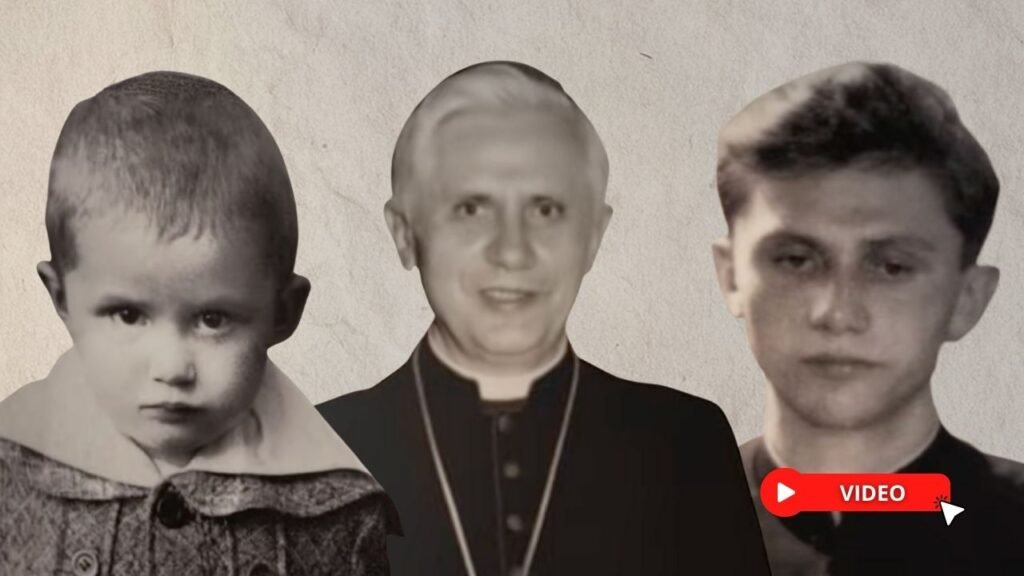
To understand why he made that decision, one must journey back to Bavaria, to the small town of Marktl am Inn, where Joseph Ratzinger was born on April 16, 1927.
Roots of Faith: Marktl am Inn and Altötting
At the Ratzinger family home in Marktl, Dr. Franz Haringer, Theological Director of the birthplace of Pope Benedict XVI, described how the foundations of Benedict’s faith were laid early in life.
“Marktl am Inn is only one of many stations on this family’s journey,” Haringer explained. “There are some memories from how the very small Joseph celebrated Christmas here for the first and second time, how he stood in front of the Christmas tree with big eyes, how he also experienced the church here.”
He added that these early years were formative. “He, the man of words, of books, learned to speak and to believe here, in the midst of a family that held together closely. This certainly also had a great impact on him from the beginning.”
Joseph Ratzinger was baptized the very night he was born. Yet another place would shape his spirituality even more deeply. Bishop Stefan Oster of Passau recalled Benedict’s lifelong devotion to Altötting, Germany’s most important Marian pilgrimage site.
“He said again and again: ‘Altötting is my spiritual home,’” Bishop Oster said. “His most beautiful and earliest childhood experiences are in connection with Altötting.”
According to the bishop, this Marian devotion shaped Benedict’s theology. “He learned the maternal dimension of the Church through Altötting. And then of course he also processed and articulated that theologically.”
That bond was visible when Benedict returned to Altötting as pope in 2006. Dr. Klaus Metzl, Director of the Marian Shrine, recalled a moment that surprised many.
“When Pope Benedict celebrated the Holy Mass on September 11, 2006 here in Altötting, he went to pay his respects to Our Lady,” Metzl said, “and to the surprise of all of us, he placed his bishop’s ring at Our Lady’s feet.”
The ring, he explained, was deeply personal. “This is the ring that his siblings Mary and George had made from an ancient gem. It shows a dove with an olive branch as a symbol of peace.”
The Decision to Resign: Truth Behind the Historic Choice
Back in Marktl, EWTN spoke with Peter Seewald, the journalist who came closer to Joseph Ratzinger than perhaps anyone else, publishing multiple interviews and an extensive biography in 2020.
Seewald explained that Benedict’s resignation was not sudden. “It was a resignation with an announcement,” he said. “Already in 2010, during our interview for the book Light of the World, I asked him if he had ever thought of resigning and he said: ‘Not yet.’”
Benedict, Seewald noted, believed one should not flee responsibility. “You can only leave when everything is more or less back in order,” he said. Yet Benedict also understood his own limits.
“In 2010, he stated quite clearly that if a pope is physically and mentally no longer able to carry out his office,” Seewald recalled, “then he not only has the right to resign, but also the duty to do so.”
Asked whether the resignation damaged the papacy, Seewald responded cautiously. “Difficult question,” he said. “If before it was true that the Vicar of Christ is taken away only by Christ himself, by God himself, he cannot decide for himself.”
But Seewald stressed the decisive factor: Benedict’s health. “It is very important to accept that Pope Benedict was seriously ill,” he said, listing heart problems, blindness in one eye, constant headaches, Parkinson’s disease, memory loss, and long-term insomnia.
“All these rumors that there are other reasons for his resignation … all this is real rubbish and does not correspond to the truth,” Seewald said firmly. “The truth is: he resigned for health reasons.”
A Pope at Peace Until the End
According to Seewald, the resignation ultimately brought Benedict peace. “He was rock-solidly convinced that he would die before the end of 2013 after his resignation,” he said.
As Pope Emeritus, Benedict was careful never to undermine his successor. “He did not want to give the impression that he was a kind of ‘shadow pope,’” Seewald explained. “The pope is the pope. There are not two popes.”
Though the Vatican still has no formal regulations for future papal resignations, Benedict’s decision has forever changed how the papacy is understood.
Seewald said Benedict never regretted stepping down. Recalling his final visit in October 2022, he shared a deeply personal moment.
“I asked him, ‘Papa Benedetto, what comforts you?’” Seewald said. “And then he said: God keeps everything in His hands.”
From a small Bavarian town to the heart of the Vatican, Pope Benedict XVI walked a path marked by humility, faith, and trust—leaving behind a legacy that continues to shape the Church and the papacy itself.
Adapted by Jacob Stein