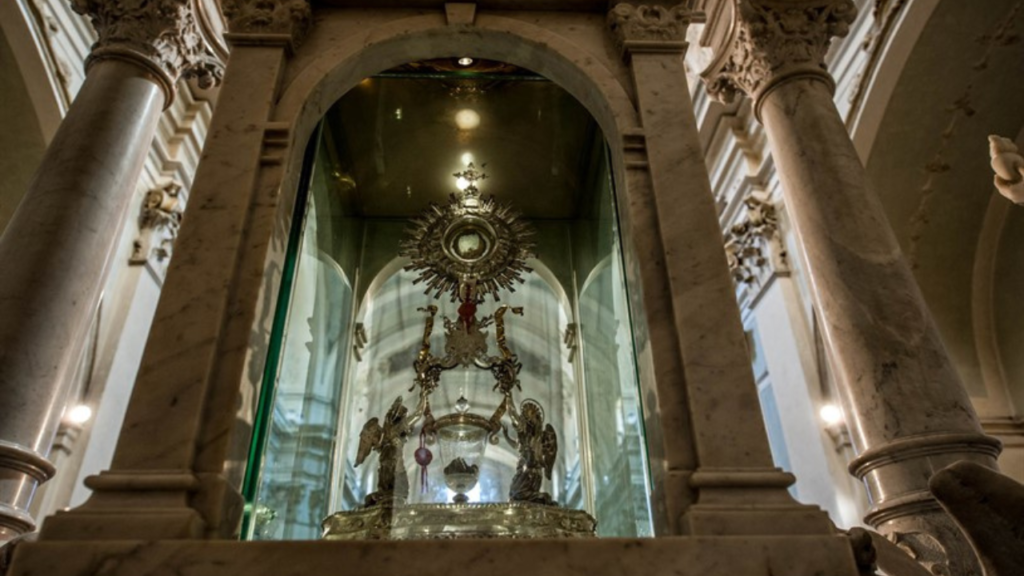
Jesus said to [Thomas], “Do you believe because you have seen me? Blessed are those who, though they have not seen, have believed” (John 20:29). These words illuminate the deep faith in the Eucharistic miracle of Lanciano, an extraordinary event that dates back to the 8th century and continues to fascinate and inspire the Catholic world. The Mass is the moment when the bread and wine become the Body and Blood of Christ, a central dogma in the Catholic faith. This miraculous event reinforced the doctrine of the Real Presence, confirming that Christ is truly present in the Eucharist.
Origins of the Miracle of Lanciano
The miracle occurred about 750 AD in the city of Lanciano, in what is now the Abruzzo region of Italy. According to tradition, a Basilian monk who doubted the doctrine of transubstantiation celebrated Mass in the Church of Saints Legonziano and Domiziano. During the Consecration, the host was transformed into flesh and the wine into blood before the eyes of the priest, who, seized with awe and awe, showed the miracle to the faithful present. Since then, the miraculous host and blood have been preserved in reliquaries, venerated by thousands of pilgrims every year.
Scientific Analysis of the Miracle
Over the centuries, the Church has protected and guarded these relics, but it was not until 1970 that extensive scientific examinations were carried out. Professor Edoardo Linoli, an expert in pathological anatomy and histology, studied the relics and confirmed that the tissue is indeed myocardial (human heart muscle) and the blood is type AB, common among relics considered miraculous, such as the Shroud of Turin. Linoli pointed out that the tissue and blood show no signs of decomposition, something that is scientifically unexplained and adds an additional element of mystery to this event.
The Church and Devotion to the Miracle
The miracle of Lanciano has received the support of the Catholic Church and continues to be a testimony of faith for many. Pope Paul VI, on the occasion of the 1975 Holy Year, recognized the miracle as authentic and worthy of veneration. Today, the city of Lanciano is a pilgrimage destination for thousands of people who seek to strengthen their faith through the contemplation of this prodigy. Brother Santino Verna, current custodian of the relics, says, “The Host became a part of the left ventricle […] and the blood congealed, while the wine became human blood.”
Spiritual Significance of the Miracle of Lanciano
Eucharistic miracles, like the one at Lanciano, are considered by the Church to be tangible signs of God’s love and Christ’s real presence in the world. Franco Serafini, a cardiologist and scholar of these events, stresses the importance of the miracle: “If the Eucharistic event is true, it means that we have a biological trace coming from the body of our Lord Jesus.” These miraculous events remind us of the need to nurture our faith and approach the Eucharist with humility and veneration.
Lanciano: An Eternal Faith that Crosses Centuries
For more than 1,200 years, Lanciano has carried on the witness of Christ’s presence in the Eucharist. Every time we attend Mass, we are invited to renew our faith in this divine mystery. As Brother Verna states, “If we put water on the host turned into human flesh, […] it begins to redden because it is dehydrated flesh.” The miracle of Lanciano reminds us that faith is alive and that the Eucharist is an eternal gift for all humanity.
The miracle of Lanciano continues to be a source of spiritual inspiration and a tangible sign of God’s love and mercy. For believers, this event is an invitation to rediscover the power of faith and the beauty of Christ’s real presence in the Eucharist.