The pope, speaking at the end of a 12-day South American journey, also discussed his recent cancer surgery, his American identity, and the U.S. midterm elections.
ABOARD THE PAPAL FLIGHT — Pope Leo XIV said he doesn’t intend to expand permission for the ordination of married men as priests, nor loosen restrictions on the celebration of the Traditional Latin Mass — in both cases, because he thinks such changes would undermine the unity of the Church.
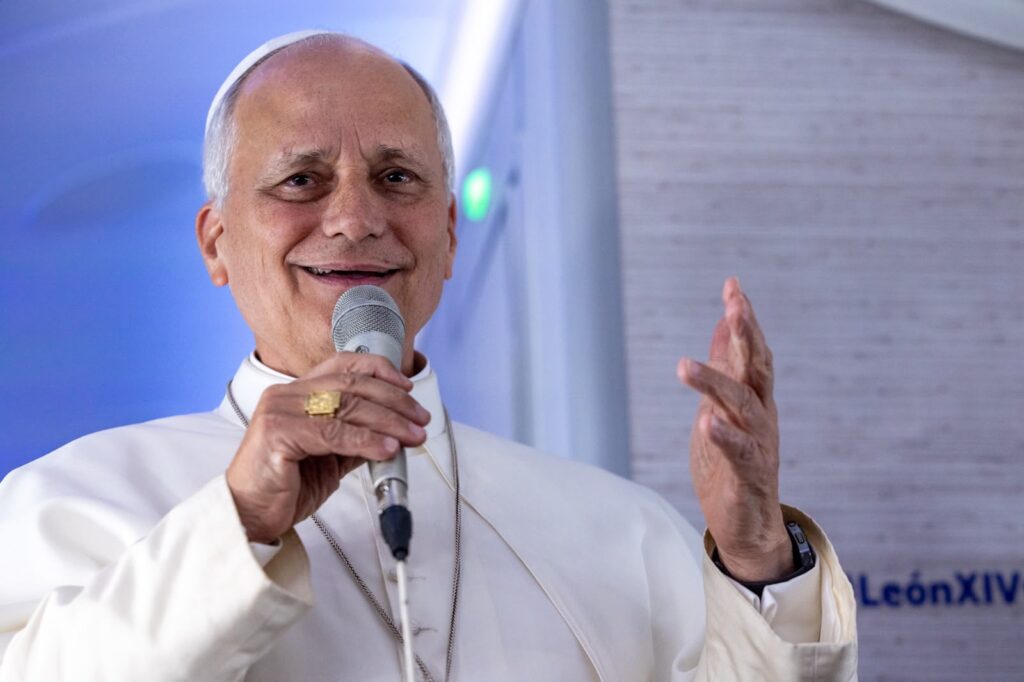
The pope spoke during a 45-minute news conference on his flight to Rome Nov. 16, 2026, at the conclusion of a 12-day trip to South America.
Leo also discussed his health, his American identity, and the aftermath of midterm elections in the U.S.
The pope was asked if he was considering approving the ordination of married men to relieve the priest shortage in regions such as South America’s Amazon, as recommended at the 2019 Synod of Bishops, a question left open in the 2020 exhortation Querida Amazonia.
Leo responded that the numbers of priestly vocations in some historically underserved areas had increased notably in recent years.
Ordaining married men is “not the only solution” to the priest shortage, the pope said, “but itʼs a solution which in certain areas of the church can cause division because there is not universal, if you will, acceptance of that concept.”
Leo said he had made it clear that one of his priorities as pope was “to promote unity and communion among us as members of the Church.”
“It may be in the future that some things will change. However, for right now what I believe [is an] important part of my ministry to the Church is to heal, bring people together … to say, first letʼs come together, letʼs consider what we believe the priorities need to be, and then weʼll see how we walk forward from there,” he said.
“All these things are going to take time and we will go with that as the Lord moves us,” the pope added.
Leo gave a similar explanation for not rescinding restrictions imposed by Pope Francis, in his 2021 motu proprio Traditionis custodes, on celebrating the Traditional Latin Mass.
“Again, for the unity of the Church, the vast majority of Catholics around the world, we celebrate the rite of Vatican II, Paul VI, and we will continue to do that,” Leo said, noting that Francis’s legislation allows for granting of permission to celebrate the Latin Mass.
In response to questions about his health, following his surgery last month to remove a cancerous tumor together with part of his right lung, Leo said that he had not experienced any symptoms and that the cancer had been discovered as part of a routine annual check-up.
The force of prayer and messages of support from around the world, “along with a certain determination, which I also have,” and good medical care had allowed him to make the demanding trip to South America, he said, speaking in Spanish.
The pope said he hoped his example would encourage people to overcome their fears of cancer and obtain regular check-ups. Speaking in Spanish, he said he was “not at 100%, but quite well.”
Asked if he had drafted a letter of resignation in case he were to be incapacitated, for instance if he fell into a coma, Leo said in Spanish that he had not seen the need and that canon law already provides for such situations, but that he would eventually do so.
Leo said that his readiness to discuss his health was a trait, along with his “profound faith in democracy, democratic participation,” that reflected his U.S. origin, saying in Spanish that “in many things I am a gringo, a North American.”
The pope answered several questions from Latin American reporters, including one about his meeting last week with Argentina’s President Javier Milei, a self-described “anarcho-capitalist” whose austerity policies have drawn criticism from the country’s Catholic bishops.
Leo said the message he wanted to bring was not political, but he did speak to Milei about the neediest in the country. He said the two men had a “mutual understanding about the value of life, the value of the human being in all its stages,” apparently a reference to Milei’s opposition to abortion.
“He had an openness to hearing this message, so I think in this sense, it was very positive,” the pope said in Spanish about his dialogue with Milei.
Asked whether he expected that the results of the U.S. midterm elections earlier this month would lead to more polarization or more moderation, the pope said, in a mix of Spanish and Italian: “I would like to see more capacity for dialogue, construction of bridges, reconciliation, less polemic, less war, less division. I know that this is also a dream, but I know that it is possible.”
In a sign of the papacy’s changing communication style under the first U.S.-born pope, an Italian journalist asked Leo if they could speak Italian, something that would have been taken for granted less than two years ago. Amid laughter, the pope said yes.
Follow the LIVE UPDATES from EWTN News in English for special coverage during Pope Leo’s Apostolic Trip to Uruguay, Argentina and Peru.
This article was originally published by EWTN News English.