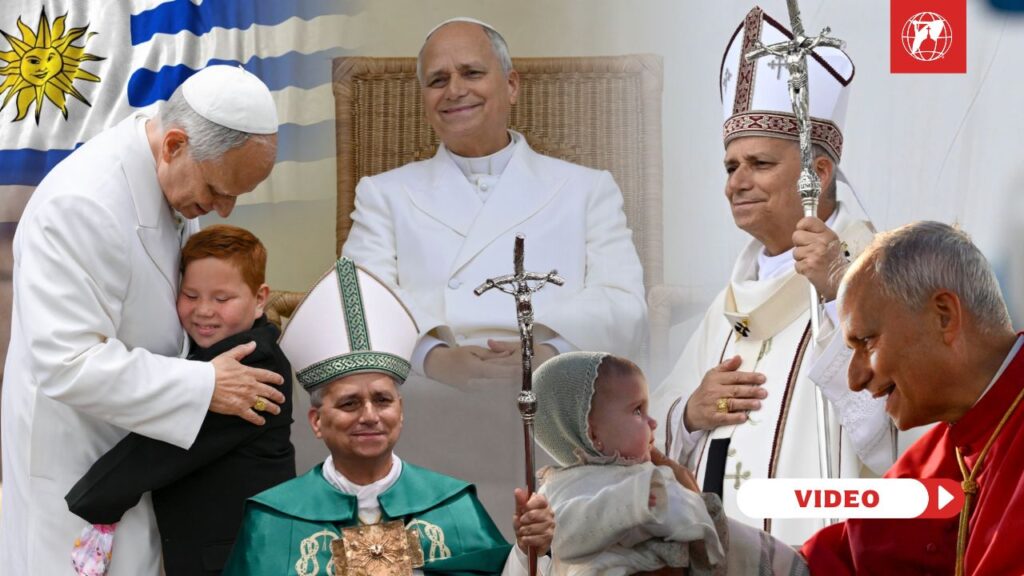
For the first time as Holy Father, Pope Leo XIV returned to South America, beginning an apostolic journey marked by calls for evangelization, solidarity and a renewed Christian witness in one of Latin America’s most secularized countries.
As on previous apostolic journeys, Pope Leo XIV was welcomed by cheering crowds and festive music. From the beginning of his visit, the Holy Father called on Uruguayans to promote the common good, uphold human dignity and care for society’s most vulnerable.
“I have come as the Successor of Peter and as a shepherd, with the desire to meet the pilgrim Church in this land and to draw near, with affection, to all its people,” Pope Leo said.
The journey marked the first papal visit to Uruguay since St. John Paul II traveled to the country in 1988. Nearly four decades later, the Pope arrived in a nation that has undergone one of the most far-reaching processes of secularization in Latin America.
Bishop Milton Luis Tróccoli Cebedio, president of the Episcopal Conference of Uruguay, described the pastoral reality facing the local Church.
“Uruguay has only 3,5 million inhabitants, and about 35% identify as Catholic, and of that 35%, approximately 10% go to Mass every Sunday or regularly receive the sacraments. That’s why evangelization in Uruguay is always a major challenge, and in that sense, we consider it a mission territory.”
Once deeply shaped by its Catholic roots, Uruguay gradually developed a strongly secular public culture, with even major Christian celebrations receiving new names on the country’s official calendar.
Prof. Guzmán Carriquiry, former Uruguayan ambassador to the Holy See, pointed to the transformation as one visible sign of that process.
“Our official calendar has replaced the standard, ordinary calendar, and from then on, December 8 was designated as ‘Beach Day’ on the official calendar, December 25 as ‘Family Day,’ January 6 as ‘Children’s Day,’ and Holy Week, even today, most Uruguayans refer to it as ‘Tourism Week.’”
Against this backdrop, the missionary dimension of Pope Leo’s journey became one of its central themes.
Celebrating Vespers at Montevideo’s Cathedral, the Pope stressed that evangelization begins not simply with words, but with Christians resembling the One whom they proclaim.
“In this land, where many of our contemporaries barely know Jesus Christ and so many young people have grown up far from the life of the Church, that witness has a special power. May the way we look at others, the way we listen or the way we reach out to those who suffer prompt them to ask about the origins of that love.”
Bringing the Church to the peripheries
Uruguay’s challenges, however, extend beyond secularization. The country also faces child poverty, social exclusion and the spread of drug trafficking.
It was within this reality that Pope Leo traveled to Casavalle, one of Montevideo’s poorest neighborhoods, an area marked by poverty, violence and the presence of drug gangs.
Carriquiry said the Pope confronted the disparity between Uruguay’s relative prosperity and the suffering present in communities such as Casavalle.
“The Pope spoke very strongly, asking how a country with one of the highest per capita incomes in Latin America can afford to ignore the violence these people suffer, their extreme poverty, and the children who sometimes don’t even have milk or bread to eat — how can that be?”
After listening to testimonies from members of the community, Pope Leo praised 15 Church-run initiatives serving residents and reflected on the Christian responsibility to care for others.
“We need to continue to commit ourselves to the charity and closeness of the Good Samaritan who did not remain indifferent upon seeing misfortune, but took responsibility for his brother’s life. We must work together: the Church, civil society, and the State.”
“Be saints!”
From the social peripheries of Montevideo, the journey then turned toward Uruguay’s young people.
Pope Leo concluded his second day in the country with a prayer vigil attended by 80,000 young people at Montevideo’s Estadio Centenario. There, his message was direct: Christians should not settle for a comfortable or merely conventional faith.
“Be saints! Do not settle for a merely decent life or for a habitual faith, content with doing only the essential. Do not give God only a part of yourselves — give yourselves completely!”
For many observers, the immense gathering offered a striking sign of the vitality of faith among young Uruguayans, particularly in a country where religion has largely disappeared from public education and much of institutional life.
“It is especially striking in a country where, in our public schools, one cannot even speak a word about religion. Yet, deep in every human heart, and especially in the hearts of young people, where life is still bubbling with energy, there arise longings for love, truth, justice, and happiness, longings that were evident in the welcome given to the Holy Father,” Carriquiry said.
Pope Leo also used the encounter to encourage young people not to be afraid of marriage, family life or permanent commitments.
“Friends, young people, dare to take the step of marrying, starting a family yourselves. Do not be afraid of ‘forever’! Married couples, open your home to life, even when the world tells you that a child is a burden.”
Entrusting Uruguay to its patroness
On his final day in Uruguay, Pope Leo XIV presided over Mass in the Cathedral Basilica of Florida Square, part of the National Shrine of Our Lady of the Thirty-Three.
There, the Pope entrusted the country and its people to God through the intercession of Uruguay’s patroness.
“On this feast of the Patroness of Uruguay, let us bring this entire people before the Lord.”
The conclusion of the long-anticipated journey inevitably brought comparisons with the historic 1988 visit of St. John Paul II, an event still fondly remembered by many Catholics in the country.
Bishop Tróccoli recalled the lasting effects of that visit on religious life in Uruguay.
“It had an impact not only on the country’s unity, but also sparked a resurgence of people’s faith and devotion, didn’t it? And we immediately saw an increase, for example, in the number of people who started attending Mass or who began returning to church after a long absence. And I believe that Pope Leo’s visit will also bring about that same effect.”
For those who accompanied Pope Leo’s journey, the hope is that his visit will likewise endure beyond the crowds and public celebrations, renewing an encounter with Christ in a country where the Church increasingly understands its presence in missionary terms.
Carriquiry summarized the significance of the Pope’s message as an invitation to reopen the country’s doors to Christ.
“Though expressed differently, the Pope’s message echoed that same call: open the doors of this country, open the doors of this people, open the hearts of these good people to the presence of Christ, who comes to meet the people of Uruguay. He wants to make His invitation resound in their hearts: ‘Come, follow me.’ It is worth it, truly worth it.”
Adapted by Jacob Stein