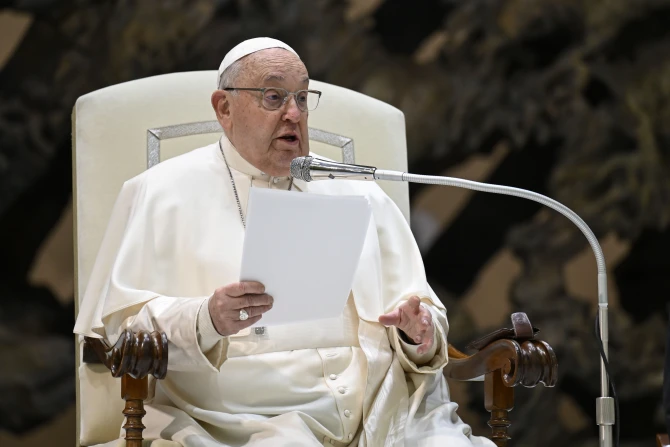
Pope Francis on Thursday released his message to global leaders attending the World Economic Forum annual meeting in Davos, Switzerland, this week, telling attendees that artificial intelligence (AI) must ultimately serve humanity and the common good.
As “a protagonist and a supporter of the advancement of science, technology, the arts, and other forms of human endeavors,” the Holy Father said, the Catholic Church teaches that such developments should be used to “improve life for everyone.”
“AI must be ordered to the human person and become part of efforts to achieve ‘greater justice, more extensive fraternity, and a more humane order of social relations,’ which are ‘more valuable than advances in the technical field,’” he said, citing Gaudium et Spes, No. 35, and the Catechism of the Catholic Church, No. 2293.
In his Jan. 23 message, the pope said AI is “not an artificial form of human intelligence but a product of it” that, when used correctly, “assists the human person in fulfilling his or her vocation, in freedom and responsibility.”
“Progress marked by the dawn of AI calls for a rediscovery of the importance of community and a renewed commitment to care for the common home entrusted to us by God,” he added.
Francis also challenged government and business leaders to implement AI in ways “to bring people together” and not simply as a “tool” for economic cooperation.
“There is, however, the risk that AI will be used to advance the ‘technocratic paradigm,’ which perceives all the world’s problems as solvable through technological means alone,” the Holy Father said.
“Within this paradigm, human dignity and fraternity are frequently subordinated in the pursuit of efficiency as though reality, goodness, and truth inherently emanate from technological and economic power,” he continued.
Pointing out other risks posed by AI, the Holy Father said critical questions must be addressed, including “its effect on the growing crisis of truth in the public forum,” ethical responsibility, and human safety.
Emphasizing that “human dignity must never be violated,” the pope said technological developments that “create or worsen inequalities and conflicts” are not true progress: “For this reason, AI should be placed at the service of a healthier, more human, more social, and more integral development.”
The Holy Father also highlighted Catholic social teaching in his message, saying the principle of “subsidiarity” is necessary to achieve the common good in the “Intelligent Age.”
“Appropriate responses should be made at all levels of society,” he said, “with individual users, families, civil society, corporations, institutions, governments, and international organizations working at their proper levels to ensure that AI is directed to the good of all.”
“Today, there are significant challenges and opportunities when AI is placed within a framework of relational intelligence, where everyone shares responsibility for the integral well-being of others,” he concluded.
This article was originally published on Catholic News Agency.