Across two millennia of Christianity, only a select group of saints have received the title “Doctor of the Church,” a recognition given to men and women whose teaching has made an exceptional contribution to the Catholic faith.
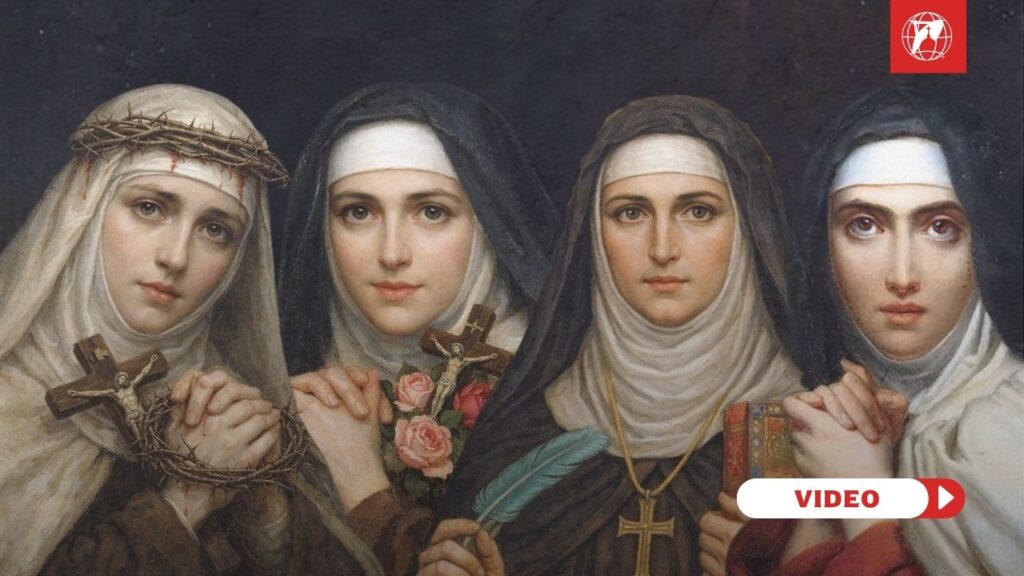
Among them are four remarkable women whose lives span nearly nine centuries: St. Hildegard of Bingen, St. Catherine of Siena, St. Teresa of Ávila and St. Thérèse of Lisieux.
They came from dramatically different worlds. One advised emperors and composed sacred music. Another helped persuade a pope to return to Rome. One reformed the Carmelite Order and became one of Christianity’s great teachers of prayer. The youngest entered a cloister at 15 and discovered a path to holiness through the smallest actions of everyday life.
Together, their lives reveal why the Church recognizes them not only as saints, but as teachers for Christians in every generation.
St. Hildegard of Bingen: Mystic, Healer and Visionary
Born in Germany in 1098, St. Hildegard of Bingen became one of the most extraordinary figures of the Middle Ages.
A Benedictine abbess, mystic, writer, musician and student of the natural world, Hildegard experienced visions from childhood. As an adult, she began recording them in theological works exploring the relationship between God, humanity and creation.
Her influence extended well beyond the monastery. She corresponded with bishops, abbots, nobles and rulers and did not hesitate to intervene in the controversies of her age. She even challenged Emperor Frederick Barbarossa over his support for antipopes against Pope Alexander III.
Pope Eugene III gave Hildegard permission to write and preach about her visions, an extraordinary recognition for a woman in the 12th century.
Her understanding of the human person also emphasized the relationship between body and soul. For Hildegard, physical and spiritual health were not entirely separate realities: the human person was created as a unity whose life ultimately finds its harmony in God.
Music formed another important part of her legacy. Hildegard is considered the earliest female composer whose body of music has survived. Her compositions were closely connected to her theology and mystical visions, bringing together poetry, music and contemplation.
In 2012, Pope Benedict XVI declared her a Doctor of the Church, recognizing the enduring importance of her theological and spiritual teaching.
St. Catherine of Siena: The Woman Who Moved a Pope
Two centuries later, another extraordinary woman emerged in Italy.
St. Catherine of Siena was born in 1347 into a Europe shaken by plague, political conflict and crisis within the Church. Although she received little formal education, Catherine became one of the most influential spiritual figures of her century.
Her mystical life began at an early age, but Catherine was anything but detached from the problems of the world around her.
One of the great crises of her lifetime was the Avignon Papacy. For decades, the popes had resided in France rather than Rome. Catherine became convinced that the pope needed to return to the city of Sts. Peter and Paul.
She wrote forcefully to Pope Gregory XI, urging him to overcome his hesitation and return.
In 1377, Gregory XI restored the papal residence to Rome after nearly 70 years in Avignon. Catherine’s letters and personal intervention played an important role in encouraging his decision.
Her spirituality was centered on an intense relationship with Christ. Her masterpiece, “The Dialogue of Divine Providence,” presents Christ as a bridge between humanity and God — the one through whom the human person can pass from earth to heaven.
Catherine also experienced what she understood as a mystical marriage with Christ and received the stigmata, which according to tradition remained invisible during her lifetime.
She died in Rome in 1380 at only 33 years old. Her remains rest beneath the high altar of the Basilica of Santa Maria sopra Minerva.
Centuries later, her legacy remains inseparable from both mystical contemplation and courageous service to the Church.
St. Teresa of Ávila: A Spiritual GPS for the Soul
Born in Spain in 1515, St. Teresa of Ávila lived during another period of upheaval in Christianity.
The Protestant Reformation was spreading across Europe, religious wars were erupting and the Catholic Church was confronting the urgent need for internal reform.
Teresa responded by beginning with the spiritual life.
She entered religious life at the age of 20, but her early years in the convent were marked by illness and a prolonged interior struggle. Eventually, her experience of prayer led her toward a profound spiritual renewal.
She became a reformer of Carmelite life, establishing communities dedicated to greater simplicity, prayer and enclosure.
Among Teresa’s most famous mystical experiences was the transverberation, in which she described an angel piercing her heart with a fiery spear. Centuries later, Gian Lorenzo Bernini immortalized the episode in his celebrated sculpture “The Ecstasy of St. Teresa” in Rome.
But Teresa’s greatest legacy may be found in her writings.
In “The Interior Castle,” she describes the soul as a castle containing many rooms, with God dwelling at its center. The Christian spiritual life is therefore a journey inward toward deeper communion with him.
One scholar interviewed in the documentary describes the work as a kind of “spiritual GPS” — a guide helping Christians understand their interior experiences in light of their relationship with God.
In 1970, Pope Paul VI declared Teresa a Doctor of the Church, making her the first woman in history to receive the title.
St. Thérèse of Lisieux: Holiness in the Little Things
Three centuries after Teresa’s birth, another Carmelite would transform Catholic spirituality — without founding monasteries, advising rulers or traveling the world.
St. Thérèse of Lisieux was born in France in 1873 to Louis and Zélie Martin, who would themselves later be canonized.
Thérèse lost her mother when she was only four years old and endured periods of illness and intense emotional sensitivity as a child. At 14, however, she experienced what she later called her “Christmas conversion,” a moment of spiritual transformation that began what she described as a “giant’s race” toward God.
Determined to become a Carmelite, Thérèse traveled to Rome with her father and personally appealed to Pope Leo XIII for permission to enter the convent despite her young age.
The pope told her to follow the judgment of her superiors.
Eventually, at just 15, she entered Carmel.
Behind the walls of the monastery, Thérèse discovered the spirituality that would become known throughout the world as her “Little Way.”
She did not believe holiness required spectacular achievements. Instead, she sought to perform the ordinary actions of daily life with extraordinary love, trusting completely in the mercy of God.
Her final years tested that trust profoundly.
Suffering from tuberculosis, Thérèse also endured what she described as a “night of faith,” an intense spiritual darkness that continued through the final months of her life.
She died in 1897 at only 24.
Before her death, Thérèse expressed her desire to continue doing good from heaven, famously promising a “shower of roses” — graces she hoped to obtain for others through her intercession.
Pope Pius XI canonized her in 1925. In 1997, exactly 100 years after her death, Pope John Paul II proclaimed her a Doctor of the Church.
Four Women, Four Paths to Holiness
Hildegard spoke through visions, theology and music. Catherine carried her mystical spirituality into the political and ecclesial crises of medieval Europe. Teresa explored the deepest chambers of the interior life. Thérèse found an entire path to God hidden within ordinary acts of love.
Their personalities, circumstances and missions could hardly have been more different.
Yet each discovered that theology is ultimately more than an intellectual exercise. Their teaching emerged from lives transformed by an encounter with Christ.
Their recognition as Doctors of the Church affirms that their insights are not simply historical curiosities or private spiritual experiences. The Church holds them up as teachers whose wisdom can help Christians understand and live the faith today.
And perhaps the youngest of the four offers the most striking conclusion.
In a world that often measures a life by visibility, achievement and measurable results, St. Thérèse offers a radically different measure: holiness can be found in hiddenness, trust and the smallest acts performed with great love.
The four women Doctors of the Church show that there is no single path by which a person becomes a great teacher of the faith. What unites them is something deeper: a life given completely to God.