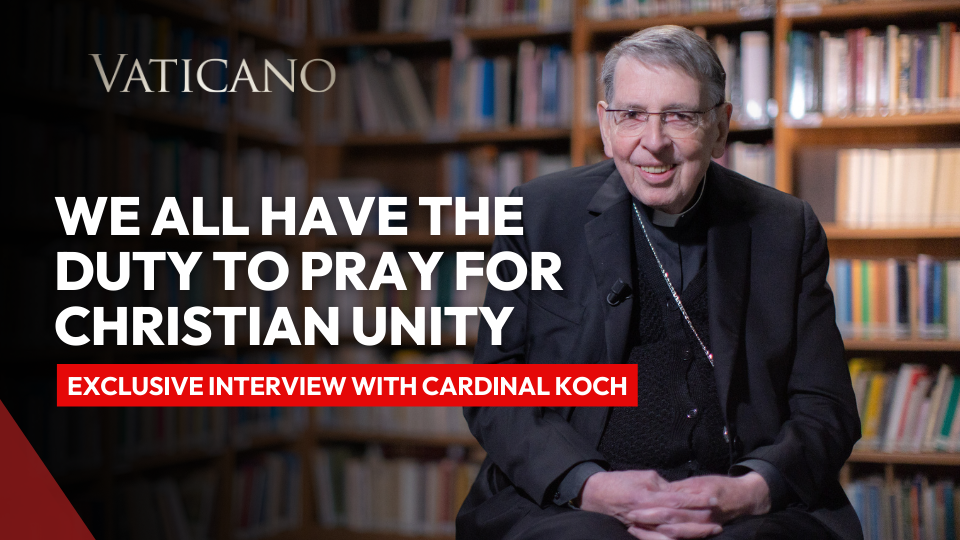
For the Feast of the Conversion of St. Paul, over a century ago, the Church established an important tradition: the Week of Prayer for Christian Unity. This year, the motto of the week is taken from the Gospel of Luke, chapter 10: “You shall love the Lord your God… and your neighbor as yourself.” EWTN Vatican Bureau Chief Andreas Thonhauser sat down with Cardinal Kurt Koch, who oversees the Church’s efforts regarding unity with other churches.
Cardinal Kurt Koch is the Prefect of the Dicastery for Promoting Christian Unity in this interview reminded us of the duty of all Christians, saying, “The prayer for Christian Unity. All people, lay people, priests, bishops have the duty to pray for Christian unity and to have a better knowledge from one another.”
Could you tell us what will be the message of this week of prayer? And what are your personal hopes for it?
The beginning of the ecumenical movement is the introduction of the Week of Prayer for Christian Unity, and it means the most important thing for Christian unity is prayer. The fundament of this issue we see in the high priestly prayer of Jesus in the 17th chapter by John. And for me, it’s always very impressive that Jesus does not command the unity between his disciples, but he prays for unity.
Is this also difficult sometimes to pray together when you don’t have the same theological basis?
I think the prayer is a good way to have a better knowledge from one another because the prayer is a very inner mode to be Christian, to be Protestant, to be Orthodox, to be Catholic. And when we see how the other is in prayer we have a better knowledge from one another.
Where would you see or how would you describe the situation of Christian churches and their journey towards unity?
It’s very different in our dicastery we have two sections, a section East and the section West in the Section East, we have the dialogue with all the Oriental Orthodox Churches and the Orthodox Churches. Here we have a very basic basis of common faith. And I think the most important question is what is church? What is unity in the church and what can be the role of the Bishop of Rome in the in the future unity? In the section West, we have many different dialogues with all the churches and ecclesial communities they come from. the Reformation, still Lutheran, Reformed, Baptist Mennonite Methodists. Here, I think we must have a deeper discussion for this church and what is the unity of the church?
And where will this discussion go? Are there any ecumenical events also planned for the Jubilee? Are there any hopes also to have this Jubilee year as a basis or a platform for conversations?
This is the Holy Year for the Catholic Church. It is clear that the Holy Year has always the issue and the theme of conversion. And I think we must also have a conversion to unity. And during 2025 we have also this commemoration of the Council. The first Council of Nicaea. This Council happened in a time when the church was not wounded by so many divisions and splits in the history. And I think all Christian churches and ecclesial communities can commemorate together this first ecumenical counsel and to confess to Christological faith that Christ is the son of God. In Union with the Father, and to deepen this Christological question of confession together is for me a very beautiful challenge.
“A beautiful challenge. What can individual faithful do across the world to help with this challenge. What can I do to help with Christian unity?
The prayer for Christian Unity. All people, lay people, priests, bishops have the duty to pray for Christian unity and to have a better knowledge from one another. And this means that we must have some meetings with one another. We distinguish in the ecumenical dialogue between a communion of love and a communion of Truth. The communion of truth means the theological dialogue about the questions that have divided the church. And a communion of love is relation in friendship, fraternal relations, and this is the main light word. This year you shall love. The Lord your God, and you shall love the neighbor as yourself from the Gospel of Luke. And I think love is a very important question for the communication dialogue, first of all, to receive the love of God for us and the first answer from our side to receiving this love of God is love. For God. And the neighbor, then, when we loved the neighbor as God laughed his sons and his daughters, then we are the image of God.”
They will recognize them by their love, your Eminence. Thank you so much for your time. And we will join you in the prayer. For Christian unity.
United in prayer during this week. Thank you.
Adapted by Jacob Stein