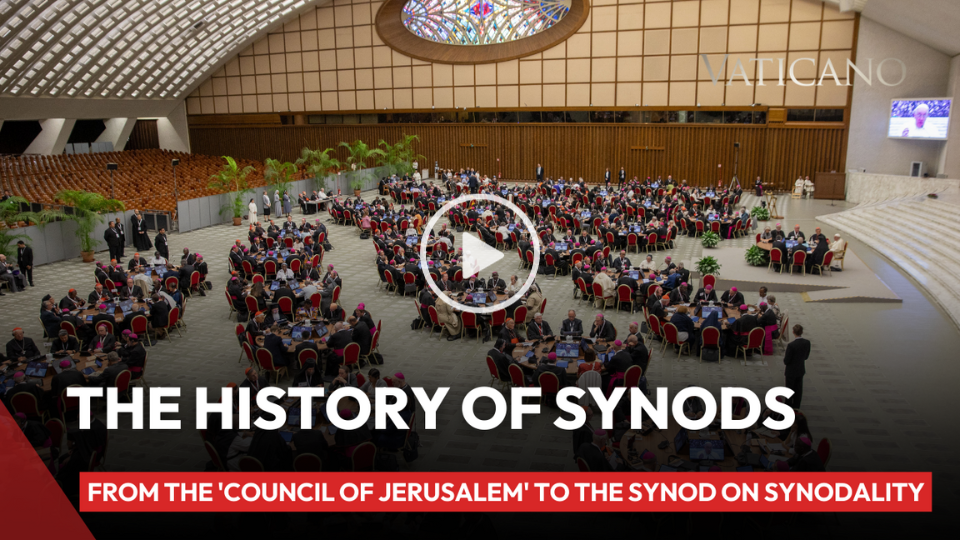
The Synod of Bishops is an event of great significance within the Catholic Church, involving bishops from all over the world in order to discuss crucial topics concerning the faith and the life of the Church.
At the opening of the Synodal Process of the Synod on Synodality on October 9, 2021, Pope Francis reiterated, “The Synod is not a parliament, the Synod is not an inquiry into opinions; the Synod is an ecclesial moment, and the protagonist of the Synod is the Holy Spirit. If there is no Spirit, there will be no Synod.”
In a development of the process of the Synod, Cardinal Grech, the General Secretary of the Synod of Bishops, explains, “The Synod is a moment where in the past, only bishops were engaged. But now Pope Francis has introduced a new dimension to this experience. That involves all the people of God. Obviously, the Synod for Bishops is an integral, important phase of the Synodal Process. So all the Church is being invited to reflect, pray, and contribute to help the Church to become more Church. Because, after all, we are talking about synodality, we are talking about the Church itself.”
Angela Ambrogetti, a Vatican journalist and editor in Chief for ACI Stampa, has closely followed 18 Synods during her career. In an interview with EWTN, explaining the origins of the Synod and its development over the centuries, she said, “One must distinguish between two origins, the modern one, let’s say, and the ancient one. Synods in the Catholic Church have existed since the very early centuries. There have been synods, there have been councils, and these were both occasions when a group of bishops and priests would gather, with or without the Pope, sometimes to discuss matters concerning the local churches.”
Indeed, in the Acts of the Apostles, one of the first issues the Church had to address was the admission of Gentile converts to the Christian faith (cf. Acts 15). The early bishops of the Church convened in Jerusalem to discuss this matter. After many debates, a final decision was reached, stating that Gentile converts were no longer required to be circumcised or follow various aspects of the Mosaic law. This gathering of bishops has since been called the “Council of Jerusalem” and has been seen as a prototype for all meetings of bishops where decisions needed to be made for the good of the Church.
Ambrogetti explained in further detail the meaning of the word “Synod,” saying, “This journeying together has naturally been interpreted in different ways over the centuries and also differently between the Eastern Church and the Latin Church. In the Eastern churches, there is a greater synodality in the sense that the Holy Synod is, so to speak, the supreme authority, even above the Patriarch.”
The interpretation is different in the Latin Church, where the Synod is “an advisory element. This is important,” Ambrogetti detailed, “because it means that this common journey does not have a true authority other than the Pope, because the Pope, for both the Latin and Eastern Catholic Church, is the only true reference point.”
The Synod of Bishops has its roots in the Second Vatican Council (1962-1965). During the Council, the need for greater collaboration among bishops worldwide in guiding the Church became apparent. This led Pope Paul VI to establish the Synod of Bishops in 1965 through the motu proprio Apostolica Sollicitudo. This body was created to allow bishops to periodically come together to discuss important issues for the Church and offer advice to the Pope.
Over the years, the form of the Synod has undergone various changes. Ambrogetti indicated an initiative of Benedict XVI, “the addition of an hour of open debate at the end of the working day. In addition to the speeches prepared by the bishops and other synodal fathers, there were these open interventions at the end of the day.”
The Synod takes place in sessions during which the participants openly discuss the assigned theme. It lasts for several weeks, and the sessions are held daily. The objective of the Synod on Synodality is in line with previous synods. It gathers a community of believers who come together under the guidance of the Lord Jesus and the Holy Spirit to spread the Gospel. Cardinal Grech emphasizes: “All the baptized are subjects empowered by the Holy Spirit,” and because of this, “Everybody is invited or better still must feel duty bound to announce Jesus to humanity today. This is the main objective also of our reflection on a synodal church.”
Cardinal Grech is not surprised that certain hot-button issues arise in this reflection on a synodal church. The cardinal explains, however, that a letter was sent to all bishops to all the churches, highlighting “that the theme of this particular Synod is for a synodal church. Other issues will not be discarded,” rather, “They will put them on the back burner. But they are not issues that this particular synodal assembly should tackle because if we enter into those issues at this particular moment, we will miss a golden opportunity, a moment of grace. The reflection: how we can really help the Church to become more synodal.”
Edited by Jacob Stein.