The papal nuncio who served in Iraq at the time of the U.S. invasion 20 years ago told Vatican News that Christians in Iraq were worse off after Saddam Hussein was removed from power.
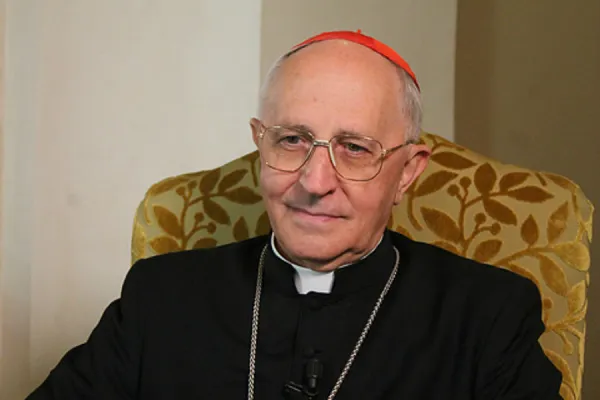
Cardinal Fernando Filoni was appointed by Pope John Paul II in 2001 as the Vatican’s ambassador to Iraq and Jordan. He told Vatican News that when war broke out on March 20, 2003, he remained at his post at the papal nunciature in Baghdad.
“I remember this period as one of the most tough periods of my life,” Filoni said. “This was the moment in which not only myself but also the bishops, the priests, the faithful, and the people in Iraq, we had the perception of our incapacity to give a different perspective than that of war.”
In the weeks before the U.S. invasion Pope John Paul II had pressed for peace. Addressing the diplomatic corps accredited to the Holy See on Jan. 13, 2003, the pope said: “No to war! War is not always inevitable. It is always a defeat for humanity.” He announced a day of prayer and fasting for peace in the Middle East to take place on March 5, 2003.
To witness the beginning of the war after working for peace left Filoni feeling powerless, he said. It was “really terrible,” he said, “just to accept — fatally — the war.”
“We tried to live this moment witnessing the faith and our solidarity with the people,” Filoni told Vatican News.
During the eight-year Iraq War, 4,600 U.S. soldiers and an estimated 270,000 Iraqis, most of whom were civilians, were killed, Vatican News reported.
The former papal nuncio, who now serves as grand master of the Equestrian Order of the Holy Sepulchre, said that during Saddam Hussein’s regime Christians were free to practice their faith in the majority-Muslim country.
“The Church was respected” under Hussein, he said. At the time the bishops asked themselves: “What kind of attitude would we assume in case Saddam Hussein’s regime came to an end?” he told Vatican News.
As feared, the overthrow of Hussein’s government made things more difficult for Christians. With power shifted from Sunni Muslims to Shiite Muslims, extremist anti-Christian groups gained power.
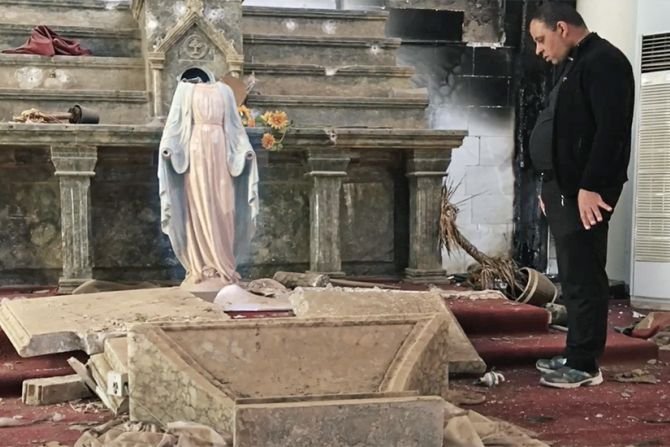
“We suffered a lot because, after the end of the regime of Saddam Hussein, the first to be attacked by [fundamentalist] groups were Christians and Catholics,” he said. “Churches were destroyed, and there were many martyrs.”
He and the representatives of the Catholic Church in Iraq worked to “defend at least those who were going to Mass, so near the churches there were fences, and security to check those who were coming in and to be sure that no one could be harmed in the churches.”
“There were very difficult moments,” he said.
The political vacuum created with the ousting of Hussein opened the door to Islamist extremism, according to political observers. During the Islamic State’s takeover of Iraq in 2014, the greater part of the Christian population fled the country and have yet to return.
Before the second Gulf War, which began in 2003, there were an estimated 1 million to 1.4 million Christians (approximately 6% of the population). Some fear there may only be about 150,000 Christians in Iraq today.
Filoni said the situation for Christians has improved in some ways, “although the churches are still watched by soldiers and police.” He said the apostolic visit of Pope Francis in March 2021 helped and that “the situation has evolved for the better.”
“It was a pilgrimage to Iraq, not for the holy sites of Abraham and many other prophets who lived there but also a pilgrimage for the many martyrs,” whom he said “suffered a lot.”