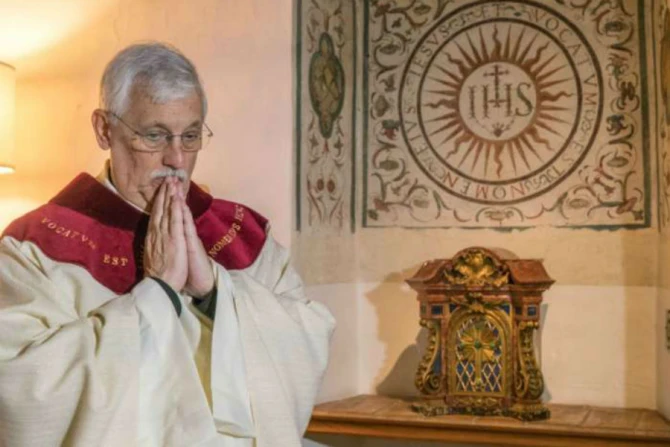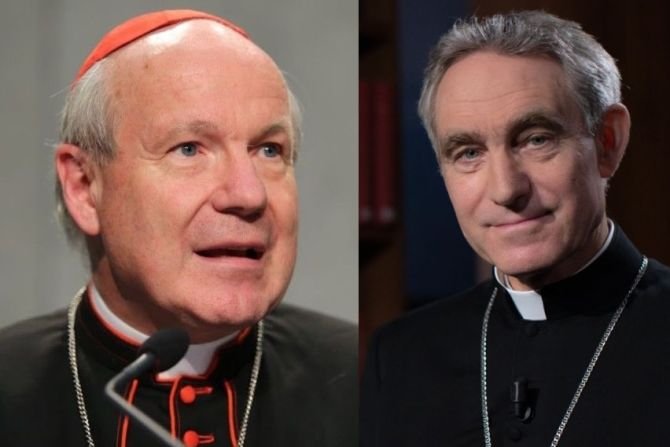
Austrian Cardinal Christoph Schönborn on Wednesday confirmed he was the person who encouraged Joseph Ratzinger to accept the conclave’s decision.
Austrian Cardinal Christoph Schönborn on Wednesday confirmed he was the person who encouraged Joseph Ratzinger to accept the conclave’s decision — if elected — to become the successor to Pope John Paul II as supreme pontiff of the Catholic Church.
Benedict’s longtime secretary, Archbishop Georg Gänswein, revealed Schönborn’s identity in his book titled “Nothing but the Truth” (“Nient’altro che la verita”), which was published in Italy last week.
CNA Deutsch, CNA’s German-language news partner, reported that Schönborn on Jan. 18 confirmed Gänswein’s assertion that Schönborn had written Cardinal Ratzinger “a little letter just in case.”
At the same time, the archbishop of Vienna accused Gänswein of committing an act of “unseemly indiscretion” with his book by publishing “confidential things,” according to the Archdiocese of Vienna’s website.
Schönborn said he had “so far deliberately kept silent” about his note to Benedict, noting “it happened within the context of the meeting of the cardinals, and not at the conclave itself.”
Benedict’s ‘guillotine speech’
Pope Benedict XVI spoke about the letter on April 25, 2005, during an audience with pilgrims from Germany.
The address is famous among German Catholics as the “guillotine speech” — in German Fallbeilrede.
In it, Benedict compared the experience of his election to that of having the axe of a guillotine dropping down on him. The guillotine blade in German is called a fallbeil.
Speaking just as openly about what swayed him to accept his election, the then newly elected pope revealed he had been “very touched by a brief note written to me by a brother cardinal.”
Benedict said: “He reminded me that on the occasion of the Mass for John Paul II, I had based my homily, starting from the Gospel, on the Lord’s words to Peter by the Lake of Gennesaret: ‘Follow me!’ I spoke of how again and again, Karol Wojtyła received this call from the Lord, and how each time he had to renounce much and to simply say: ‘Yes, I will follow you, even if you lead me where I never wanted to go.’”
“This brother cardinal wrote to me: Were the Lord to say to you now, ‘Follow me’, then remember what you preached. Do not refuse! Be obedient in the same way that you described the great pope, who has returned to the house of the Father. This deeply moved me. The ways of the Lord are not easy, but we were not created for an easy life, but for great things, for goodness.”
Benedict added: “Thus, in the end I had to say ‘yes.’”
In his book, Gänswein also addressed the fact that Schönborn and Ratzinger were on a first-name basis.
Apart from Benedict’s childhood friends, Cardinal Schönborn, a member of Ratzinger’s circle of students, was one of the few who addressed his former teacher as “Du” (the informal “You”), Gänswein wrote.
Another episode covered in Gänswein’s book — a brief but very personal conversation between the newly elected Pope Benedict XVI and Schönborn — also took place as described by Gänswein, the Viennese archbishop confirmed on Jan. 18.
Schönborn, a Dominican friar descended from the Austrian nobility, tendered his resignation as archbishop of Vienna before his 75th birthday on Jan. 22, 2020.
Around the same time, the archdiocese said Pope Francis had declined the resignation, asking Schönborn to stay on for “an indefinite period.”
This article was originally published by EWTN News English.