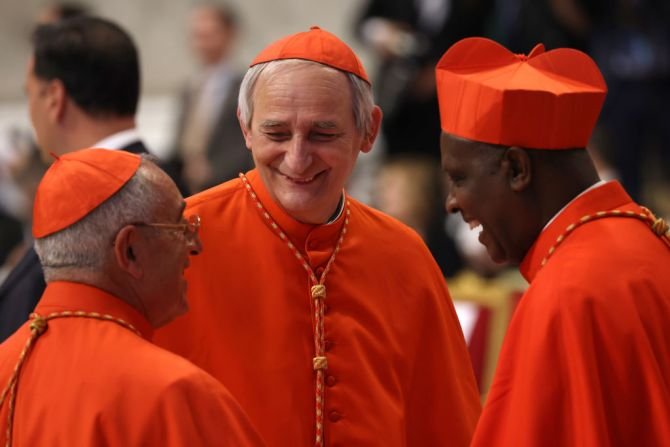
Cardinal Matteo Zuppi, the Italian prelate tasked by Pope Francis to head a peace mission between Ukraine and Russia, is traveling to Washington, D.C. this week, the Vatican announced.
The cardinal’s visit comes only weeks after the Biden administration announced it was sending an additional $800 million in weapons to aid Ukraine’s counteroffensive — including morally problematic “cluster bombs” that have been banned by most countries, including the Holy See.
Zuppi, who has already visited both Ukraine and Russia, will be in the U.S. capital from July 17-19 and will be accompanied by an official from the Vatican’s Secretariat of State.
“The visit will take place in the context of the peace promotion mission in Ukraine and aims to exchange ideas and views on the current tragic situation and to support humanitarian initiatives to alleviate the suffering of the most affected and most fragile people, especially children,” read the Vatican statement announcing Cardinal Zuppi’s visit.
The Vatican has not disclosed with whom Zuppi will meet during his three-day visit.
The United States has been a major provider of military support to Ukraine since the country was invaded by Russia on Feb. 24, 2022. To date, the U.S. has sent $41.3 billion in military aid to the Eastern European country, according to the U.S. Department of Defense.
The latest round of support has drawn criticism from the United States Conference of Catholic Bishops (USCCB), as well as bishops conferences from other countries, for its inclusion of cluster bombs in the military package. Cluster bombs present an especially grave threat to civilians given that they impact indiscriminately large areas and often do not explode until long after impact.
One hundred twenty-three countries signed the 2008 Convention on Cluster Bombs, which explicitly bans the use, transfer, production, and stockpiling of the munitions. The U.S., however, along with Russia and Ukraine, are not signatories of the convention.
In a statement following the Biden administration’s announcement, Bishop David Malloy, head of the USCCB’s international justice and peace committee, underscored that the U.S. bishops have long advocated the U.S. government to sign the convention.
“Pope Francis has addressed the conventions on antipersonnel mines and cluster munitions, exhorting all countries to commit to these conventions ‘so that there are no more mine victims,’” Malloy wrote.
“While recognizing Ukraine’s right to self-defense, we must continue to pray for dialogue and peace,” he added. “I join with our Holy Father in supporting and sharing in his moral concern and aspiration.”
Cardinal Zuppi has played a prominent role in promoting peace between Ukraine and Russia since Pope Francis asked him in May to lead a peace mission on behalf of the Vatican. The cardinal, who is the archbishop of Bologna and the president of the Italian bishops’ conference, has strong ties to the influential peace-building community Sant’Egidio, a lay Catholic association that has taken part in peace negotiations in many countries including Mozambique, South Sudan, Congo, Burundi, and the Central African Republic.
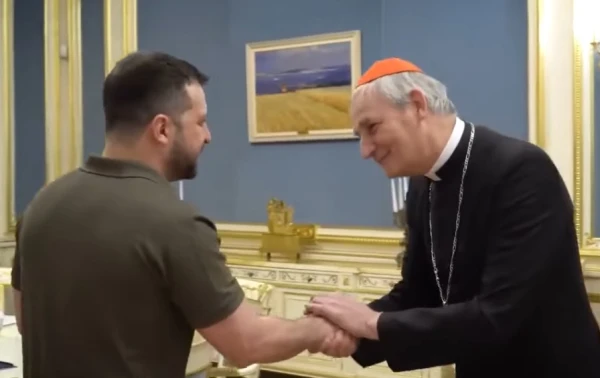
As part of his peace mission, he visited Kyiv June 5-6, meeting with Ukrainian President Volodymyr Zelenskyy and other political and religious leaders. The papal envoy then visited Moscow from June 28-29, a trip that included a meeting with Patriarch Kirill, the Primate of the Russian Orthodox Church.
This article was previously issued on CNA.