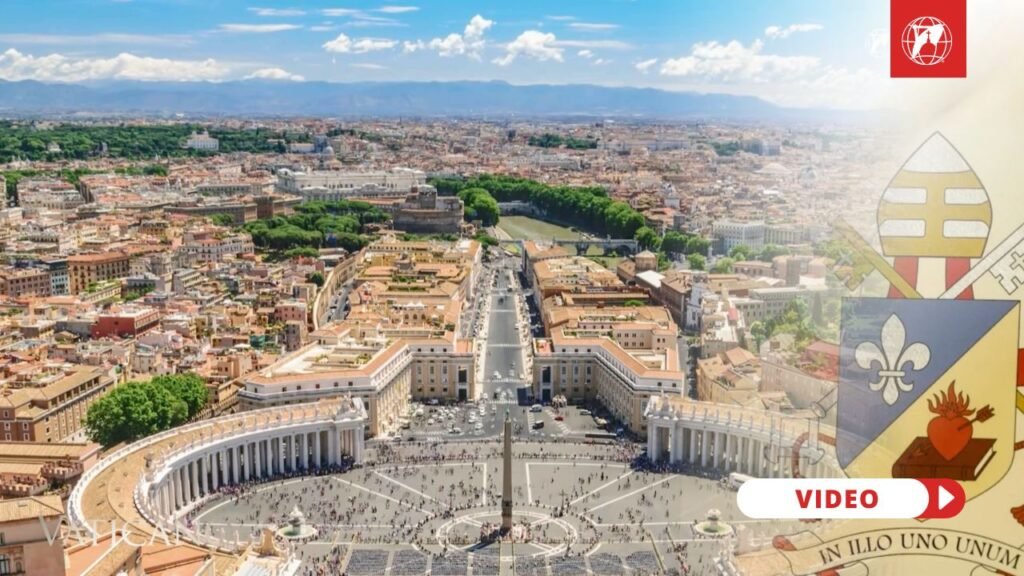
Strolling through the streets of Rome, it is easy to be overwhelmed by the city’s grandeur. Yet for those who slow down and look more closely, another layer of meaning emerges—symbols carved in stone or placed above doorways, quietly telling the story of the church or prelate connected to that place. These are coats of arms, and far from mere decoration, they form a visual language of faith, history, and identity within the Church.
For decades, Father Antonio Pompili has been dedicated to preserving and interpreting this tradition. As Vice President of the Italian Heraldic Genealogical Institute, he was entrusted with designing the coats of arms of the last two popes, continuing a centuries-old ecclesial art form.
From Battlefield to Papal Court
Explaining the origins of heraldry, Fr. Pompili traces its roots to practical needs far removed from churches and basilicas. As he explains, “Heraldry is essentially an identification system based on signs that we commonly call coats of arms, which are composed of colors and figures.” He notes that this system emerged on the battlefield and in medieval tournaments, where knights needed to be identified beyond their armor.
Initially, the Church was cautious in adopting heraldry. Over time, however, bishops—especially those who were also feudal lords—recognized its usefulness. According to Fr. Pompili, ecclesiastical heraldry gained definitive recognition when it reached Rome in the late thirteenth century. He recalls that “the first Pope to make use of a personal coat of arms” was Boniface VIII—significantly, also the first pope to proclaim a Jubilee.
Symbols, Colors, and Ecclesial Identity
Every coat of arms is rich in meaning, carefully reflecting the office and mission of its bearer. Fr. Pompili emphasizes that “the essential part of a coat of arms is, in any case… the shield,” which carries the figures and colors that define it. Surrounding elements then indicate rank and role within the Church.
He explains that clerics share a common ornament: the wide-brimmed prelatial hat. Its color and the number of tassels signify ecclesiastical dignity. “For cardinals, the traditional color from the beginning has been red,” he says, while bishops and archbishops use green, Roman Curia prelates violet-red, and others black. The pope stands apart as an exception. While centuries of pontiffs used the tiara, Fr. Pompili notes that Benedict XVI replaced it with a mitre marked by three golden bands, intentionally distancing the papacy from symbols of temporal power.
A Treasure Hunt in Plain Sight
Rome, Fr. Pompili observes, may be unmatched in its abundance of heraldry. “Rome is a city full of coats of arms—I don’t know if there’s any city richer in coats of arms than Rome,” he says, pointing to façades where the arms of the reigning pope and the church’s titular cardinal often appear side by side.
Yet these symbols are not limited to churches. They appear in mosaics, sculptures, paintings, and even throughout the city’s civic spaces. Fr. Pompili notes a familiar experience: once people learn to recognize coats of arms, “they start seeing them everywhere.”
In Rome, heraldry invites visitors and pilgrims alike to read the city differently—to encounter faith not only in words and rituals, but in symbols silently speaking from stone.
Adapted by Jacob Stein. Produced by Andrea Manna; Camera by Fabio Gonnella; Video edited by Andrea Manna.