1 in 6 couples struggle with infertility worldwide.
Not being able to conceive can be a very difficult experience for couples wanting to start a family.
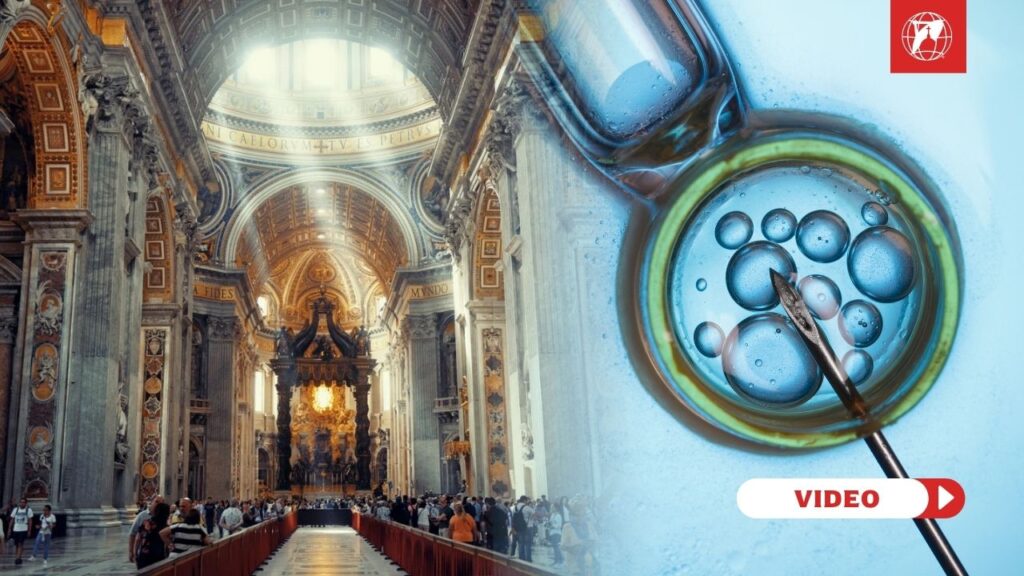
In the late 1970’s, a medical breakthrough happened with the first successful birth through In Vitro Fertilization, commonly known as ‘IVF’, a medical procedure in which an embryo is created in a petri dish in a laboratory before being transferred into the womb.
In an interview with EWTN’s Zofia Czubak, Fr. Francesco Giordano, director of Human Life International, explains the complex moral and ethical implications of this practice and why the Catholic Church opposes it.
The Catholic Church is arguably one of the most pro-life institutions in the world. We’re the first to celebrate the culture of life and the creation of life. But we say no to IVF. Why?
“Yes, it is strange that the Church, from the outset, you would think it’s strange, because the Church is completely pro-life, and why would the Church not be supportive of vitro fertilization? It’s a logical question. But if you know what in vitro fertilization is, then you can see why the Church would have problems with it. First of all, as I said, it’s ‘fertilizing’, procreating outside of the body. It’s in a petri dish. And we have to go back to understanding the two ends of the marital act. You have to have a procreative end and a unitive end.
There’s no, there’s nothing happening between the couple. It’s completely mechanical, it’s completely technological, and technology at its height. And one can say, well, if you have the technology, why the problem with this? Well, because we have to understand that medicine does not replace what naturally happens. Medicine assists nature.
Because oftentimes the IVF issue comes up with the infertility issue. So if a couple is unable to have children, the church certainly permits medicine to assist them in having children and helping with whatever biological problems there may be in the father or the mother to make the fertility possible.
There’s many more approaches that can be used that are natural, that are not contrary to the unitive act that can help people make this happen.”
One thing that I feel is often forgotten about in the conversation about IVF is that it’s not only one life that is created. It’s multiple and only one of them is really given a chance at survival and the rest are either frozen or destroyed or sometimes even used for experimentation.
“First of all, they have to create and stimulate the woman. It’s actually a painful process. Stimulate her to have many more eggs than she would have. Then they have to basically conceive all those eggs. And what do those eggs then become? They become embryos. They are conceived persons, human persons and you are keeping millions of these conceived human persons frozen. What do you do with that? That’s the issue. That is one of the biggest issues.
So you can see why there’s a dehumanizing effect about all this, not only in the sexual act itself, but in the in what happens with the children that you have that you procreate. You have these children and then you freeze them and you select the one that you want from those. And so there’s a selective abortion going on as well. There’s a selection of who’s going to survive and based on what criteria.”
What would you tell someone that would come up to you and say, father, I’m a child of IVF?
“Yes, I’ve had that happen. And what do you do? I mean, you are a child of God. You are a child of God.
I mean, you have no fault in any of this. There’s none of your fault. And they can say, well, it’s my parents’ fault or whatever.
Oftentimes people get involved with IVF because they don’t know of any other alternatives. And even doctors are not taught other alternatives when people have infertility problems. So yeah, so I would just say, I would emphasize that there’s respect for the person and I would never I would never put any blame on that person or even the parents because oftentimes there is so much ignorance about this.”
Through not only IVF today, but also surrogacy and abortion, euthanasia, we are seeing eugenics literally play out in front of our eyes. How did we get to this point?
“I hear this, I read this, they go to clinics and they say, I want my child to have blue eyes, I want my child to be this tall, I want my child to be athletic, I want my child… And they don’t realize that what they’re doing there is they’re selecting, they’re selectively breeding their own child. Or they say, I don’t want my child to suffer like this, I don’t want my child to have this sort of genetic problem, and so let me just abort them.
That’s a form of eugenics. You decide everything. So we live in a situation right now in a society where everyone wants to do it his way. And I did it my way. And that’s not really what God calls us to. God calls us to do it his way. And that entails accepting life as a gift, accepting gifts.
And really, a lot of us just take a lot of things for granted. The very fact of having children, for instance, is taken for granted. People, when they do marriage prep, they start doing marriage prep about being careful not to get pregnant. Why do you assume that you’re going to get pregnant?
Maybe you’re not going to be pregnant. It’s not a right. You don’t have a right to a child. It’s a gift.”