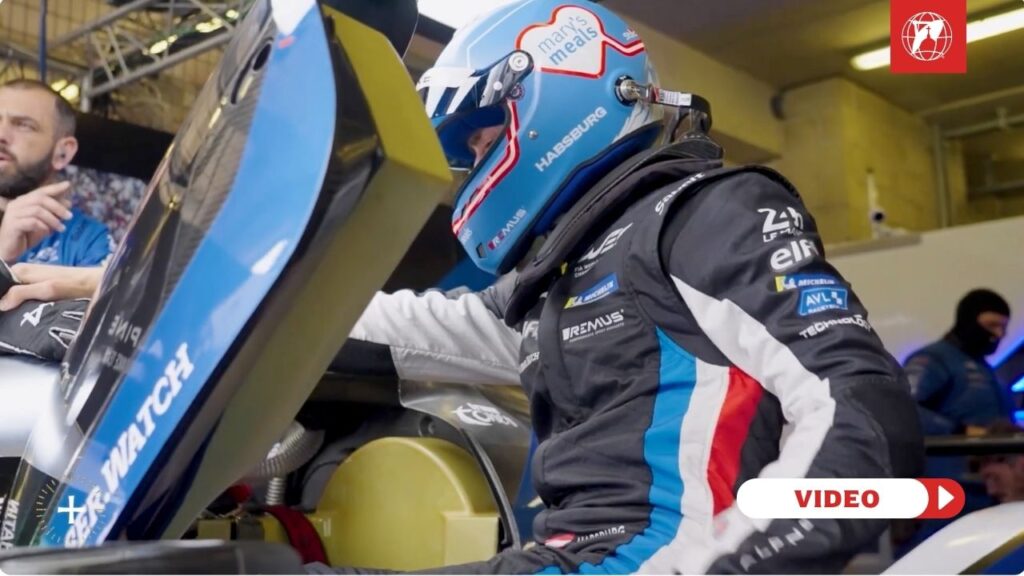
Most people know Ferdinand Habsburg as a professional endurance racing driver competing at the highest levels of motorsport. Fewer know that the great-grandson of Blessed Karl of Austria carries a rosary into the cockpit before every race.
ROME — During a recent gathering of the European Order of St. George in Rome, EWTN spoke with Ferdinand Habsburg, professional endurance race car driver, member of the historic Habsburg family, and great-grandson of Blessed Karl of Austria. In a wide-ranging conversation with Andreas Thonhauser, Vice President and Chief Global Officer of EWTN, Habsburg reflected on the role of faith in his life, the challenges of competing in one of the world’s most demanding sports, the legacy of Blessed Karl, and how prayer continues to guide him through moments of success, adversity, and personal growth.
Finding God at Full Speed
Speaking with EWTN Vatican during a gathering of the Order of St. George in Rome, Habsburg reflected on how faith shapes his life both on and off the track.
“I have a passion for motorsports. It’s my job. Thanks be to God, I have the best job in the world,” he said. “And I feel like faith is the most valuable thing you can have.”
For Habsburg, faith is not separate from racing. It provides the foundation for everything he does. In a sport where weather, mechanical failures, and split-second decisions can determine success or failure, trust in God is essential.
“All I can do is do my best and trust that God will do the rest for me,” he explained.
Before climbing into the car, he turns to prayer.
“I try to bring the rosary before I go into the car,” he said. “It’s a beautiful prayer to Our Lady who protects me.”
The rosary helps calm the nerves that accompany a profession where danger is always present.
Witnessing to Faith in a Secular Environment
While Habsburg finds support within Catholic communities such as the Order of St. George, he admits that openly living the faith can be challenging in professional sports.
“Sometimes I feel very grateful because I’m privileged to have beautiful communities where faith is so prevalent,” he said. “And then the next day I’m on a racetrack and I get the complete opposite where I’m being mocked for my faith.”
Rather than discouraging him, those experiences have strengthened his conviction.
“It’s not good to just be comfortable,” he reflected. “Jesus was not comfortable.”
The contrast between faith-filled communities and the secular world has helped him understand the importance of authentic Christian witness. For Habsburg, faith is not meant to remain hidden when it becomes difficult.
“I know that I need to be uncomfortable to be able to make a difference in a world that can be broken,” he said.
The Crash That Strengthened His Faith
One of the defining moments of Habsburg’s career came during preparations for the 24 Hours of Le Mans. A brake failure during testing sent him into a wall at high speed, leaving him with a broken back and months of recovery ahead.
Yet his first reaction was gratitude.
“As soon as I was taken out of the car and on my way to the hospital, I only felt this intense gratitude that I could feel my legs,” he recalled.
The accident could have been far worse. A slight difference in timing might have left him permanently disabled.
“I am so grateful to Our Lady,” he said. “I feel like she intervenes there.”
The experience transformed the way he approaches fear.
“Now when fear creeps in, I just think to myself, I know I’m safe. I’m in God’s hands.”
Rather than weakening his confidence, the accident deepened his faith and helped him return to racing with a renewed sense of purpose.
Carrying the Habsburg Legacy
As a member of one of Europe’s most famous dynasties, Habsburg is aware of the responsibilities that come with his family name. Yet the lessons he received growing up emphasized humility above all else.
“There is so much history in it,” he said. “But my grandfather always taught us, ‘You are not your name. You carry your name.'”
That lesson came from Otto von Habsburg, son of Blessed Karl and heir to the Austro-Hungarian throne.
“You need to remember that you are just a child of God.”
The perspective has helped Ferdinand view his heritage not as a privilege to enjoy, but as a responsibility to serve others.
Inspired by Blessed Karl and Mother Teresa
When speaking about Blessed Karl, Habsburg points to his great-grandfather’s commitment to peace during the First World War.
“His sole purpose was to end the war as quickly as possible,” he said. “It was more important to him to end the bloodshed.”
The witness of Blessed Karl continues to shape his understanding of leadership, sacrifice, and holiness.
Another major influence was Mother Teresa, whose example helped lead him back to the faith after drifting away from the Church as a teenager.
“The first one who really moved me, who really brought me to faith, was Mother Teresa,” he said.
Today, Habsburg hopes to provide the kind of authentic witness that once inspired him. His message is simple but powerful:
“The only thing that matters is the truth,” he reflected. “And that is that I’m loved. And I hope everyone else can recognize it.”
Whether racing at hundreds of kilometers per hour or speaking openly about his faith, Ferdinand Habsburg continues to show how trust in God can guide even the most demanding paths in life.