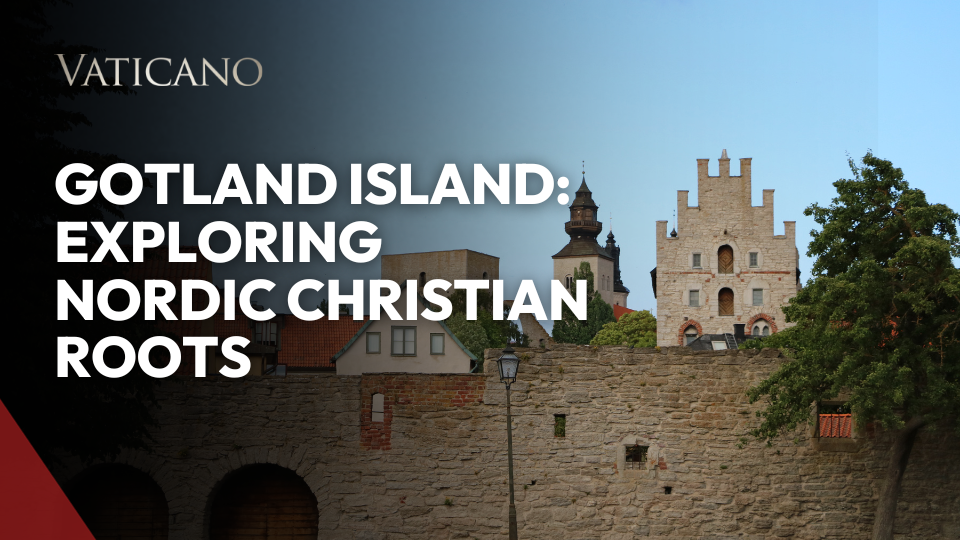
In the heart of Gotland, Sweden, a place steeped in history, EWTN hosted a Forum to examine the deep Christian roots of Europe at the intersection of tradition and the ever-evolving story of the Catholic Church.
In observing the Swedish landscape punctuated by an extraordinary number of churches, the question arises, “Why so many churches?” Lars Kruthof, a guide at The Gotland Museum, explained the reason, “the Catholic orders. We had Dominicans, we had Franciscans, we had the Cistercian nunnery just outside the town wall.” The presence of religious orders changed after the Protestant Reformation, “Franciscans were thrown out. Also, the Cistercians and the Dominicans.” With religious orders thrown out, what kept the churches among the landscape? “I have a theory,” Kruthof said, “I think it’s very easy for people to abandon religious beliefs from one generation to another. But it’s much more difficult to abandon tradition because you want to do the same thing as your forefathers did, but we don’t have the belief. We do things because we have always done it, but we don’t know why.”
Co-founder of the Gotland Forum, Fr. Elias Leyds, c.s.j., explained the reason for beginning the Forum in Gotland, “Gotland is quite an amazing place. There is a walled city. The whole island is full of churches. It shows the incredible flourishment of Christianity in the Middle Ages. So Gotland Island was the best place to start this forum.”
Father continued, “There is an enormous crisis in our Christianity in Northern Europe, and young people are longing for something that is tradition, that is authentic. So we want to help them discover their true ancestors,” that is, to understand who they really were and who they really became when they converted to Christianity.
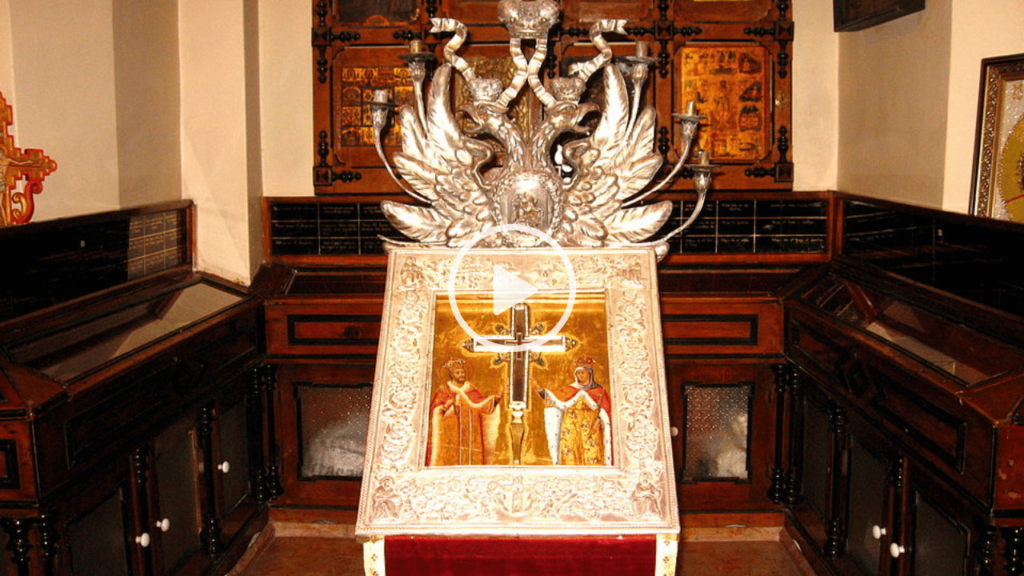
Archimandrite Cyril Hovorun, a participant in the Forum and Professor of Ecclesiology, International Relations, and Ecumenism, described the particular flourishing of culture and faith on Gotland Island. He explained, “In the Middle Ages, the common pattern of Christianization was that the rulers imposed it: a ruler would adopt Christianity and then would introduce it to his people. At the same time, Gotland was rather an exception. It [the faith] became really a people’s faith from the beginning, through trade routes, through interactions between different peoples and areas. And I should remind [you] that an important input to the Christianization of Gotland was made by a version of Christianity, which is known as Eastern Christianity, which was Byzantine Christianity. In this sense, Gotland became really an ecumenical place where West and East met together.”
The religious experience remains active in Gotland, too. The story evolves. Standing in the old parts of the church building, Kruthof told us of a new addition to the spiritual patrimony of Gotland: a relic, “a small drop of blood from the robe, the habit that Saint John Paul wore when he was shot at Saint Peter’s Square.” He further explained why this relic of Saint John Paul II is kept in Gotland: “After his death and sainthood, they cut small pieces of the robe and selected churches all over the world, and one of these churches that was selected was this small, small church in Visby. And I think it is so amazing that world history has moved into this small church of Corpus Christi in Visby.”
The ever-evolving story of the Church involves difficulties, as well. In the Forum, Father Elias, in conversation with Cardinal Anders, Bishop of Stockholm and the first-ever Scandinavian Cardinal, pointed to the struggle of young people, longing for authenticity and tradition, the struggle to find, to reconquer silence in a busy world, in noisy cities. To this difficulty, the Cardinal responded, “I think the first thing is to realize that there is a silence within ourselves, that there is a sacred temple where the Trinity lives thanks to baptism, where there is always adoration and silence, even if on the surface, there is noise because it’s very hard to find a place without any noise whatsoever. But if we accept that inside, deep inside, there is always an interior space with silent adoration, then you have conquered.”
(Adapted by Jacob Stein)