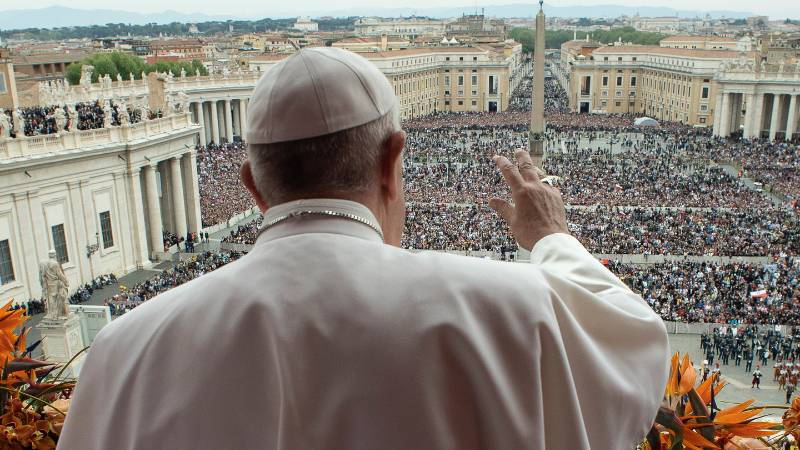
The “Urbi et Orbi” blessing is older than the invention of television. Nevertheless, most people today receive the blessing via media.
Every year, Catholics worldwide gather around their televisions, radios, and internet livestreams to witness the Pope bless “Urbi et Orbi,” the city of Rome and the world.
Father Martin Wolf, Missionary Oblate of Mary Immaculate, sat down with EWTN Vatican and explained, “‘Urbi et Orbi’ might sound unusual, but let me explain what it means. This term refers to a special and most solemn blessing that a pope can offer. The blessing is traditionally given from the ‘loggia,’ the blessing balcony of St. Peter’s Basilica, immediately after a pope’s election. Additionally, it is bestowed during Easter and Christmas, precisely at midday, and always in Latin.”
The “Urbi et Orbi” tradition began in the 13th century and developed over the centuries.
“It’s possible,” Father Martin explained further, “as we’ll see in the Jubilee 2025, for special occasions to prompt the Pope to impart the ‘Urbi et Orbi’ blessing. A memorable instance was during the 2020 COVID pandemic. In March 2020, Pope Francis offered this blessing, standing alone in an empty St. Peter’s Square—a powerful and unforgettable image. Exceptionally, the blessing included the Eucharistic’ Urbi et Orbi,’ which isn’t usually done, in the presence of the ‘Salus Populi Romani’ icon, a revered Marian image in Rome, and the Roman plague cross. This moment touched people worldwide, truly becoming a profound symbol of hope.”
The “Urbi et Orbi” blessing is also associated with a plenary indulgence.
Johannes Grohe, Professor of Medieval Church History at the Pontifical University of the Holy Cross, explained this phenomenon. “Throughout centuries of Church history,” he said, “indulgences have always been linked to forgiveness. We understand that anyone who sincerely repents and asks God for forgiveness will receive it, a promise secured in the Sacrament of Penance through Jesus.”
“However,” he continued, “sins often carry consequences, requiring amends. This concept introduces the idea of punishments for sins, leading to a distinction between the forgiveness of sin and the repayment of its consequences. This practice has evolved to the point where we discuss ‘sin debt’ being settled over time.”
His explanation continued, “In contemporary penitential practice, we refer to plenary indulgences and partial indulgences. A plenary indulgence is comprehensive, addressing not just the sin but also the guilt associated with it. A partial indulgence, on the other hand, covers only a portion of the sin and its guilt, though not specified in detail.”
To receive a plenary indulgence during the “Urbi et Orbi” blessing, individuals must do the following: fully detach from all sin, confess their sins, partake in Holy Communion, and pray for the intentions of the Pope.
The indulgence is available to those physically present in St. Peter’s Square for the “Urbi et Orbi” blessing and to anyone who devoutly participates through radio, television, or the internet.
“For us Catholics,” Father Martin exhorted, “it’s important to remember: after celebrating Easter Sunday, let’s turn on the television at noon and tune into EWTN. Then, we’ll await the Apostolic Blessing’ Urbi et Orbi,’ when the Pope extends God’s blessing to the entire world.”
The good news is that every Catholic can receive a plenary indulgence from eight days before to eight days after the “Urbi et Orbi” blessing. Therefore, Easter isn’t just the most significant time of the year—it’s also a prime moment for reconciliation with God.
Adapted by Jacob Stein
Sign up for our newsletter here: https://mailchi.mp/ewtn/vatican