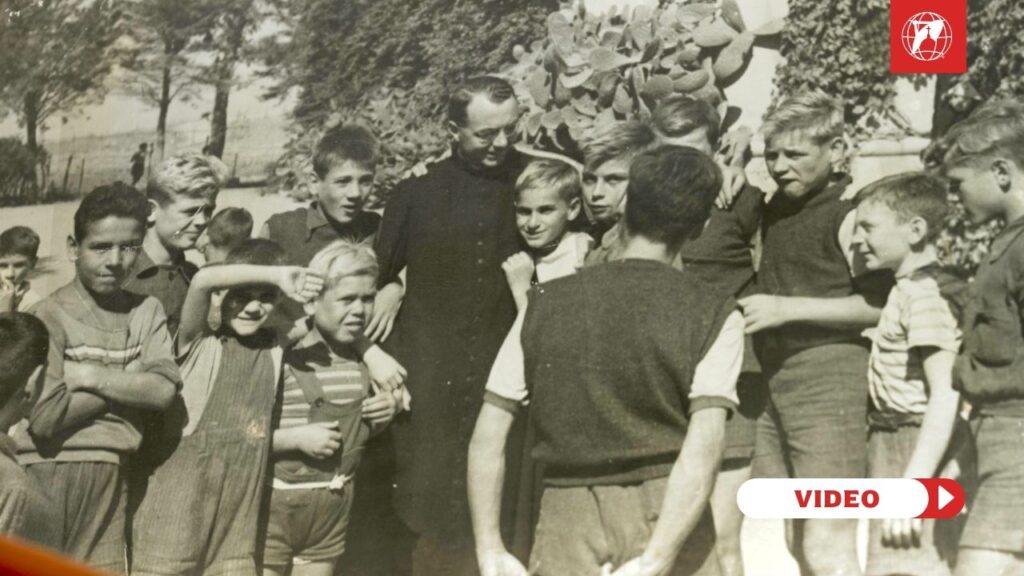
ROME — Just 30 minutes outside the center of Rome, a quiet community has been transforming the lives of vulnerable young people for more than seven decades.
Spread across 63 acres of land, La Città dei Ragazzi (“Boys’ Town”) was founded in 1953 by Irish-born Monsignor John Patrick Carroll-Abbing as a refuge for orphaned and disadvantaged boys in the aftermath of the Second World War. Today, the institution continues that mission by welcoming young migrants and minors from unstable family backgrounds, offering them education, stability, and the opportunity to build a new future.
For many of its former residents, Boys’ Town became far more than a place to live.
“He was our family”
Among them is Mekonen Zeray Asfaha, who arrived in Rome from Eritrea in 1983 at the age of 14.
Unable to care for him because of the demands of his work as a domestic servant, Mekonen’s father entrusted his son to Monsignor Carroll-Abbing, whose vision was to provide boys with the support and opportunities they might never otherwise have received.
“When I arrived, Monsignor Carroll Abbing, the founder of Boys’ Town, was still here,” Mekonen recalled. “He was our family, not only for me, but for all the former residents.”
The priest combined discipline with deep compassion, leaving a lasting impression on generations of boys.
“When necessary, he would get angry with us, but always out of love. And when we were struggling, he embraced us wholeheartedly.”
An education—and a future
For Mekonen, one of the greatest gifts he received was the chance to study, an opportunity his family could not afford.
“The opportunity that Monsignor gave me was the chance to study, something that otherwise would not have been possible,” he said.
“My father had ten children, and it wasn’t possible for him to have one child study and the others not; the others also needed to live and be cared for. The work he did was honest work, but he earned very little.”
Beyond education, Carroll-Abbing encouraged the boys to take responsibility for themselves through an innovative system of self-government.
“One of the most important things he created was self-government among the boys,” Mekonen explained. “It was an extraordinary educational tool. It helped us learn the language, voice our opinions, and participate in decisions.”
“He also gave us the opportunity to express ourselves, to take responsibility for our own lives, and to grow as responsible individuals.”
Giving back to the next generation
After completing his studies, Mekonen planned to move on. Instead, Monsignor Carroll-Abbing urged him to stay and become an educator for the next generation of boys.
“He would always tell me, ‘You need to stay with the boys.’ He asked me to remain here, attend university, and continue working with them.”
Today, Mekonen serves as a councilor at Boys’ Town, helping guide young people who now arrive from countries across the world.
“So I thought, why not? If being here makes me happy, why shouldn’t I stay here?”
“But I stayed because I see that young people still need Boys’ Town, and they need us too, I think, as guides. I want them to see that they can succeed, just as I did.”
Helping young migrants rebuild their lives
While Boys’ Town was originally created to care for children left orphaned after World War II, its mission has evolved to meet today’s challenges.
The community now serves young migrants, helping them navigate the difficulties of displacement while integrating into Italian society.
Educational Director Michela D’Urso said the center currently houses 34 boys between the ages of 14 and 18 in four apartment-style residences.
“At present, there are 34 boys here, and our facility consists of four apartment-style residential units, for a total of 34 minors,” she explained. “The boys who arrive at the facility are between the ages of 14 and 18. They all come from a variety of different countries.”
For D’Urso, the greatest reward comes from watching the boys rediscover a stage of life many never had the chance to experience.
“Our greatest satisfaction comes when, after a relatively short time, the boys begin to blossom and completely change in both appearance and behavior.”
She described many of the residents as “adultified adolescents.”
“It means that in their lives they have had very little opportunity to experience adolescence. They were burdened with responsibilities from a very young age.”
“What we try to do when they arrive here is help them reclaim the adolescence they never had the chance to experience. They take part in recreational activities and play a great deal of sport. We have created many projects specifically to allow them to see possibilities beyond the ultimate objective that brought them here—that is, becoming adults, finding work, and helping their families.”
A legacy built on love
More than seventy years after its founding, the faces and backgrounds of Boys’ Town’s residents have changed, but its mission remains remarkably consistent: to offer vulnerable young people a safe place to begin again.
For Mekonen, the enduring legacy of Monsignor Carroll-Abbing cannot be measured by buildings or programs alone.
“What Monsignor gave us is impossible to fully describe,” he said.
“As I said before, he gave us even more than the best family in the world could give. And it wasn’t about money. It was the love he gave us that made us feel rich, protected, and equal to everyone else. We truly felt free.”
Today, that same vision continues to shape the lives of dozens of young people who arrive at Boys’ Town seeking not only shelter, but hope, belonging, and the chance to build a future they can call their own.