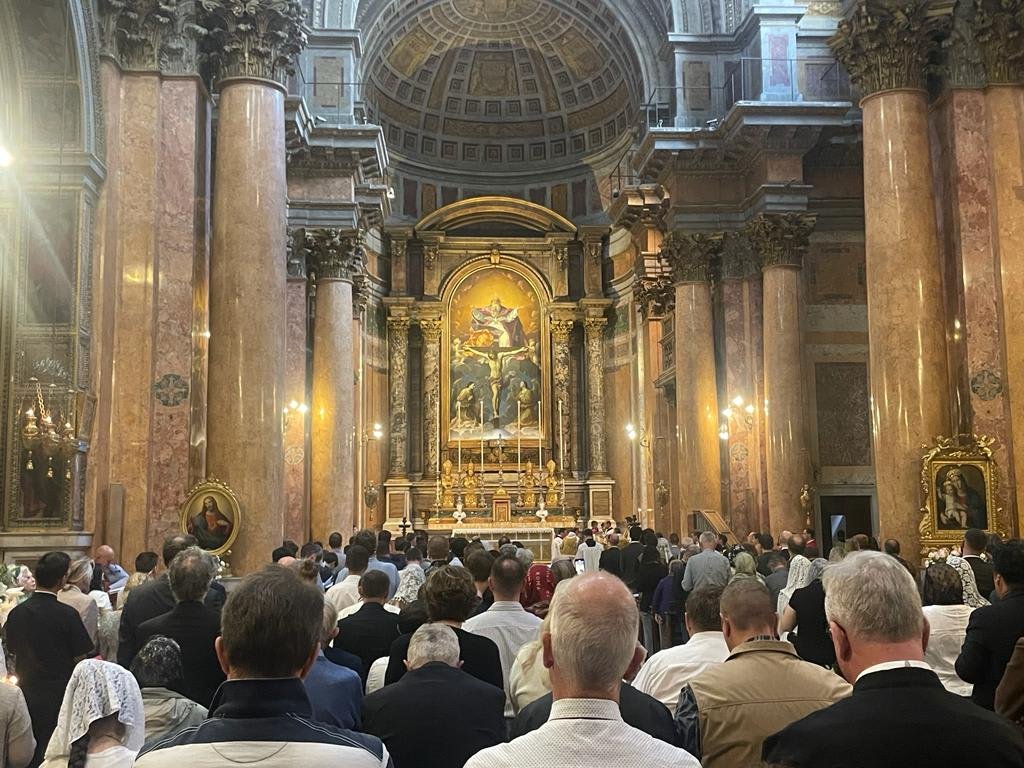
VATICAN CITY — Sixty years ago, on December 8, 1965, the Catholic Church concluded one of the most transformative events in its modern history: the Second Vatican Council. For nearly four years, thousands of bishops and theologians gathered in St. Peter’s Basilica to discern how the Church could speak to a world in rapid social and cultural change.
Among those who witnessed it firsthand was Gianfranco Svidercoschi, a young journalist who would later become Vice Director of L’Osservatore Romano, the Vatican’s official newspaper.
At just 25 years old, Svidercoschi experienced the Council up close — and today remains one of the few living witnesses who can recount its earliest moments. “It was truly something new, something incredible: 2,500 bishops walking across St. Peter’s Square and entering St. Peter’s Basilica — and you could really grasp the universality of the Church. I must say, honestly, that the real Council began that evening — on that same day, October 12, 1962 — because it was the Church speaking once again the language of the people, not the lofty, theological, philosophical language the Church had used for so many centuries. It was the language of ordinary people.”
That same evening, Pope John XXIII addressed the faithful gathered in St. Peter’s Square. He said: “‘Look at the moon up there in the sky, it has come to visit us,’ and then he spoke about hardships, about people who weep, and he said: ‘Go back home and give your children a kiss and a caress.’ And I went back home and caressed my one-year-old son.”’
Svidercoschi also recalls an unforgettable moment on the Council’s first day.
“That morning, when the Council’s work opened, I, being curious, went ahead to have a look, to exchange a few words. But then they declared ‘extra omnes’ — meaning all outsiders had to leave — and I found myself, despite running, stuck halfway inside the Basilica. I didn’t know where to go, and I could feel the gaze of two gendarmes who seemed ready to take action.
“So, as soon as I found an opening, I slipped away and hid inside a confessional. And there, inside that confessional — the only journalist in the world — I listened to the first debate, which was very heated, especially from the French and German bishops. They demanded that the conciliar commissions not be formed in the same way as the preparatory commissions, which had been made up entirely of Curia members.”
Reflecting on key figures of the era, Svidercoschi points to Cardinal Léon-Joseph Suenens, whose influence helped shape the Council’s direction.
“For example, Suenens, who at the end of the first session suggested how to shape the Council, distinguishing between Church ad intra — the Church in itself — and Church ad extra — the Church in its relationship with the world — which would later become the two constitutions De Ecclesia and Gaudium et Spes.”
Svidercoschi also makes clear that figures not only changed the course of the Council, but the course of the Church.
“The Church changed because the Church as an institution was no longer what it had been before. The Bible returned once again into the hands of the people, something that had never happened before. There was the liturgical reform… The Church opened itself to the world with Gaudium et Spes, which addressed all the problems concerning the lives of men and women — life, family, justice, and also peace and war.
“After 2,000 years, the Church was saying that the Jewish people — of both yesterday and today — were not responsible for the death of Jesus. I mean, today, with everything happening in the Middle East, I can no longer see these two religions, Judaism and Islam, with the same spiritual originality they once had. This is what the Council sought to address and renew — and it’s important now to understand why that effort did not continue and why it’s necessary today to recover what was the very foundation of the Council.”
Even six decades later, Svidercoschi believes Vatican II’s mission remains unfinished.
“Because the very fact — for example, within the Church — the relationship between the primacy of the Pope and episcopal collegiality has still not been clearly defined.”
And while he sees continuity between Vatican II and Pope Francis’ leadership, Svidercoschi also notes the Jesuit Pope’s distinctive style.
“Francis has already opened many of these issues, but, being a typical Jesuit, he never fully brought them to completion. But he himself says that problems must be opened without necessarily resolving them. And now this Pope finds himself having to deal with a Church situation in which some issues need to be picked up and brought to completion, while others perhaps should not be addressed, but set aside.”
As one of the last eyewitnesses to the Council, Gianfranco Svidercoschi’s reflections remind us of Vatican II’s lasting call — to renew the Church’s dialogue with the modern world, grounded in truth, mercy, and faith.
Adapted by Jacob Stein. Alexey Gotovskiy contributed to this article. Produced by Alexey Gotovskiy; Camera by Alberto Basile; Video Edited by Ilaria Chimenti; Special thanks & Credits: Gianfranco Svidercoschi