On Pope Francis’ first full day of public appearances in Indonesia on Wednesday, the pope called upon the political leaders of the world’s largest Muslim country to protect the country’s delicate balance of many cultures and religions by respecting the human rights of all, including minorities.
“In order to foster a peaceful and fruitful harmony that ensures peace and unites efforts to remove the imbalances and suffering that still persist in some areas of the country, the Church desires to increase interreligious dialogue,” Pope Francis said in his opening speech on Sept. 4.
The pope was welcomed to the Indonesian capital of Jakarta by a grand ceremony at the Merdeka Palace, official residence of the Indonesian president. The ceremony marked the start of the pope’s highly anticipated 11-day visit to four countries in Southeast Asia and Oceania.
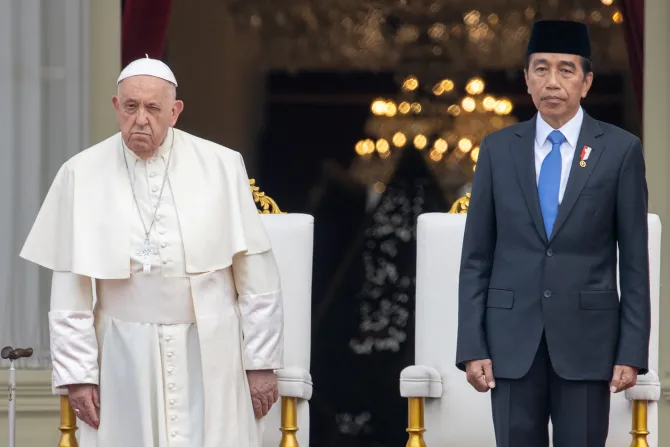
Children waved flags and cheered as the pope’s car approached the palace. The 87-year-old pope was then pushed in a wheelchair to the palace entrance, where he was received by President Joko Widodo and saluted by an honor guard dressed in red and white.
The first visit by a pope to Indonesia in three decades comes at a pivotal moment for the Southeast Asian country, which is home to the world’s largest Muslim population. Pope Paul VI visited Indonesia in 1970, and Pope John Paul II in 1989.
Pope Francis and President Widodo met privately on the veranda of the presidential palace after the welcome ceremony.
Indonesia’s President-elect Prabowo Subianto, who assumes office on Oct. 20, was also present to welcome the pope.
Since Prabowo’s election earlier this year, concerns have arisen regarding his human rights record and the future of Indonesia’s democracy.
In the pope’s speech to roughly 300 local authorities, civil society representatives, and members of the diplomatic corps gathered at the palace, Francis commended Indonesia’s efforts to maintain religious harmony in such a diverse society and underlined the need for the preservation of human rights for all.
“Your national motto Bhinneka tunggal ika (United in Diversity, literally Many but One) captures well this multifaceted reality of diverse peoples firmly united in one nation,” Pope Francis said.
With approximately 242 million Muslims — constituting 87 percent of the population — Indonesia presents Pope Francis with the opportunity to strengthen Muslim-Catholic relations.
The Indonesian government officially recognizes six religions: Islam, Buddhism, Hinduism, Confucianism, Catholicism, and Protestantism. Pope Francis’ trip is seen as a reaffirmation of the Catholic Church’s commitment to interfaith dialogue and promoting religious harmony.
“It is a work of craftsmanship — I repeat, craftsmanship — entrusted to everyone, but in a special way to those in political life, who should strive toward harmony, equity, respect for the fundamental rights of human beings, sustainable development, solidarity and the pursuit of peace, both within society and with other peoples and nations,” Francis said.
“The Catholic Church is at the service of the common good and wishes to strengthen cooperation with public institutions and other actors in civil society, but never proselytizing, always in respect for others, therefore I encourage the formation of a more balanced social fabric and ensure a more efficient and equitable distribution of social assistance,” he added.
Praise for Indonesia’s Demographics and Family Values
The pope also commended the country’s high birth rate, joking that in the West, some families “prefer to have only a cat or a little dog” to children. “In this, you offer an example to other countries,” he said.
As President Widodo approaches the end of his second and final term, the meeting also served as a moment for reflection on Indonesia’s trajectory in fostering religious tolerance.
Indonesia emerged from more than 350 years of Dutch colonial rule to declare independence in 1945. Since then, the country has navigated the complexities of religious pluralism, sometimes facing challenges in upholding the constitutional guarantees of religious freedom. Instances of religious intolerance, bureaucratic hurdles for minority religions, and corruption are reminders of the ongoing work required to fulfill the country’s vision of “unity in diversity.”
Pope Francis said: “Sometimes violent tensions arise within countries because those in power want to make everything uniform, imposing their vision even in matters that should be left to the autonomy of individuals or associated groups.”
“In this regard, I make my own the words of Saint John Paul II during his 1989 visit to this very palace,” Francis added.
“Among other things, he said: ‘In acknowledging the presence of legitimate diversity, in respecting the human and political rights of all citizens, and in encouraging the growth of national unity based on tolerance and respect for others, you lay the foundations for that just and peaceful society which all Indonesians wish for themselves and long to bequeath to their children.’”
After the formal meetings, Pope Francis returned to the Apostolic Nunciature for a private meeting with Jesuits from the region.
In the afternoon, Pope Francis will visit Indonesia’s bishops and the local Catholic community in Jakarta’s Cathedral of Our Lady of the Assumption, which is located across the street from the largest mosque in Southeast Asia, where the pope will take part in an interfaith meeting on Sept. 5.
This article was originally published on Catholic News Agency.