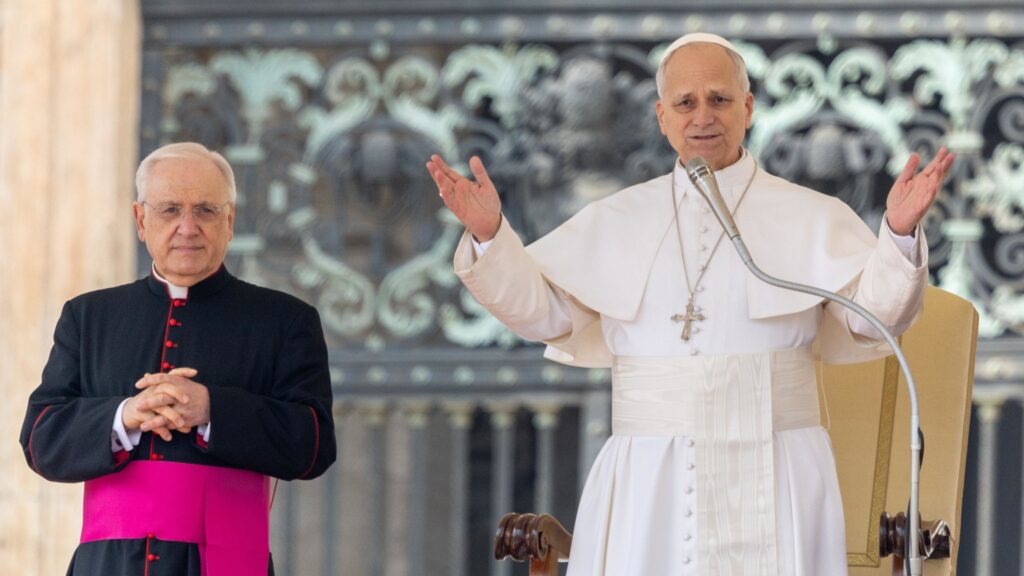
The pope’s catechesis focused on the dogmatic constitution Lumen Gentium, one of the pillars of Vatican II.
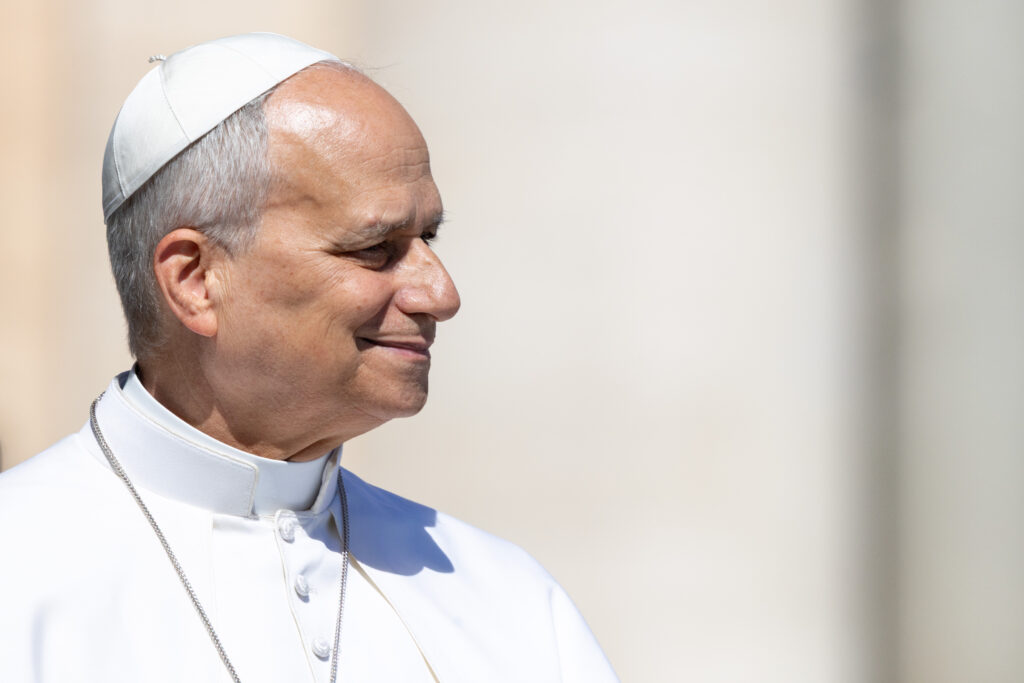
VATICAN CITY — Pope Leo XIV said Wednesday that the Church cannot be understood solely from a human perspective but rather as the fruit of God’s plan of love for humanity realized in Christ. He also emphasized that this does not imply the spiritual superiority of the Church’s members.
“An ideal and pure Church, separated from the earth, does not exist; only the one Church of Christ, embodied in history,” the Holy Father affirmed at the general audience in St. Peter’s Square on March 4.
The pope continued his catechesis on the dogmatic constitution Lumen Gentium, one of the pillars of the Second Vatican Council, in which the Church is described as “a complex reality.”
However, he clarified that this complexity does not mean the Church is “complicated” or difficult to explain. Rather, the Latin meaning of the word “complex” refers to “the orderly union of different aspects or dimensions within the same reality.”
The pope noted that the Church is “a well-organized body, in which the human and divine dimensions coexist without separation and without confusion.”
‘Both human and divine’
Leo pointed out that the Church’s human dimension is immediately perceptible, since it is “a community of men and women who share the joy and struggle of being Christians, with their strengths and weaknesses, proclaiming the Gospel and becoming a sign of the presence of Christ who accompanies us on our journey through life.”
Yet this aspect, even together with its institutional organization, is not sufficient to describe the Church’s true nature, because it also has a divine dimension. This, he explained, “does not consist in an ideal perfection or spiritual superiority of its members, but in the fact that the Church is generated by God’s plan for humanity, realized in Christ.”
Therefore, the Church is “at the same time an earthly community and the mystical body of Christ, a visible assembly and a spiritual mystery, a reality present in history and a people journeying towards heaven.”
He added that the human and divine dimensions “integrate harmoniously, without one overshadowing the other,” forming a fruitful paradox: “She is a reality that is both human and divine, which welcomes the sinful man and leads him to God.”
To illustrate this condition, the pope referred to the life of Jesus. Those who met Christ along the roads of Palestine experienced “his humanity, his eyes, his hands, the sound of his voice.” Yet through this visible humanity they encountered God, since “Christ’s flesh, his face, his gestures, and his words visibly manifest the invisible God.”
In the light of Christ’s reality, the pope said, the Church can be understood more clearly: “When we look at her closely, we discover a human dimension made up of real people, who sometimes manifest the beauty of the Gospel and other times struggle and make mistakes like everyone else.”
Yet “it is precisely through her members and her limited earthly aspects that Christ’s presence and his saving action are manifested,” he added.
No opposition between the Gospel and the Church
Pope Leo recalled the words of Pope Benedict XVI, who stated that there is no opposition between the Gospel and the institution of the Church. Rather, the structures of the Church serve the “realization and concretization of the Gospel in our time.”
The holiness of the Church, he explained, lies in the fact that Christ dwells within her and continues to give himself through the smallness and fragility of her members.
Reflecting on this “perennial miracle,” one can understand what the pope called “God’s method:” God “makes himself visible through the weakness of creatures.”
He also recalled the words of Pope Francis in the apostolic exhortation Evangelii Gaudium, which invites Christians “to remove our sandals before the sacred ground of the other (cf. Ex 3:5).”
The Church is built not only by organizing visible structures but also by building “that spiritual edifice which is the body of Christ, through communion and charity among ourselves,” Leo said.
He quoted St. Augustine, who emphasized that charity is the heart of ecclesial life: “If only we could all just let our thoughts dwell on the one thing, charity! It’s the only thing, you see, which both surpasses all things, and without which all things worth nothing, and which draws all things to itself, wherever it may be.”
This report was originally published by ACI Prensa, the Spanish-language sister service of EWTN News. It has been translated and adapted by EWTN News English.