Pope Leo XIV’s apostolic journey in Africa is unfolding as a mission marked by appeals for peace, a return to the roots of Christian history, and a renewed emphasis on evangelization. From Cameroon to ancient Hippo, the Pope has linked the challenges of the present with the spiritual inheritance of the early Church. Alongside the trip, the Vatican has also announced key initiatives that point to the direction of his pontificate.
Peace in Cameroon at the heart of Pope Leo XIV’s Africa journey
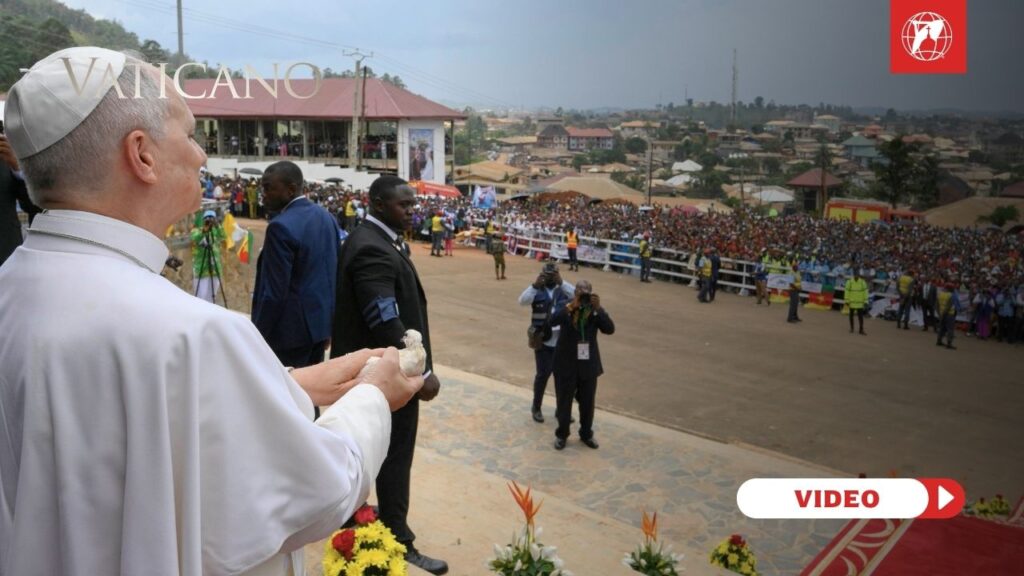
Peace has emerged as one of the defining messages of Pope Leo XIV’s Africa journey. Addressing civil authorities and members of the diplomatic corps in Yaoundé, the capital of Cameroon, the Holy Father said peace cannot simply be imposed from above or established by decree. Instead, he insisted, it must be welcomed, shared, and lived by society as a whole.
His words came in a country marked by deep diversity, but also by longstanding tensions, including the Anglophone crisis. In that context, Pope Leo encouraged political leaders, young people, and civil society to assume responsibility for building reconciliation and justice. He presented Cameroon not only as a nation facing difficulties, but as a land rich in cultures and traditions, suggesting that this very richness can become the basis for lasting peace.
The appeal fits into a broader thread that has characterized his recent public interventions, especially during the Easter season, when reconciliation and healing have remained central themes of his preaching.
A return to Saint Augustine’s roots in ancient Hippo
Earlier in the trip, Pope Leo visited the ancient city of Hippo, in present-day Annaba, Algeria, where Saint Augustine served as bishop. For the first Augustinian Pope, the stop carried a particularly strong symbolic weight, representing a return to the spiritual and historical roots of his vocation.
Even under heavy rain, the Holy Father walked through the archaeological ruins and stopped in prayer, turning the visit into more than a historical commemoration. The moment underscored the living bond between the Church today and the witness of early African Christianity.
The visit also cast fresh light on the enduring relevance of North Africa in the history of the faith. In returning to Hippo, Pope Leo pointed to a Christian legacy that continues to shape the Church’s identity and mission in the present.
A long apostolic trip with a missionary horizon
After Angola and Cameroon, the Pope is also expected to visit Equatorial Guinea and Angola, making the current tour one of the longest apostolic journeys undertaken by a pontiff in modern times. The scale of the visit reflects not only pastoral closeness, but also a clear desire to place Africa at the center of the Church’s attention.
The journey has combined institutional meetings, spiritual gestures, and historically significant stops, giving it both diplomatic and ecclesial importance. In this sense, Pope Leo XIV’s Africa journey is not simply a sequence of visits, but a broader statement about the Church’s priorities.
June consistory announced before departure
Before leaving for Africa, the Vatican announced that a consistory of cardinals will be held on June 26 and 27. In a letter to the College of Cardinals, Pope Leo called for a renewed focus on the Church’s missionary identity, making clear that evangelization remains at the heart of his vision.
He urged a fresh reception of Evangelii Gaudium, the landmark apostolic exhortation of Pope Francis, describing it as a vital reference point for the life of the Church. The text, he indicated, remains essential because it places Christ and the proclamation of the Gospel at the center of ecclesial life.
That emphasis on mission provides an important interpretive key for the Pope’s current travels. His presence in Africa, his message to political authorities, and his return to the cradle of early Christianity all point in the same direction: a Church called to proclaim the Gospel with renewed clarity and conviction.
Sunday Eucharist called indispensable for Christian life
Back at the Vatican, on Divine Mercy Sunday, Pope Leo also offered a strong catechesis on the centrality of the Eucharist. He reminded the faithful that participation in Sunday Mass is indispensable for Christian life, drawing on the witness of the Martyrs of Abitene.
Recalling those Christians who chose death rather than renounce the Eucharist, the Pope said the Mass is where faith is nourished and where believers receive the strength to become witnesses of peace and reconciliation in the world. It was a message closely aligned with the themes of his African journey, where peace is presented not as an abstract ideal, but as a vocation sustained by faith.
The Vatican prepares to honor Benedict XVI’s centenary
The week also brought another announcement from the Vatican. On what would have been his 99th birthday, plans were unveiled to mark the 100th birthday of Pope Emeritus Benedict XVI in 2027.
Speaking about the initiative, the new head of the Joseph Ratzinger Foundation, Roberto Regoli, said symposia, cultural events, and academic initiatives will be organized across several continents. The aim is to celebrate the theological legacy of the German pontiff, born on April 16, 1927, and to deepen reflection on his contribution to the life of the Church.